
Land an Airline Job in 18–24 Months: FAA vs EASA License

EASA licensing is the stronger choice if your goal is a European or Middle Eastern airline job, since integrated programs and lower hour thresholds get you hired faster. FAA licensing wins on cost and speed to your first flying job in the United States, especially through CFI hour-building. Plenty of career-minded pilots eventually hold both, and converting a private license between the two systems is far easier than converting a commercial or ATPL credential.
TL;DR:
- EASA licensing offers faster airline entry in Europe and the Middle East due to integrated programs and lower hour requirements, while FAA licensing is cheaper and quicker for initial flying jobs in the U.S., especially through CFI routes.
- Converting private licenses between the two systems is relatively simple with TIP-L, but commercial and ATPL conversions are complex and time-consuming, requiring passing additional theory exams and practical assessments.
- Hour thresholds significantly influence career moves, with EASA pathways enabling earlier airline employment at fewer hours, whereas FAA pilots often spend more time instructing to meet 1,500 hours for an ATP certificate.
- English language proficiency testing and documentation nuances vary, with EASA demanding a language endorsement and a different medical revalidation process compared to the FAA’s standards.
- Insurance and operational clearances depend on specific jurisdictional rules, and pilots must carefully track expiry and currency dates for both systems to maintain legal flying privileges.
Table of Contents
- FAA vs EASA License Snapshot
- How Do FAA and EASA Training and Exams Differ?
- What Are the Real Limits of Converting FAA to EASA?
- Which License Gets You Hired Faster?
- What Do FAA and EASA Training Actually Cost?
- Do FAA and EASA Language Requirements Differ?
- How Does Insurance Coverage Differ Between FAA and EASA Pilots?
- What Operational Limits Apply Under Each License?
- How Often Do You Need to Fly to Stay Current?
- What Should Matter Most in Your FAA vs EASA Decision?
- Simulator-Backed Training for Your Conversion Path
- Sources
- FAQ
FAA vs EASA License Snapshot
Before you commit years and tens of thousands of dollars to one system, look at how the two authorities actually differ in scope and structure.
- Geographic scope: EASA governs licensing across EU/EEA member states, though individual national aviation authorities issue the actual Part-FCL certificates. The FAA governs U.S. airspace and certificates, with pilot certification handled through Part 61 or Part 141 pathways.
- Theory exams: EASA’s ATPL track requires exams across 13 to 14 subjects. The FAA typically requires one written knowledge test per certificate level.
- Training structure: EASA mandates training through an Approved Training Organization (ATO) or Declared Training Organization (DTO). The FAA lets you train under Part 61 with a flight instructor or enroll in a structured Part 141 school.
- Validity: EASA licenses and many ratings carry expiry dates requiring revalidation. FAA certificates don’t expire, though currency rules still apply to keep privileges active.
- Conversion headline: TIP-L simplifies private pilot and instrument rating conversion between the two systems. Commercial and ATPL conversions require substantially more theory work and testing.
Training timelines and rough costs vary widely by country and school, but the structural gap above explains most of the difference in how long each path takes to an airline seat.
How Do FAA and EASA Training and Exams Differ?
The exam structure is where the two systems diverge most sharply, and it’s the detail most first-time applicants underestimate.
EASA’s ATPL theory syllabus spans 13 to 14 subjects, covering everything from air law to meteorology to aircraft general knowledge, and you have an 18-month window to pass all of them once you sit the first exam. Miss that window, and you start over.
The FAA takes a different approach. Each certificate level (private, instrument, commercial, ATP) has its own single knowledge test, and if you fail a section you can retake it after a short remediation period rather than losing your entire progress. That structural difference alone shapes how schools schedule students.
Minimum flight hours diverge too. EASA integrated ATPL programs compress training into roughly 18 to 24 months and route you directly toward airline-ready hour minimums. Modular EASA training, done part-time or piecemeal, takes longer but costs less upfront. In the U.S. system, Part 61 or Part 141 training gets you to a commercial certificate relatively fast, but reaching the 1,500-hour ATP minimum for airline captaincy usually means a stretch of hour-building, often as a flight instructor.
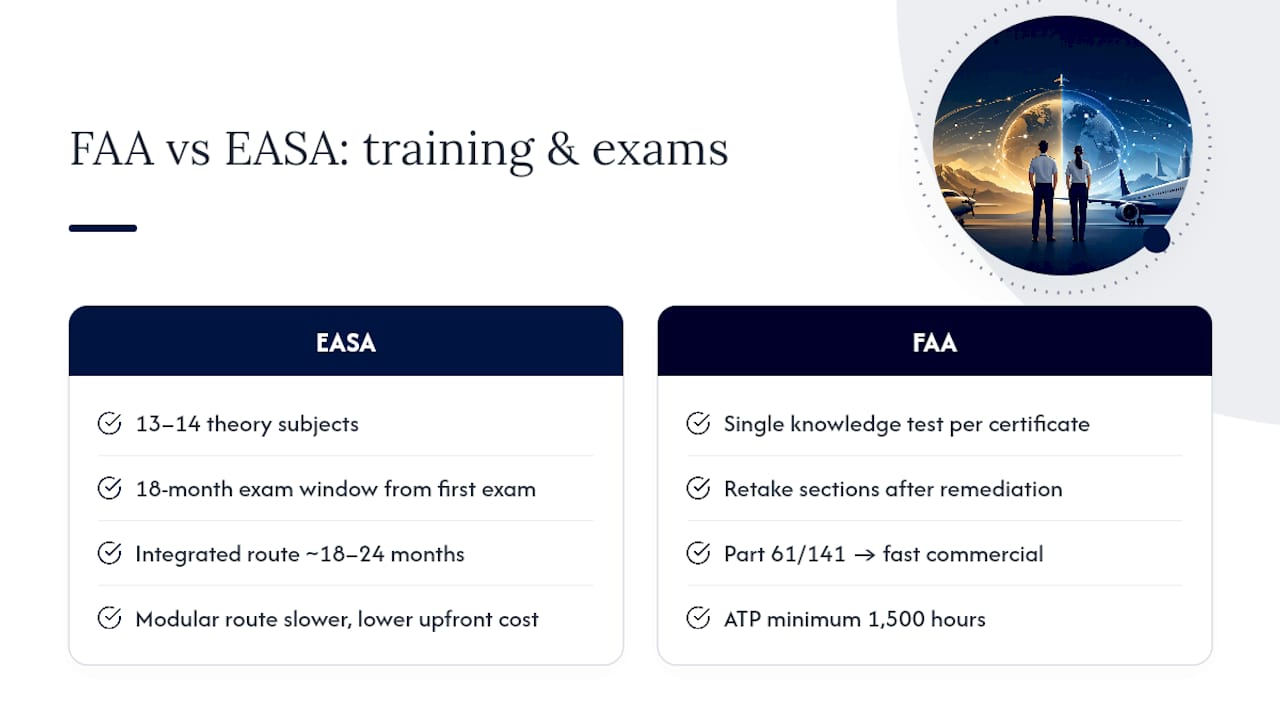
The practical implication: EASA’s integrated route tends to align training directly with airline hiring pipelines from day one. The FAA route is often cheaper and faster to your first paid flying job, but it demands a longer runway to reach airline transport pilot minimums.
What Are the Real Limits of Converting FAA to EASA?
TIP-L, the Technical Implementation Procedures for Licensing agreement between the FAA and EASA, covers private pilot privileges along with instrument and night ratings in specified categories. It does not cover type ratings, and it excludes commercial-level privileges entirely.
Here’s how the conversion actually runs for a private pilot license:
- License confirmation. The receiving authority verifies your existing license directly with the issuing authority. National aviation authorities can request supporting training records, so keep your logbook and certificates organized.
- Skill test. You sit a practical skill test with an examiner from the authority you’re converting into.
- Medical requirements. EASA requires a Class 1 or Class 2 medical under Part-MED, which does not automatically carry over from an FAA medical certificate, even the FAA’s BasicMed option.
- Document processing. Turnaround time varies by national authority, and delays are common when paperwork is incomplete.
Commercial and ATPL conversions are a different animal. TIP-L doesn’t shortcut these; you’ll need to pass EASA’s theory exams (or secure exam credits where your prior training qualifies) plus practical checks. Expect months, not weeks, and budget accordingly.
The most common pitfalls: assuming your FAA medical satisfies EASA’s Part-MED requirements, underestimating how individual national authorities interpret TIP-L differently, missing documentation, and overlooking the English language proficiency endorsement EASA requires on the license itself.
Which License Gets You Hired Faster?
European and many Middle Eastern carriers generally prefer EASA licenses, partly because EASA’s integrated training programs feed directly into airline cadet pipelines and partly because it avoids the conversion paperwork on the employer’s end. U.S. carriers overwhelmingly hire on FAA certificates, and a smaller set of global operators will accept FAA credentials with conversion support.
Hour thresholds matter more than most applicants expect. EASA pathways can put you into a right seat at a regional or low cost carrier with fewer accumulated hours than U.S. carriers typically require, since the FAA mandates 1,500 hours for an ATP certificate before you can serve as captain (with limited exceptions for structured degree programs). That single number shapes a lot of career math: it’s why FAA-track pilots often spend a year or more instructing or flying charter to build time before an airline will look at them.
Dual licensing exists precisely because these tradeoffs cut both ways. A common strategy: train FAA-first for cost and weather advantages, build hours as a CFI, then convert or add EASA credentials once a European job is within reach. The reverse, starting EASA and adding FAA later, suits pilots targeting U.S. carriers or general aviation work stateside.
Before committing to either path, check your target airlines’ specific minimum hour requirements and any nationality or residency restrictions tied to their hiring programs. Requirements shift year to year and vary by carrier.
What Do FAA and EASA Training Actually Cost?
Numbers vary enormously by country, school, and aircraft type, but rough patterns hold across the industry. A U.S. Part 61 or Part 141 path from zero hours to a commercial certificate with instrument rating commonly runs in the tens of thousands of dollars, with CFI add-ons that let you earn while building hours toward ATP minimums. EASA integrated ATPL programs in Europe tend to cost more upfront, largely because the theory phase, exam fees, and ATO structure add overhead that Part 61 training in the U.S. doesn’t carry.
Timelines follow the same pattern. Integrated EASA programs typically run under two years start to finish. Modular EASA training and FAA modular training both stretch longer, often 2 to 3 years, depending on how much you train part-time. TIP-L conversions for a private license can close in weeks; CPL and ATPL conversions often take several months once theory exams and checkrides are factored in.
Quick decision checklist:
- What airlines or regions are you actually targeting?
- What’s your total training budget, including hour-building?
- Does your residency or visa status limit where you can train or work?
- Does your local climate support year-round modular training, or do you need an integrated school?
- Are you willing to sit EASA’s theory exams, or does that timeline not fit your goals?
Pro Tip: If cost and weather are bigger constraints than your target airline right now, train FAA-first. Building hours in the U.S. is generally cheaper, and you can add EASA credentials later once a specific European opportunity justifies the investment.
Do FAA and EASA Language Requirements Differ?
Both authorities require English language proficiency testing, but the mechanics differ. EASA mandates a language proficiency endorsement directly on the license, tested against ICAO’s six-level scale, and it expires periodically for anyone below the top proficiency level, requiring retesting. The FAA requires English proficiency as a certification prerequisite but doesn’t attach a separate expiring endorsement to the certificate itself.
Testing standards diverge too. EASA’s theory exams are standardized across the 13 to 14 ATPL subjects regardless of which national authority administers them, though the language of instruction and testing can vary by country if you train outside an English-medium ATO. The FAA’s knowledge tests are administered in English nationwide through a small number of approved testing centers, with a consistent question bank across all Part 141 and Part 61 candidates.
For non-native English speakers, this distinction matters more than it first appears. An EASA candidate training in a non-English-medium ATO may face a harder path if their target airline operates in English, since cockpit communication standards at most international carriers assume ICAO Level 4 proficiency at minimum. FAA training, conducted almost entirely in English by default, front-loads that language exposure from day one.
If your long-term goal involves flying for a multinational carrier or converting between systems later, prioritizing English-medium training now, regardless of which authority you start under, removes a friction point you’d otherwise face during conversion or during airline interviews down the road.
How Does Insurance Coverage Differ Between FAA and EASA Pilots?
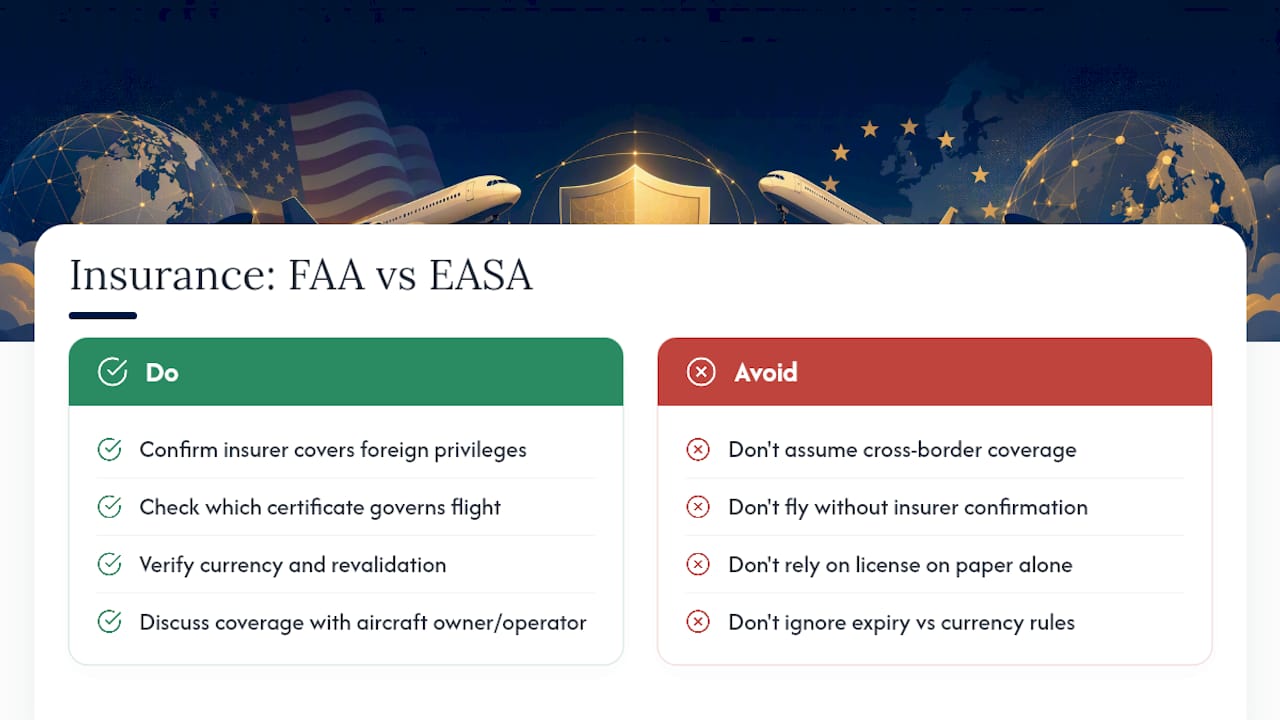
Insurance and liability frameworks track the regulatory system you’re certified under, and mixing licenses without checking coverage is a common blind spot. Aircraft insurers in the U.S. typically underwrite policies based on FAA certificate level, total hours, and recency of experience, following the currency expectations built into Part 61. An FAA-certificated pilot flying under a European-registered aircraft without also holding valid EASA privileges can find their coverage void in a claim dispute, even if the flight itself was legal under a reciprocal arrangement.
The same risk runs in reverse. EASA-licensed pilots renting or flying FAA-registered aircraft in the U.S. need to confirm their insurer recognizes foreign license privileges exercised under whatever validation or reciprocal agreement applies, since a policy written against EASA-standard training and revalidation cycles may not automatically extend to FAA-specific operational rules.
Liability exposure compounds this. Because EASA ratings carry expiry dates and FAA certificates track currency instead, an insurer investigating an incident will look closely at whether the pilot’s proficiency checks, medical certificate, and rating revalidations were current under the specific regulatory system governing that flight, not just whether a license existed on paper. A lapsed EASA instrument rating revalidation, for instance, can void coverage even if the pilot’s underlying license remains valid.
Dual license holders face the most complexity here, since they need separate insurance conversations for each jurisdiction they fly in. If you’re flying internationally on convertible privileges, confirm with your insurer, and ideally with the aircraft owner or operator’s policy, exactly which certificate and currency standard governs coverage for that specific flight.
What Operational Limits Apply Under Each License?
Airspace access is the most immediate limitation. An FAA certificate alone does not authorize you to act as pilot in command in EU/EEA airspace under commercial operations, and the reverse holds for EASA licenses operating in U.S. airspace, outside specific reciprocal arrangements like TIP-L’s narrow scope. This isn’t a paperwork technicality; it determines which jobs you can legally accept without additional certification.
Aircraft type authorization follows the same logic. A type rating earned under FAA rules for, say, an Airbus A320 doesn’t automatically transfer to EASA privileges, and vice versa, because type ratings sit outside TIP-L’s coverage entirely. Pilots moving between systems typically need to complete type rating training again under the new authority, even with prior experience on the same airframe. This is one reason simulator-based type rating programs matter so much during conversion: the aircraft systems knowledge carries over, but the regulatory sign-off does not.
Operational category restrictions also differ. EASA distinguishes sharply between private, commercial, and complex aircraft operations, with training and currency requirements scaling accordingly. The FAA’s Part 61 and Part 141 structure draws similar lines but applies them differently, particularly around high-performance and complex aircraft endorsements, which the FAA treats as separate sign-offs rather than folding them into the certificate level itself.
The bottom line for career planning: don’t assume a license earned under one authority gives you automatic operational privileges under the other, even for aircraft you’ve already flown. Budget time and money for requalification whenever you cross systems.
How Often Do You Need to Fly to Stay Current?
Currency rules diverge in structure even where the underlying safety logic is similar. The FAA ties currency to recent flight experience under Part 61, requiring a set number of takeoffs and landings within a rolling 90-day window to carry passengers, plus a flight review every 24 calendar months to exercise certificate privileges at all. Miss the review, and your certificate privileges lapse, though the certificate itself never expires.
EASA operates on a revalidation model instead. Many ratings, particularly instrument ratings and type ratings, carry explicit expiry dates, and you must complete a proficiency check or a combination of recent experience and training before that date to keep the rating valid. Let it lapse, and you’re often looking at a renewal process closer to reactivation testing than a routine currency flight.
This distinction catches dual license holders off guard more than any other rule in this comparison. It’s entirely possible to be current under FAA rules while your EASA instrument rating has quietly expired, because the two systems track different clocks on different schedules. Pilots who fly under both licenses need two separate currency calendars, not one shared mental checklist.
For anyone planning a conversion or maintaining dual privileges long term, building a habit of tracking EASA expiry dates alongside FAA’s 90-day and 24-month windows isn’t optional. It’s the difference between showing up ready to fly and discovering mid-career that a rating quietly lapsed six months ago.
What Should Matter Most in Your FAA vs EASA Decision?
Most advice on this topic treats FAA and EASA licensing like a simple cost comparison, and that framing undersells the real decision. The number that should drive your choice isn’t tuition. It’s how fast each path gets you in front of an airline that’s actually hiring for the seat you want, and that answer depends entirely on which region you’re targeting.
The conventional wisdom that FAA training is “always cheaper” also deserves pushback. It’s cheaper to a commercial certificate, yes. But factor in the hour-building years many FAA-track pilots spend instructing before reaching ATP minimums, and the true cost gap narrows considerably against an EASA integrated program that lands you at an airline door sooner, even at higher upfront tuition.
What the research actually supports: TIP-L is genuinely useful, but only at the private pilot level. Anyone expecting a shortcut into commercial or ATPL conversion is planning around a rule that doesn’t exist. Budget real time and real theory study for that step, and treat simulator-based type rating training, rather than paperwork alone, as the part of conversion that actually determines whether you’re airline-ready.
— Jake
Simulator-Backed Training for Your Conversion Path
Once you know which regulatory path fits your career goal, the harder question is execution: passing the skill test, clearing ATP-CTP requirements, and walking into an airline interview with type rating hours that hold up. Some training centers focus on exactly that gap, pairing Level D full-motion simulators with instruction from experienced airline captains for pilots converting between systems, not just pilots starting from zero.
For pilots working through an EASA to FAA conversion, the program structures skill test preparation, ATP-CTP coursework, and simulator hours around the specific gaps a conversion candidate faces, rather than treating conversion students like first-time trainees. Type rating courses on the Airbus A320, A330, Boeing 737, and 757 platforms run on the same Level D simulators used for airline-standard checkrides, which matters most when your prior type rating doesn’t transfer under TIP-L and you need requalification that actually reflects operational readiness. If you’re weighing which conversion route fits your timeline and budget, start with the admissions page to review course dates and enrollment steps.
Sources
FAQ
Is EASA Better Than FAA?
Neither system is objectively better; EASA suits pilots targeting European or Middle Eastern carriers, while the FAA route generally costs less and gets U.S.-focused pilots flying paid hours sooner.
Can You Convert an EASA License to FAA?
Yes, for private pilot privileges and specified instrument and night ratings under TIP-L, but commercial and ATPL conversions require passing FAA knowledge tests and checkrides rather than a simplified transfer.
Can I Have Both FAA and EASA at the Same Time?
Yes, many career-focused pilots hold both licenses to maximize job options across U.S. and European markets, though each license carries its own separate currency and revalidation tracking.
Is It Hard to Convert FAA to EASA?
Converting a private pilot license is straightforward through TIP-L’s skill test and medical verification process, but converting a commercial or ATPL certificate is significantly harder since it requires EASA’s full theory exams and practical checks with no TIP-L shortcut.