
Instant Airmen Check and 45–90 Day FAA Verification for Foreign Pilots

Check the FAA Airmen Inquiry for an instant, free lookup that confirms whether a certificate exists and shows releasable name and address data. If you need an official document for a foreign aviation authority, an employer’s HR department, or a legal proceeding, you’ll need to request a formal verification letter through the Airmen Certification Branch, a process that runs roughly 45 to 90 days.
TL;DR:
- The FAA Airmen Inquiry provides a quick, free way to verify if a pilot certificate exists, but does not display enforcement history or full personal details.
- Getting an official verification letter involves a manual process that can take weeks to months, especially for foreign license validation, and it is necessary for legal, employer, or authority purposes.
- Public FAA records reveal only limited information such as name, address, certificate type, and medical certificate dates, while sensitive data remains private and separate.
- Employers and training providers should wait for the official verification letter before scheduling flights or training, as delays in foreign CAA responses can extend the process.
- Starting verification requests before finalizing training or job offers can prevent months of delays impacting scheduling and certification timelines.
Table of Contents
- How to Check FAA Pilot Certificate Status Online
- When You Need a Formal FAA License Verification Letter
- What FAA Records Are Public, and What Stays Private
- How to Request an Official Verification Letter
- Practical Cautions for International Applicants and Employers
- Why Verification Timing Shapes the Whole Training Plan
- Getting Help With FAA License Conversion and Prep
- Sources
- FAQ
How to Check FAA Pilot Certificate Status Online
The FAA Airmen Inquiry is the fastest way to run an FAA license lookup, and it costs nothing to use. It’s a name-and-address search, not a full credential dump, so knowing what it does and doesn’t return saves you a lot of guesswork.
Here’s how to get a clean result:
- Enter the last name. It’s the only required field, and the system won’t run without it.
- Add a first name, city, or state if the last name is common. “Smith” alone will return dozens of matches.
- Use the certificate number instead, if you have it. It’s the fastest route to a single, exact record.
- Read the result carefully. A match confirms the certificate exists and displays the name, a releasable address, and limited medical certificate dates when available.
What you won’t see matters just as much as what you will. The registry never displays a Social Security number, a full date of birth, or a complete certificate number, and it will not show enforcement history. For that, you need a separate check, which the next sections cover. If a search returns nothing, don’t assume the certificate doesn’t exist. Double check spelling, try a maiden name or alternate last name, and confirm the person hasn’t requested an address that’s withheld from public release.
When You Need a Formal FAA License Verification Letter
The online lookup answers “does this person hold a certificate?” It doesn’t answer “is this person legally authorized, and can you certify that for our records?” That second question comes up constantly, and it requires a different process entirely.
You’ll typically need a formal verification letter, not just a screenshot of the Airmen Inquiry result, when:
- A foreign civil aviation authority (CAA) is evaluating a license conversion or validation application.
- An airline or charter employer’s compliance department requires documented proof for a hiring file.
- A court, insurance carrier, or government agency needs certified confirmation for a legal matter.
- A training organization requires official verification before enrolling a foreign-licensed pilot in a conversion course.
For foreign license holders specifically, the FAA runs this through its Verification of Authenticity of Foreign License and Medical Certification process, often referenced against AC 8060-71 and submitted through IACRA. The applicant files the request, the FAA’s Airmen Certification Branch contacts the issuing foreign CAA directly, and the CAA’s response gets attached to the applicant’s file once it comes back.
Processing typically takes weeks to a few months, according to the FAA’s own guidance, and that clock starts ticking only once the FAA has everything it needs. The most common delay isn’t on the FAA’s end. It’s a slow or unresponsive foreign CAA, or missing supporting documents the CAA has to provide before it will confirm anything.
Treat the resulting letter as time-limited. Most training providers and employers expect it to be current, generally within six months of issuance, unless the requesting CAA or agency specifies a different window. Don’t let it sit in a drawer for a year and assume it still counts.
What FAA Records Are Public, and What Stays Private
FAA airman records sit in a gray zone that trips people up. The registry is public, but it’s not a full background check.
Here’s the actual split:
- Public: name, releasable mailing address, certificate type and ratings, and limited medical certificate dates.
- Private: Social Security number, full date of birth, and the complete certificate number.
- Separate system: accident, incident, and enforcement history, which lives in a different portal entirely.
The Airmen Inquiry is also, plainly, a federal government system. Like most federal databases, it carries standard monitoring and authorized-use language, meaning the data is meant for legitimate verification purposes, not for building a mailing list or tracking someone’s location.
Pro Tip: If a medical certificate date looks wrong or outdated in the registry, that’s a records issue, not a certificate issue. Contact the Civil Aerospace Medical Institute (CAMI) directly at (405) 954-4821 to request a correction rather than assuming the pilot’s certificate has lapsed.
How to Request an Official Verification Letter
When the free lookup isn’t enough, you write to the Airmen Certification Branch directly. The process is manual, but it’s not complicated once you know what to include.
- Gather the airman’s full legal name, date of birth, and certificate number.
- Include your business name and contact information as the requestor, since the FAA needs to know who’s asking and why.
- State your preferred delivery method. Foreign CAA-initiated requests typically get an official response sent directly back to the CAA’s own address, not to a personal email.
- Send the request. Applicants generally work through IACRA, while a foreign CAA can submit an official request directly to the FAA on the airman’s behalf.
- Email the Airmen Certification Branch at 9-AMC-AFS760-Airmen@faa.gov if you have questions about a request already in progress.
Once the FAA completes the check, the verification letter typically gets uploaded to the applicant’s IACRA account. Mail-in requests get a mailed or emailed copy instead, and the FAA will route a copy to the relevant Flight Standards District Office (FSDO) when a specific one is tied to the application.
Practical Cautions for International Applicants and Employers
Do not book travel, schedule a checkride, or commit to a training start date until the physical verification letter is in your hands. The FAA explicitly warns against this, and with good reason: a 45 to 90 day window can stretch further if your foreign CAA is slow to respond.
Before you submit anything, call or email your issuing CAA and confirm two things: that they actually respond to FAA verification inquiries in a reasonable timeframe, and whether they require any country-specific forms alongside the FAA’s standard request. Some CAAs need extra paperwork the FAA doesn’t automatically request, and that’s usually where months get lost.
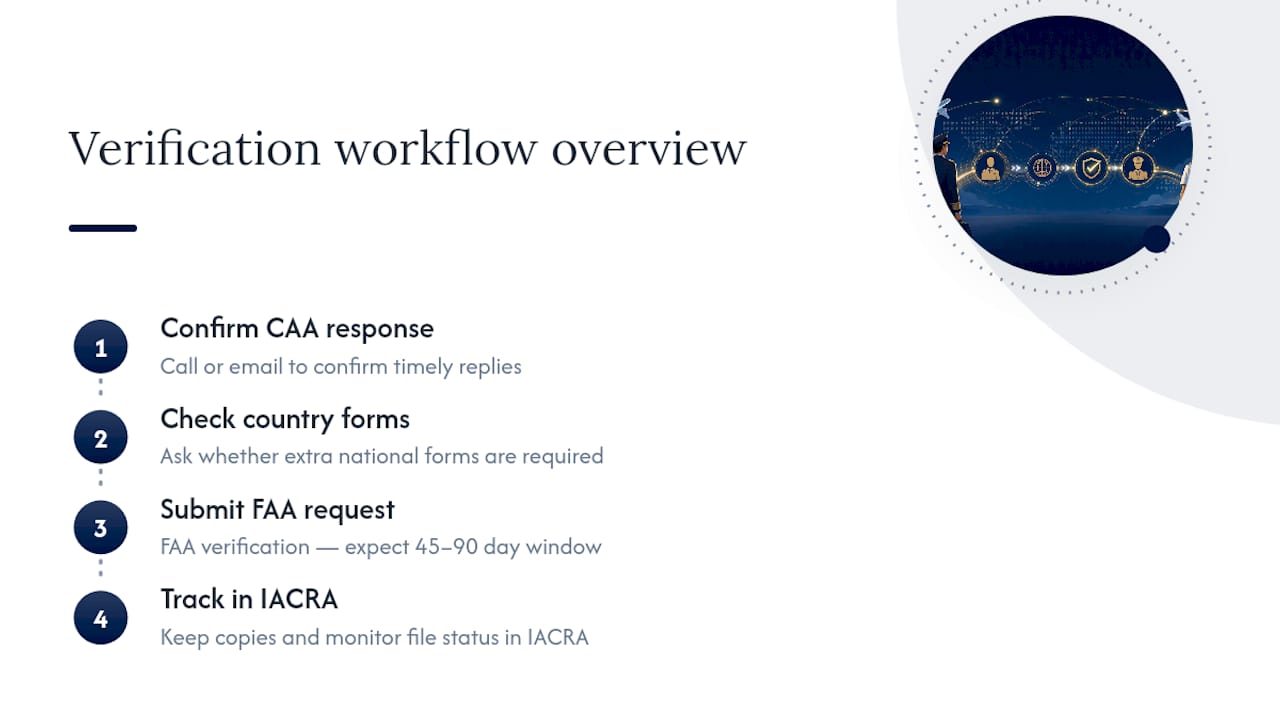
Keep copies of everything you submit and track your file status inside IACRA rather than relying on memory or a single email thread.
Why Verification Timing Shapes the Whole Training Plan
Verification looks like paperwork until it collides with a training schedule. Most type-rating programs and simulator blocks get booked weeks or months out, and a training center can’t seat a foreign-licensed pilot in a program until the FAA has confirmed the underlying credential is legitimate. That 45 to 90 day window isn’t a footnote. It’s the actual critical path for anyone converting a foreign license toward FAA certification.
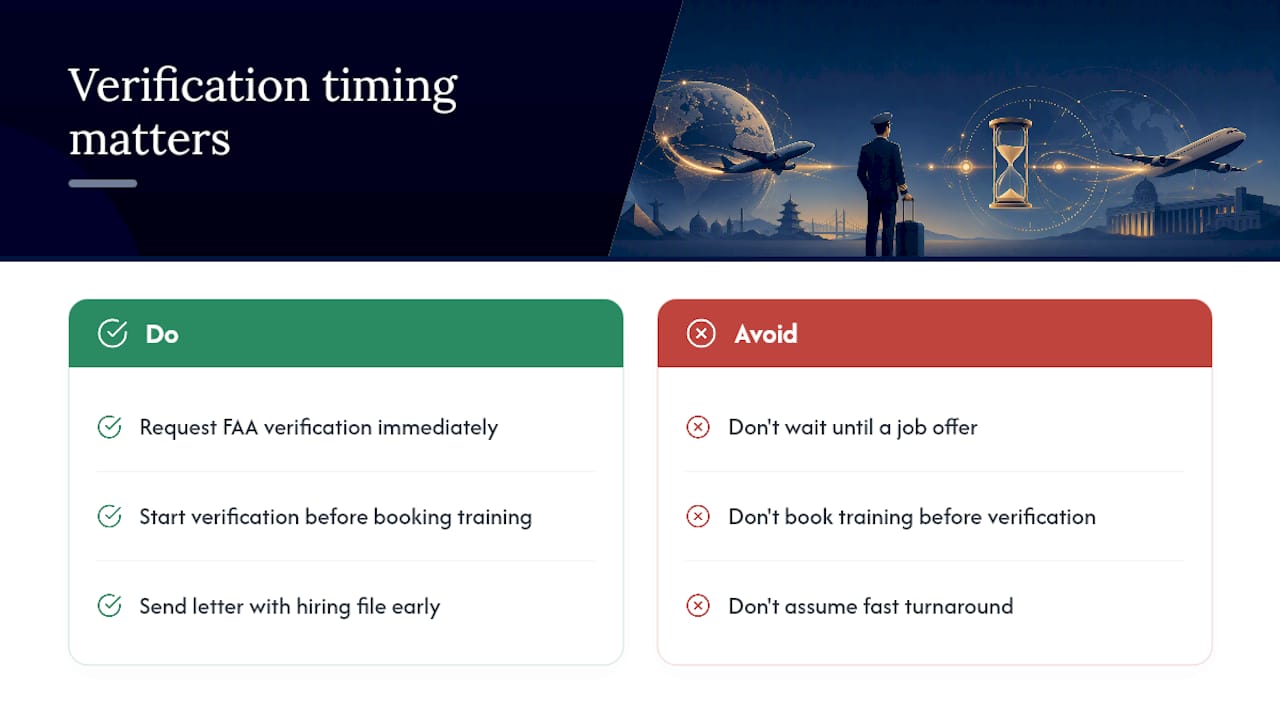
Employers run into the same wall. Airlines and charter operators increasingly ask for the FAA verification letter as a hiring-file requirement, not a nice-to-have, which means a pilot who waits until an offer is on the table has already lost two or three months they didn’t need to lose.
The pilots who move through conversion fastest are the ones who start the verification request before they’ve locked a training date, not after.
— Jake
Getting Help With FAA License Conversion and Prep
Verification is only the first document you’ll need. Once that letter is in hand, converting a foreign license into an FAA certificate still means navigating IACRA applications, knowledge tests, and aircraft-specific training requirements, and that’s where a lot of foreign-licensed pilots get stuck.

The center works with pilots holding various foreign licenses to assist with organizing documentation, sequencing paperwork to avoid delays, and preparing candidates for type-rating checkrides on full-motion simulators once the FAA process is complete. The center doesn’t issue verification letters, that’s exclusively an FAA function, but it does help pilots avoid the scheduling mistakes that turn a 90-day wait into a six-month one. If you’re holding a foreign license and staring down an FAA conversion, the FAA License Conversion Center is the place to start mapping out your documentation and training timeline before you submit anything.
Sources
- FAA Registry - Airmen - AirmenInquiry - Name Search
- Verify the Authenticity of a Foreign License and Medical Certification | Federal Aviation Administration
FAQ
Are FAA licenses public record?
Yes. The FAA Airmen Inquiry is a public database that lets anyone confirm a certificate exists and see releasable name and address information.
Can you look up whether someone has a pilot license?
Yes, using the FAA Airmen Inquiry by entering a last name, though the tool only returns limited public fields like name, releasable address, and certificate type, not full personal details.
Can I search the FAA registry by name?
Yes, last name is the required search field, and adding a first name, city, or state narrows results when the last name is common.
Do FAA certificates expire?
Most FAA pilot certificates don’t expire, though medical certificates do and privileges depend on maintaining currency requirements; a formal verification letter itself is generally treated as valid for up to six months unless the requesting agency specifies otherwise.