
Regulator Playbook for Pilots to Revalidate Type Ratings and Avoid Grounding

Most type ratings stay valid for about a year under EASA rules, with a short window before expiry when revalidation is straightforward. If your expiry date is more than three months away, no action is needed yet. If you’re inside that window, contact an approved training organization (ATO) now to book a proficiency check. If your rating has already lapsed, you’ll need an ATO assessment to determine whether refresher training is required before you can fly the type again.
TL;DR:
- Revalidating your type rating early can reset your 12-month validity period to the check date, potentially gaining you weeks before expiry.
- A rating that has already lapsed requires an assessment and possibly refresher training before attempting the proficiency check.
- In some cases, single-pilot single-engine ratings may have longer validity periods, but this does not apply to multi-crew aircraft like the A320 or B737.
- Missing the expiry by even a single day usually moves you into renewal procedures, involving additional refresher training and documentation.
- Booking your assessment and training at least three months before expiry helps avoid last-minute scheduling issues and unnecessary grounding time.
Table of Contents
- Understanding Type Rating Validity Periods
- Revalidation vs. Renewal: Why the Distinction Matters
- How EASA, UK CAA, CASA, and FAA Rules Actually Differ
- Currency and Recency: The Rules That Let You Actually Fly
- The Practical Steps to Revalidate or Renew Your Rating
- Common Pitfalls and Smarter Planning
- What Realistic Timelines Look Like From the Training Side
- How Simulator Center Supports Your Revalidation Timeline
- Where to Verify the Details for Your Licence
- Why the Paperwork Framing Misses the Point
- Sources
Understanding Type Rating Validity Periods
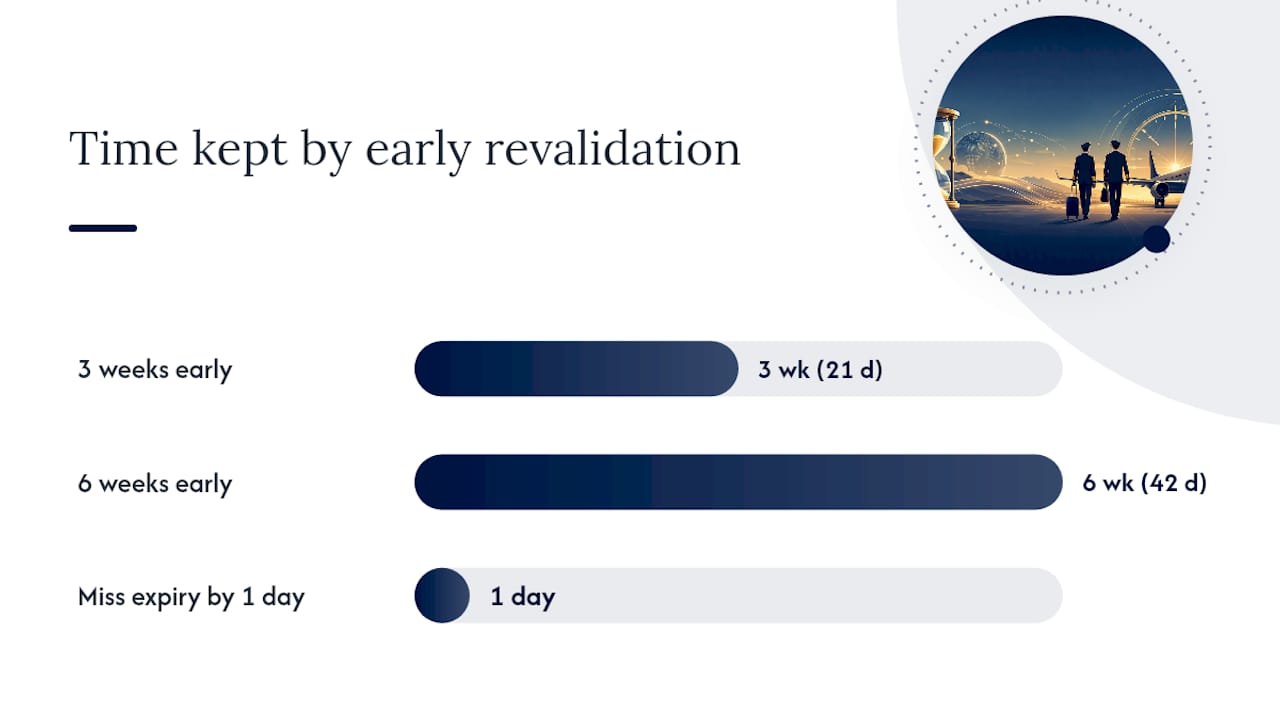
The 12-month rule is the baseline most pilots operate under, and it comes straight from FCL.740 in EASA’s regulatory text. That regulation also permits early revalidation, which resets your new expiry date to the day of the successful proficiency check rather than the original date. Fly your check three weeks early and you don’t lose those three weeks. You gain them, because the new 12-month clock starts fresh.
There’s one notable exception worth knowing. Single-pilot single-engine (SEP) class ratings can carry a longer validity period in some cases, a detail confirmed in older UK statutory instrument language on revalidation certificates. That’s the exception, not the rule, and it doesn’t extend to multi-crew type ratings like the A320 or B737.
Expiry dates typically get rounded to the end of a month for administrative simplicity. A few common scenarios:
- A rating issued mid-March often expires at the end of March the following year, not on the exact anniversary date, as expiry dates typically get rounded to the end of a month for administrative simplicity.
- Revalidating six weeks early still gives you a full new 12-month period from the check date.
- Missing the expiry by even a single day usually triggers the renewal path instead of the simpler revalidation path.
Revalidation vs. Renewal: Why the Distinction Matters
These two words get used interchangeably by pilots, but regulators treat them as completely different processes with different stakes.
- Revalidation happens when you complete your proficiency check before your rating expires, typically within the three-month window the UK CAA outlines for keeping ratings valid. It’s a single event: pass the check, get your endorsement, move on.
- Renewal kicks in once the rating has already lapsed. An ATO must first assess your currency and experience gaps, which often means mandatory refresher training before you’re even eligible to attempt the proficiency check.
- Documentation differs too. Revalidation usually produces a straightforward licence endorsement. Renewal often generates a course completion certificate from the refresher training plus the endorsement, since the paper trail needs to show you closed the competency gap.
The UK CAA’s own guidance frames this well: the process exists to confirm practical ability, not just to update a date on a card.
How EASA, UK CAA, CASA, and FAA Rules Actually Differ
Pilots flying under different regulatory regimes, or converting between them, run into real inconsistencies here. Four systems, four different philosophies.
- EASA/FCL.740: The 12-month clock with end-of-month rounding is the anchor rule, and early revalidation resets that clock to the check date rather than the original anniversary.
- UK CAA: Follows the same basic structure but adds a hard procedural requirement: the rating must appear on the front of your licence to be considered valid, and an ATO assessment decides whether you need refresher training before the check.
- CASA (Australia): Recognizes equivalent overseas training, but only when it’s performed by an operator authorized by the foreign national aviation authority that approved that training in the first place. Simulator use is commonly mandated for larger aircraft type ratings.
- FAA: Doesn’t run a 12-month expiry model at all. A type rating is a permanent designation on your certificate under 14 CFR § 61.31. What expires is your recency, not the rating itself. You need current flight reviews and recent experience to legally act as pilot in command, but the type rating on paper never lapses.
That FAA distinction trips up a lot of pilots converting from EASA licences. They expect an expiry date and there isn’t one, because the FAA measures currency instead of certification.
Currency and Recency: The Rules That Let You Actually Fly
A valid rating on paper doesn’t automatically mean you’re legal to fly the aircraft. Recency requirements sit alongside the rating itself, and they’re where a lot of pilots get caught out.
- Route sectors and recent landings: Most operators and authorities track a rolling count of takeoffs and landings in type, separate from your revalidation date.
- Instrument proficiency checks (IPC): If your instrument privileges have lapsed, you may need an IPC even when your type rating itself is technically current.
- Operator proficiency checks (OPC): Pilots flying for a commercial operator often get OPC credit that satisfies the regulator’s revalidation requirement in one combined check, rather than sitting a separate standalone proficiency check. This exemption is genuinely useful. It saves a duplicate session.
Pro Tip: Track your recent landings the same way you track your rating expiry. A current type rating with stale route-sector experience still leaves you needing extra training before an operator will roster you for line flying.
The Practical Steps to Revalidate or Renew Your Rating
Here’s the sequence that actually plays out at an ATO, whether you’re revalidating on time or renewing after a lapse.
- Check your licence and medical status first. A type rating renewal means nothing if your medical certificate has also expired, and the rating must sit in the correct position on your licence document.
- Contact an approved ATO for assessment. Bring your logbook, current licence, and last proficiency check paperwork. The ATO uses this to decide your training path.
- Complete refresher training if required, then the proficiency check. Pilots flying for an operator may combine this with an OPC rather than scheduling a separate check.
- Get the examiner’s endorsement. This is what actually updates your licence record, and processing times vary by national aviation authority.
| Step | Who’s involved | Typical outcome |
|---|---|---|
| Assessment | ATO instructor | Training plan confirmed or waived |
| Refresher training | ATO / simulator instructor | Course completion certificate (renewal only) |
| Proficiency check | Approved examiner | Pass/fail determination |
| Licence endorsement | Examiner + national authority | Updated expiry date on licence |
Common Pitfalls and Smarter Planning
Late booking is the pitfall that causes the most grounding time, full stop. Examiners and Level D simulator slots fill up fast, especially around peak recurrent-training seasons, and pilots who wait until the final two weeks of their window often find nothing available.
Two other mistakes show up constantly: forgetting that a rating has to sit on the front of the licence to count as valid in some jurisdictions, and miscalculating expiry by assuming it’s the exact anniversary date rather than the end-of-month rounding many authorities apply.
Book inside the three-month window as early as possible. Treat it as a scheduling buffer, not a deadline. Early revalidation also resets your clock to the check date, so there’s no real downside to going early.
Refresher courses are structured around this exact problem. The training includes Level D full motion simulators, an ATO-aligned curriculum, and instruction from experienced airline captains to give pilots a realistic run at the proficiency check standard before they’re sitting in front of an examiner.
What Realistic Timelines Look Like From the Training Side
Booking a Level D simulator slot with an available examiner usually needs more lead time than pilots expect, particularly for widebody types where simulator availability is tighter across the industry. A straightforward on-time revalidation might run a single session or two. A renewal after lapse, especially one involving a longer gap in flying, often needs several refresher sessions before the candidate is ready for the actual check.
Combined OPC arrangements shorten this considerably for pilots already flying for an operator, since one check satisfies two requirements instead of forcing a separate standalone session onto an already tight calendar. That’s the practical argument for booking early: it’s not just about avoiding a lapse, it’s about giving yourself room if the assessment reveals more gaps than you expected.
How Simulator Center Supports Your Revalidation Timeline
This training center offers an alternative to scrambling for a last-minute slot when your window is closing. The Level D full-motion sessions cover aircraft types including A320, B737, A330, ATR 42/72, and B757/767, providing pilots with ATO-aligned refresher training and proficiency-check preparation under instructors with airline experience.

If you’re heading into a revalidation or renewal, bring your current licence, medical certificate, and logbook records to enrollment. That paperwork lets the training team scope your session count accurately instead of guessing. Pilots converting an EASA, GCAA, or other foreign licence can also review FAA license conversion support alongside type-specific training. Ready to lock in a slot before your window closes? Start with pilot training admissions to check simulator and examiner availability for your type.
Where to Verify the Details for Your Licence
Regulatory specifics shift by country, so confirm your own case directly with the source:
- FCL.740: the EASA legal text on validity and renewal.
- UK CAA ratings guidance: revalidation windows and front-of-licence rules.
- CASA type rating guidance: overseas recognition and simulator requirements.
- 14 CFR § 61.31 and the FAA Type Ratings registry: US recency rules and procedural verification.
Why the Paperwork Framing Misses the Point
Most guidance on type rating validity treats it as a compliance checkbox: hit the date, pass the check, get the stamp. That framing undersells what regulators are actually testing for.
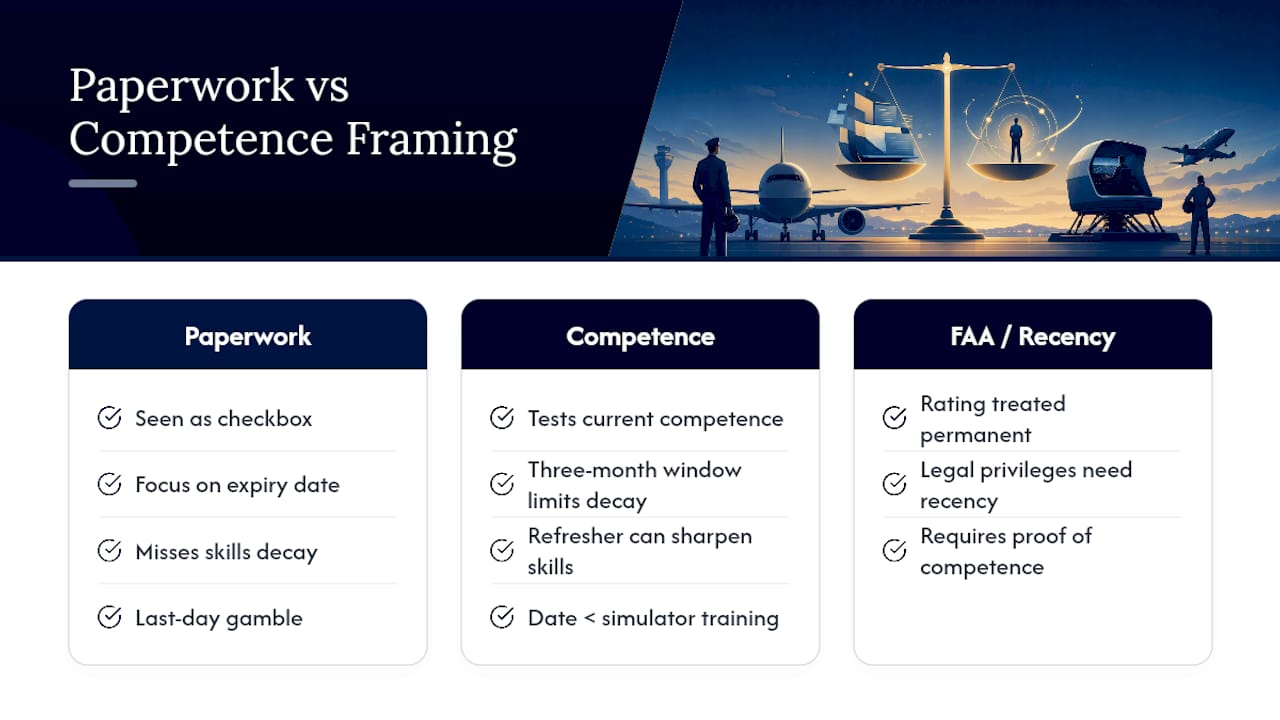
The three-month window isn’t a bureaucratic courtesy. It’s a built-in acknowledgment that skills decay faster than paperwork suggests, and that pilots who wait until the final days of their validity period are gambling on examiner and simulator availability they don’t control. The FAA’s approach, treating type ratings as permanent while tying legal privileges to ongoing recency, arguably gets closer to the real safety question than a hard annual expiry does. A rating that “expired” yesterday doesn’t mean a pilot suddenly forgot how to fly the aircraft. It means the system wants proof of current competence, not just a valid certificate.
Where I’d push back on conventional advice: too many pilots treat renewal as a worse version of revalidation, something to avoid at all costs. Sometimes a renewal with proper refresher training produces a sharper, more current pilot than a rushed on-time revalidation squeezed in during a busy roster. The date matters less than what actually happens in the simulator before the check.
— Jake
Sources
- Keeping your ratings valid | UK Civil Aviation Authority
- Getting an aircraft type rating | Civil Aviation Safety Authority
- 14 CFR § 61.31 — Recent flight experience: pilot in command
- FAA Type Ratings registry