
Non U.S. Pilots: 6 Steps to TSA Clearance and Avoid Weeks of Delay

If you are a non-U.S. citizen planning to start flight training in the United States, you need a TSA Security Threat Assessment and a Determination of Eligibility through the Flight Training Security Program before any covered training begins. The program now works on a candidate basis: pay once, get vetted once, and train under that clearance for up to five years. Your first move is simple. Open an FTSP candidate account and start the application before you book any lessons.
TL;DR:
- The TSA Security Threat Assessment and Determination of Eligibility are required for most non-U.S. citizens seeking initial or recurrent flight training in the U.S., with some exemptions like military trainees.
- The application process must be started early through the FTSP portal, including completing biographic details, submitting clear documents, paying a one-time fee, and scheduling fingerprinting at approved locations.
- Processing typically takes around 30 days once all documents and fingerprints are submitted correctly, so candidates should start at least two months before training begins.
- The TSA clearance is valid for up to five years, but it immediately expires if the candidate’s lawful U.S. presence ends or if new disqualifying information arises.
- Carefully managing document quality, timing fingerprint appointments according to TSA instructions, and avoiding premature application submission are crucial to prevent delays.
Table of Contents
- TSA Security Requirements for Pilots: Who Actually Needs This
- How to Get TSA Clearance as a Pilot: The Application Steps
- Documents and Fingerprints: Avoiding the Most Common Delays
- TSA Screening Process for Pilots: Timing and How Long Clearance Lasts
- What Disqualifies a Pilot and What Happens If You’re Denied
- Provider and Candidate Roles: Who Does What in the Portal
- How Simulator Center Supports International Candidates
- The Part of This Process Nobody Talks About Enough
- Sources
TSA Security Requirements for Pilots: Who Actually Needs This
Not every international student pilot needs to go through this process, and not every flight requires it. TSA defines a “candidate” as any non-U.S. citizen seeking flight training, ground training tied to a certificate, or a recurrent training event at a covered provider. The rule, finalized in the FTSP final rule effective July 30, 2024, covers a wide range of training events:
- Initial pilot certificates (private, commercial, ATP)
- Instrument rating training
- Multi-engine ratings
- Type rating courses, including transition training on aircraft like the A320 or B737
- Recurrent training tied to a type rating
Some categories are exempt. DoD-endorsed military trainees skip the STA entirely. Certain recurrent training that doesn’t involve a new type rating, discovery or demo flights, and purely ground-based instruction with no aircraft time generally fall outside FTSP’s scope. AOPA’s guidance on the rule is worth reading closely if your training plan mixes covered and exempt activities.
One nuance that trips people up: lawful permanent residents, refugees, and parolees are technically non-U.S. citizens under this rule, so they still need a Determination of Eligibility. Green card holders do get a faster document path, which the next section covers.
How to Get TSA Clearance as a Pilot: The Application Steps
The process runs entirely through the FTSP portal, and skipping steps or doing them out of order is the single biggest cause of delay.
- Register as a candidate. Create an account on the FTSP portal and select candidate registration rather than provider registration.
- Complete the online application. You’ll enter biographic details (name, date of birth, citizenship, current address, passport number) and upload document images.
- Pay the STA fee. Payment runs through Pay.gov, linked directly from the portal. This is the one-time, candidate-based fee tied to the FTSP’s shift away from event-based vetting.
- Wait for fingerprint instructions. TSA emails you specific guidance on where and how to get fingerprinted. Do not schedule fingerprinting before this email arrives.
- Get fingerprinted at an approved location. Only TSA-accepted collectors count, and the fingerprint-based FBI criminal history check required under 49 CFR 1552.31 has to run through one of them.
- Select your provider(s) once your Determination is issued. The portal lets you name the training provider and coordinate scheduling directly.
Pro Tip: Don’t get fingerprinted early just because you’re impatient. TSA’s instructions specify approved collection sites, and prints submitted outside that window or through an unapproved collector often get rejected, restarting the clock instead of saving time.
Once your Determination clears, you’re not locked into one school. Many candidates use that window to start comparing programs, whether that’s an A320 type rating or an FAA license conversion track.
Documents and Fingerprints: Avoiding the Most Common Delays
Your application lives or dies on document quality. TSA and provider guides consistently point to the same failure points: blurry uploads, cropped edges, and expired documents.
Acceptable identity documents typically include:
- A valid passport
- Current visa or other immigration status documents
- A green card, for permanent residents (this generally routes through expedited processing)
For photos and uploads, keep it simple: color images only, full document visible with no cropped corners, and file formats the portal actually accepts (check the current portal specs before you upload, since they can change). A candidate guide published by an FTSP-affiliated provider notes that most rejected applications come down to illegible scans, not missing information.
On fingerprints: TSA emails specific instructions after your application clears initial review, naming approved collection sites near you. Do not walk into a random law enforcement office or fingerprinting service and expect it to count.

If your visa or immigration document expires while your application sits in review, contact the portal support channel immediately rather than waiting for the system to flag it. If you lack a conventional U.S. immigration status document, TSA’s disqualifying-factors guidance and the portal’s help section outline alternative documentation paths, but expect a longer manual review.
One figure worth remembering: a Determination of Eligibility runs for up to five years, but it expires immediately if your lawful presence in the U.S. expires first, regardless of how much time is left on the five-year clock.
TSA Screening Process for Pilots: Timing and How Long Clearance Lasts
Processing time varies, but industry reporting suggests many candidates see initial review completed in around 30 days once the application, documents, and fingerprints are all submitted correctly. That’s the optimistic case. Build in a buffer.
- Start at least two months before your planned training date. Flight-industry guidance consistently recommends this window to absorb document resubmissions or fingerprint scheduling delays.
- Expect the Determination to last up to five years under 49 CFR 1552.31, covering multiple training events without a new fee each time.
- Keep your portal profile current. Address changes, visa renewals, and new immigration documents all need updating, since TSA runs continuous monitoring against this data.
A Determination can end early. Losing lawful presence status is the most common trigger, but new disqualifying information surfacing during TSA’s ongoing checks can also cut it short.
What Disqualifies a Pilot and What Happens If You’re Denied
TSA maintains a specific list of factors that can make a candidate ineligible, and it’s worth reading in full rather than guessing. The disqualifying offenses list includes:
- Certain serious criminal convictions, including crimes involving explosives, treason, espionage, and violent felonies
- Extended periods of imprisonment tied to a qualifying offense
- Security-related regulatory violations, including prior aviation security infractions
TSA doesn’t just check once and move on. The agency runs continuous vetting against this same criteria for the life of your Determination, and new information (an arrest, a status change, a flagged record) can trigger revocation even after training has started.
If you’re denied or revoked, don’t assume it’s final. Review exactly what documentation TSA cited, request redress through the appropriate channel, and loop in your training provider early since they need to know before continuing any scheduled sessions. For anything involving a criminal record or immigration complication, talk to an immigration or aviation attorney before you resubmit.
Provider and Candidate Roles: Who Does What in the Portal
Training providers carry their own obligations under FTSP, and misunderstanding this split causes a lot of confusion. Providers register separately in the portal and use it to verify a candidate’s Determination status before scheduling any covered training.
- Providers must confirm your Determination is active before your first lesson, not after.
- Industry guidance points to a common acknowledgement window, often around 30 days, for providers to report a new candidate’s arrival into the system.
- If TSA notifies a provider that a candidate has become ineligible, training has to stop immediately. No exceptions, no finishing the current lesson.
A partner training organization like Formation PNC’s program in Cholet illustrates how international crew training programs elsewhere structure similar pre-training coordination, even outside the U.S. system.
One more thing worth knowing: Known Crewmember and CMAP privileges are employer-issued access programs for working crew. They do not substitute for FTSP clearance. If you’re a working pilot with KCM access starting a new type rating as a non-U.S. citizen, you still need the STA.
How Simulator Center Supports International Candidates
Simulator Center works with international pilots on the practical side of FTSP timing, not legal advice. That means reviewing document quality before submission, sequencing fingerprint appointments against training start dates, and coordinating admissions once your Determination clears for programs like FAA license conversion or full type rating courses.
The Part of This Process Nobody Talks About Enough
The FTSP rule change gets treated online like a paperwork hurdle, and technically it is one. But the candidates who struggle aren’t the ones confused about the regulation. They’re the ones who treat the 60 day window as a suggestion instead of a floor.
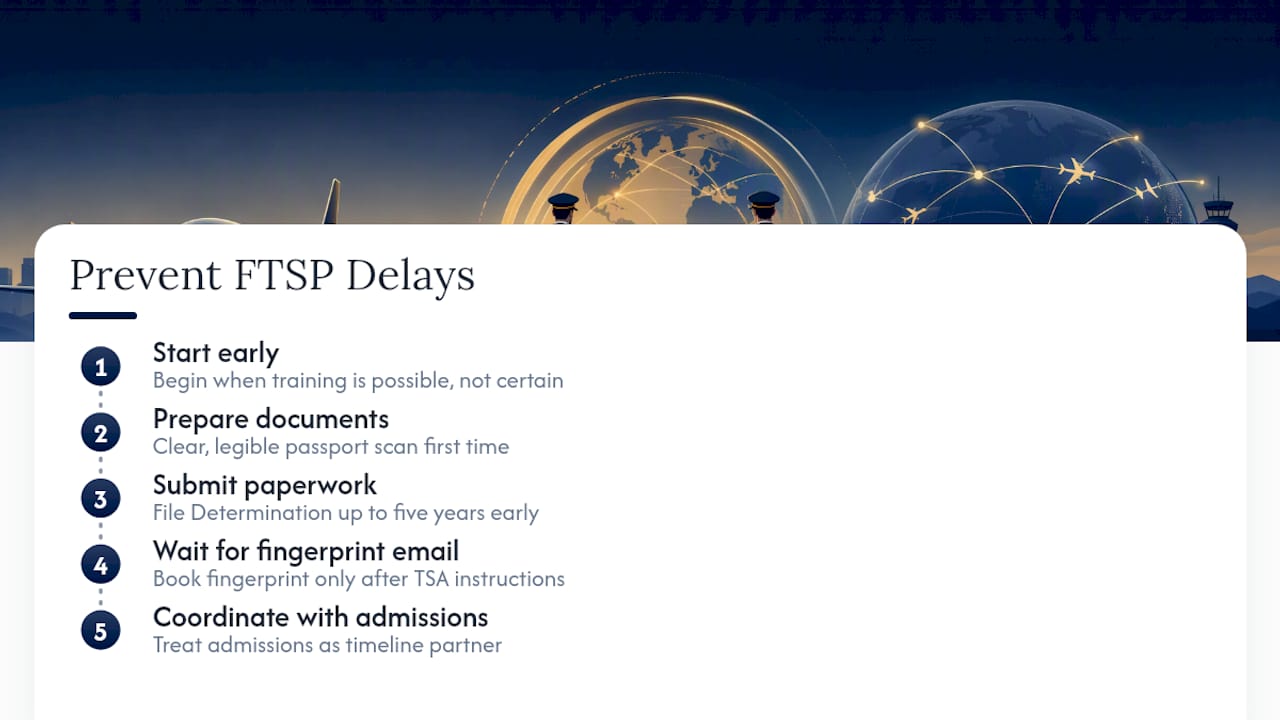
Most delays trace back to two things: a blurry passport scan and a fingerprint appointment booked before TSA’s instructions arrived. Both are entirely avoidable, and both cost candidates weeks they didn’t need to lose. If there’s one piece of conventional advice worth ignoring, it’s the idea that you can “start the process once training is confirmed.” Start it the moment training is a real possibility, not a certainty. The Determination is good for up to five years. There’s no penalty for early clearance and a real cost to late clearance.
What actually matters here isn’t memorizing every disqualifying offense on TSA’s list. It’s document discipline and sequencing. Get the paperwork right the first time, wait for the fingerprint email, and treat your provider’s admissions team as a partner in the timeline rather than someone you loop in after the fact. That’s the whole playbook, and it works better than most people expect once they stop overcomplicating it.
— Jake
Ready to line up your clearance timeline with an actual training schedule? Simulator Center’s admissions team helps international candidates coordinate FTSP timing with enrollment in type rating and FAA conversion programs, so your Determination and your training start date land where they should.
Sources
- TSA announces the publication of the Flight Training Security Program Final Rule | Transportation Security Administration
- 49 CFR § 1552.31 - Security threat assessment required for flight training candidates. | LII / Legal Information Institute
- TSA Training Requirements for Non-U.S. Citizens at FlightSafety