
Avoid Losing Your Simulator Slot: 6 FTSP Steps for Type Rating Pilots

BLUF: the TSA Flight Training Security Program (the successor to AFSP) is a security eligibility check for covered flight training. It does not substitute for FAA type-rating issuance or ATP certification. If you’re scheduling a type-rating course, confirm your FAA eligibility under 14 CFR §61.31 first, then prepare the exact documents TSA wants, and only then lock in simulator dates with a provider like Simulator Center.
TL;DR:
- TSA processes non-U.S. citizen candidates’ security threat assessments before training, while U.S. citizens only need identity verification and event submission.
- FAA type-rating approval requires completion of FAA training, endorsements, and a practical test, which TSA clearance does not replace.
- Candidates must verify FAA eligibility and gather correct documents, including clear airman certificate images, before TSA submission to avoid delays.
- FTSP approvals are specific to each training event and must be renewed for multiple type ratings or recurrent training, affecting scheduling and timing.
- Proper sequencing of FAA and TSA requirements is crucial, with internal provider management of event submission significantly reducing scheduling surprises.
Table of Contents
- What Does TSA AFSP/FTSP Cover for Type-Rating Candidates?
- How FAA Type-Rating Rules Differ From TSA Security Checks
- Step-by-Step: Preparing and Scheduling a Type-Rating Course Under FTSP
- Which Documents Cause the Most FTSP Delays?
- Real-World Timing and What Actually Speeds Things Up
- How Long Does TSA FTSP Clearance Last?
- How Does FTSP Interact With Fingerprinting and Background Checks?
- What Happens if FTSP Processing Is Delayed or Denied?
- The Real Gap in How This Gets Explained
- How Simulator Center Handles FTSP Documentation for Type-Rating Candidates
- Sources
- FAQ
What Does TSA AFSP/FTSP Cover for Type-Rating Candidates?
The program TSA now calls the Flight Training Security Program, still referred to informally as AFSP, exists to vet who gets access to flight training, not to decide who is competent to fly an aircraft. Under 49 CFR Part 1552, a “candidate” is anyone seeking flight training or recurrent training from a covered provider, and covered events explicitly include simulator training and type ratings, not just initial flight instruction. That single definition is why every type-rating course at a certified training center needs a TSA event notice before the first simulator session.
Providers carry real weight here. A training center has to designate a security coordinator, vet candidates against the regulation’s identity and citizenship rules, and submit each covered training event to TSA before it begins. That workflow, not just the candidate’s paperwork, determines how fast a class can move.
- Non-U.S. citizen candidates generally require a completed TSA security threat assessment before training starts, a point AOPA’s FTSP overview stresses repeatedly for international pilots.
- U.S. citizens still need a covered-event submission and identity verification, just not the full non-citizen threat assessment.
- Expedited eligibility generally depends on prior clean FTSP history and complete documentation on first submission. There is no shortcut for incomplete files.
How FAA Type-Rating Rules Differ From TSA Security Checks
TSA and the FAA are answering two completely different questions. TSA asks whether you’re a security risk for accessing an aircraft or simulator. The FAA asks whether you can actually fly the airplane to standard. Confusing the two is the single most common misunderstanding among first-time type-rating candidates.
14 CFR §61.31 sets the legal requirements for adding a type rating: specific ground and flight training, an endorsement from an authorized instructor, and a practical test administered under standards the FAA lays out in FAA Order 8710.3E, Chapter 13. That order governs everything from how examiners conduct the checkride to how temporary certificates get issued the moment you pass.
- The FAA requires completed training records and instructor endorsements before a checkride can even be scheduled, per FAA Order 8710.3E.
- Candidates pursuing an ATP concurrent with a type rating typically need the ATP Certification Training Program described in FAA AC 61-138A, which is a distinct training block from the type-rating course itself.
- FAA AC 61-65E confirms type-rating practical-test standards apply uniformly regardless of the certificate level the applicant already holds.
TSA clearance never waives a single one of these FAA steps. Approval to train just means you’re allowed in the door.
Step-by-Step: Preparing and Scheduling a Type-Rating Course Under FTSP
Getting from “I want a type rating” to “I’m in the simulator” runs cleaner when you sequence FAA and TSA steps correctly instead of doing them in parallel and hoping they meet in the middle.
- Confirm FAA eligibility first. Verify whether you need an ICAO-to-FAA conversion or an ATP-CTP before the type-rating course even starts. Resolving this upfront prevents a TSA submission built around the wrong training category.
- Gather your document set. Pull clear images of your airman certificate showing Section XII type-rating entries, plus passport or immigration evidence if you’re not a U.S. citizen.
- Let the provider submit the covered event. Your training center files the FTSP event notice; this is a provider responsibility, not something a candidate can do independently.
- Submit your candidate application. Upload documents exactly as instructed in the TSA FTSP Candidate Guide.
- Wait for acknowledgment before locking dates. Don’t finalize simulator or checkride bookings until both the provider event and your candidate application show acknowledged status.
- Request expedited processing only if eligible. This generally requires a clean prior FTSP record and a complete file submitted the first time.
Pro Tip: Budget your FAA-side prerequisites, like ATP-CTP academics, on a separate timeline from TSA processing. Trying to compress both into the same two-week window is the fastest way to lose a simulator slot you already paid for. If you’re mapping out ATP-CTP timing against a type-rating course, the ATP-CTP cost and scheduling guide breaks down how the academic and simulator hours typically stack.
Which Documents Cause the Most FTSP Delays?
Nearly every processing delay traces back to one thing: an incomplete or misread airman certificate image. TSA’s own candidate guidance calls for specific fields, country of issuance, certificate number, issue date, and the Section XII type-rating entries, and warns that many applicants need to upload multiple pages just to capture all of them in one legible set.
The most frequent mistakes, according to the TSA FTSP Candidate Guide:
- Uploading a course completion certificate instead of the actual airman certificate.
- Cropping images so Section XII type-rating entries aren’t visible.
- Mistyping certificate numbers or issue dates during manual data entry.
- Submitting passport pages that don’t match the immigration status claimed on the application.
International candidates need an extra layer of care. Foreign-issued certificate images, visa or permanent-resident card copies, and passport bio pages all need to be current and legible, not scans of scans. A provider that packages these correctly before submission catches most of these errors before TSA ever sees them, which is exactly the kind of pre-enrollment review AOPA notes reduces candidate-side delay.
Real-World Timing and What Actually Speeds Things Up
Processing timelines vary by candidate history and document completeness, so treat any specific day count you hear from another applicant as anecdotal rather than a guarantee. What’s consistent, based on how the candidate guide frames it, is that complete first-submission files move faster than files that get bounced back for corrections. Expedited eligibility exists, but it leans heavily on a clean prior record and zero missing fields, not on urgency alone.
Pro Tip: Have your training center review your documents before you pay tuition, not after. Retaining your original certificate images (not compressed copies) and coordinating your FAA paperwork, including IACRA or Form 8710-1, ahead of simulator bookings saves weeks, not days.
- Confirm your FAA conversion sequencing before scheduling anything TSA-related.
- Ask your provider whether they manage event submission internally. AOPA’s guidance notes this shifts real workload off the candidate.
- Never assume “recurrent” and “initial” training categories are interchangeable on the FTSP application. Misclassifying this can restart your expedited-eligibility clock.
How Long Does TSA FTSP Clearance Last?
FTSP clearance isn’t a one-time badge that follows you for life. It attaches to specific covered training events, which means a new type-rating course, even at the same provider, generally triggers a fresh submission rather than reusing an old approval.
This matters most for pilots stacking multiple type ratings over a career, since each new aircraft qualification, an A320 rating followed later by an A330 add-on, for instance, counts as its own covered event. Recurrent training and refresher courses fall under the same logic: the classification as “initial” versus “recurrent” affects both the paperwork and your expedited-eligibility standing, a distinction AOPA’s FTSP guidance flags as a common point of confusion.
For working airline pilots, this has a practical downstream effect. Employers scheduling recurrent simulator sessions or requalification training need to know that FTSP isn’t a background check you clear once and forget. It’s tied to the training calendar itself. A pilot who lets a covered-event window lapse between recurrent sessions may need to resubmit, which can collide badly with an airline’s own training deadlines. Building FTSP timing into your annual training plan, not just your initial certification plan, avoids that collision entirely.
How Does FTSP Interact With Fingerprinting and Background Checks?
Non-citizen candidates face the heaviest scrutiny under FTSP: a full TSA security threat assessment, which typically includes fingerprint-based background checks and immigration status verification, has to clear before training can start. That’s a categorically different process from the identity verification U.S. citizen candidates go through, and conflating the two is a common source of confused expectations among mixed-nationality training cohorts.

The fingerprinting and background-check component isn’t something a training provider can waive or expedite on its own authority. It runs through federal systems on federal timelines. What a provider can control is making sure the underlying application, correct documents, correct candidate category, correct certificate numbers, is clean before it enters that pipeline. A dirty submission doesn’t just delay the paperwork; it can restart the background-check clock entirely if TSA has to kick the file back for correction.
For dual-status candidates, someone with both a foreign license and a path toward FAA certification, this gets more complicated. The security check runs against whatever citizenship and immigration documentation is on file, independent of which FAA conversion path (ICAO-to-FAA, EASA-to-FAA, or similar) they’re pursuing. Getting the FAA conversion sequencing right, described earlier in the step-by-step checklist, doesn’t shortcut the background-check requirement, but it does prevent a second, unrelated delay from stacking on top of it.
What Happens if FTSP Processing Is Delayed or Denied?
An FTSP delay doesn’t just push back a simulator session. It can cascade through an entire hiring timeline. Airlines and training providers build class schedules around confirmed FAA and TSA milestones, so a candidate stuck in TSA review often loses their assigned simulator slot to someone whose paperwork cleared first, not because of any fault in their flying, but purely on documentation timing.
The consequences compound for candidates already inside an airline’s conditional job offer window. Many carriers set hard deadlines for completing type-rating training before a start date. A denial, which is rare but does happen, typically stems from unresolved security-threat-assessment findings, not from anything related to piloting skill, and can force a candidate to restart the entire application from scratch. Even administrative delays, the far more common scenario, can push a candidate past a training class cutoff, forcing a costly reschedule into the next available cohort.
The practical defense against all of this is the same one this guide keeps returning to: submit a complete, correctly categorized application the first time. Candidates who treat the TSA step as an afterthought to “the real training” are the ones who end up explaining a schedule slip to a chief pilot. Candidates who treat it as its own critical-path item, with its own deadlines, generally don’t.
The Real Gap in How This Gets Explained
Most guidance on this topic treats TSA clearance and FAA certification as if they’re sequential boxes on the same checklist, when in practice they’re parallel tracks that only intersect at scheduling. The conventional advice, “get your TSA clearance, then start training,” undersells how much of the delay problem is actually a documentation-quality problem, not a bureaucratic-speed problem.
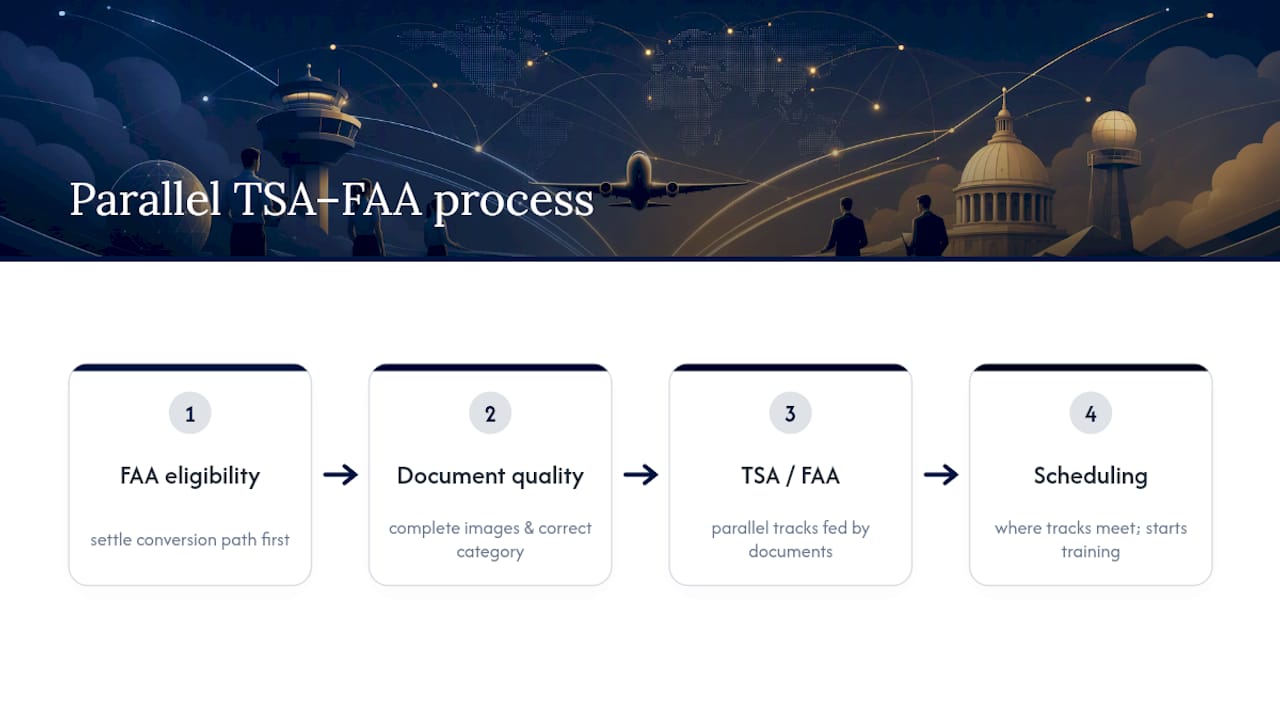
The evidence points somewhere more specific: candidates who fail don’t usually fail because TSA is slow. They fail because their airman certificate images were incomplete, their training category was misclassified, or their FAA conversion path wasn’t settled before they touched the TSA application at all. That’s a preventable problem, not an inherent one.
If there’s one thing worth prioritizing above everything else in this process, it’s sequencing your FAA eligibility question before your TSA paperwork question. Everything downstream, document prep, provider submission, scheduling, gets dramatically simpler once that order is locked. Providers who manage the FTSP event submission internally, rather than leaving it entirely to the candidate, consistently produce fewer scheduling surprises. That’s not a minor operational detail. It’s the difference between a training timeline that holds and one that doesn’t.
— Jake
How Simulator Center Handles FTSP Documentation for Type-Rating Candidates
Simulator Center runs admissions document review before tuition is finalized, catching the exact issues that trigger TSA delays, missing Section XII entries, mismatched certificate numbers, incomplete passport pages, before they ever reach a submission.

Training happens on Level D full-motion simulators with instruction from current and former airline captains, across A320, A330, ATR 42/72, B737, B737 Classic, and B757/767 type-rating programs. For pilots who still need to resolve their FAA eligibility first, whether that means an ICAO-to-FAA, EASA-to-FAA, or DGCA-to-FAA conversion or a full ATP-CTP course, that groundwork gets sorted before scheduling begins, not discovered halfway through it. All of it runs inside one program, so documentation, checkride coordination, and simulator logistics get handled in a coordinated manner without candidates managing multiple vendors separately.
If you’re planning a type-rating course and want your FAA prerequisites and TSA paperwork sequenced correctly from day one, reach out through admissions to start the document review process now.
Sources
- eCFR :: 49 CFR Part 1552 – Flight Training Security Program
- FAA Order 8710.3E - Chapter 13 Conduct a pilot type rating certification
- Flight Training Security Program - AOPA
- Revised Candidate Guide (TSA FTSP candidate guidance)
FAQ
Does TSA AFSP/FTSP Approval Count as an FAA Type Rating?
No. FTSP approval is a security eligibility determination under 49 CFR Part 1552 that lets you access covered training. The type rating itself still requires FAA training, endorsements, and a practical test under 14 CFR §61.31.
How Long Does TSA FTSP Processing Typically Take?
Processing time depends heavily on document completeness and candidate history, and TSA doesn’t publish a fixed universal turnaround. Complete, correctly categorized submissions consistently move faster than files sent back for correction, according to the TSA FTSP Candidate Guide.
What Documents Do I Need for a TSA AFSP Type Rating Application?
You need clear images of your airman certificate showing Section XII type-rating entries, country of issuance, certificate number, and issue date. Non-citizen candidates also need passport and immigration status documentation as outlined in the candidate guide.
Is ATP-CTP the Same Requirement as a Type Rating?
No, they’re distinct but often scheduled together. ATP-CTP is a separate academic and simulator training block described in FAA AC 61-138A, required for candidates pursuing an ATP concurrently with certain type ratings.
Does Simulator Center Help With FAA License Conversion and TSA Documentation?
Yes. Simulator Center offers ICAO, EASA, and DGCA to FAA license conversion along with admissions document review that checks certificate images and paperwork before a TSA submission goes out. Course pricing details are available directly through the type-rating program pages.