
Shorten Your LOE Learning Curve With a Simulator First Plan

The pilots who pass their Line Oriented Evaluation without drama treat it as three problems, not one: SOP mastery, crew resource management under pressure, and enough full-mission simulator repetition to make the unusual feel routine. Book focused sim time and run partner CRM rehearsals well before the check, not the week of. The rest of this guide breaks down the scenarios you’ll face, a six-week study timeline, and the paperwork checklist that trips up pilots who otherwise flew a clean profile.
TL;DR:
- Most pilots succeed in their LOE by thoroughly preparing SOP flows, crew resource management, and full-mission simulation practice well before the check.
- Examiners assess whether pilots follow airline SOPs, communicate clearly, and make sound decisions under realistic, full-flight scenarios.
- Common LOE scenarios include engine failure, pressurization loss, cascading system failures, wind shear, and upset recovery, with preparation focusing on scenario escalation.
- Structured six-week study plans with system reviews, partner CRM drills, and simulator sessions help build performance consistency and confidence.
- Effective LOE preparation also involves logistical readiness, such as verifying documentation, arriving rested, and practicing critical callouts and task prioritization.
Table of Contents
- What Is a Pilot LOE and How Does It Fit Recurrent Training?
- What Do Examiners Actually Score in an LOE?
- Common LOE Scenarios and How to Rehearse Them
- Your 4-to-6-Week LOE Study Plan
- Sim Day: Before, During, and After
- CRM Drills and Communication Scripts Worth Rehearsing
- Handling Task Saturation When Failures Stack Up
- Pre-LOE Documentation and Personal Readiness Checklist
- How Simulator Center Approaches LOE Readiness
- Book LOE Prep Sessions With Simulator Center
- Sources
- FAQ
What Is a Pilot LOE and How Does It Fit Recurrent Training?
A Line Oriented Evaluation is a mandatory, simulator-based check that grades how you fly an entire mission, not an isolated maneuver. Under an Advanced Qualification Program, the LOE replaces or supplements the traditional checkride model, folding technical performance and crew coordination into one realistic flight scenario. That’s the core distinction from a Line Proficiency Check or Maneuver Validation, which tend to isolate specific tasks. An LOE puts you in a cockpit, hands you a full flight plan, and lets problems unfold the way they would on an actual line.
The regulatory backbone for this sits in 14 CFR Part 121 Subpart Y, which governs how AQP carriers structure proficiency-based training and assessment. Most airlines run LOEs regularly, often pairing a non-graded practice day with a graded evaluation day.
A few things distinguish LOE design from older-style checks:
- Scenarios simulate a complete flight profile, from dispatch briefing to gate arrival, not a series of disconnected maneuvers.
- Crew integration is scored alongside technical execution, so a technically perfect approach flown in silence still loses points.
- Evaluators are trained to standardize scoring across sessions, which is why the scenario script rarely deviates once it starts.
Interestingly, a nationwide survey by the American Institutes for Research found pilots rate LOEs and Maneuver Validations as equally effective at measuring performance. Don’t assume the LOE format alone makes you a stronger pilot. It just tests a different, more realistic slice of the job.
What Do Examiners Actually Score in an LOE?
Examiners aren’t grading whether you land the airplane. They’re grading whether you run the flight the way your airline’s SOPs and CRM model expect, under conditions designed to reveal how you think.
The scoreable competency areas generally include:
- CRM and communication — briefing quality, workload distribution, and how clearly you state intentions.
- SOP compliance — flows, callouts, and checklist sequencing performed at the right time, not just eventually.
- Decision-making — how you weigh options when information is incomplete or conflicting.
- Manual flying skill — raw-data flying when automation degrades or fails.
- Checklist discipline — using the correct checklist for the correct condition, without skipping items under stress.
- Threat and error management — catching your own mistakes before they compound into someone else’s problem.
The evidence examiners look for is specific. A strong CRM score usually traces back to something concrete: you verbalized a plan before executing it, you asked your crew for input rather than just assigning tasks, or you caught an altitude bust and corrected it out loud instead of quietly fixing it. Hamman and Holt’s methodology for LOE design describes how evaluators are standardized against these observable behaviors precisely so two different examiners score the same actions the same way.
Pro Tip: Narrate your decision-making even when you’re confident. Silence reads as uncertainty to an examiner, even when your hands are doing the right thing.
Common LOE Scenarios and How to Rehearse Them
LOE scenario writers pull from a known playbook, and that playbook rewards preparation more than raw talent. Expect variations on:
- Engine failure at V1 or during second segment — tests immediate memory items and crew coordination under time pressure.
- Pressurization loss — tests checklist discipline, descent planning, and communication with cabin crew and ATC simultaneously.
- Electrical or hydraulic cascading failures — tests systems knowledge and prioritization when one failure triggers a second.
- Wind shear on approach or departure — tests manual flying and go-around discipline.
- Extended-envelope events — unusual attitude recovery and upset scenarios, which became a bigger training focus industry-wide after Air France 447 pushed carriers toward more extended-envelope training.
The smartest way to prepare isn’t memorizing this list. It’s building your own escalating scenario the way training departments do: start with one failure, add a complication ten minutes later, then introduce a time or fuel constraint that forces you to prioritize. That progression trains the triage instinct examiners are actually watching for, not just the memory-item recall.
Three practice formats work well outside the graded sim itself. Full-mission simulator sessions remain the gold standard because they replicate the exact pacing and sensory load of the real check. Non-marked practice sessions, run either solo or with a training partner, let you make mistakes without consequence. One first-person account from a pilot documenting a biannual sim check makes the point well: treating the practice day seriously, not as a throwaway, is what carried over into a clean graded day. Desktop or chair-flying walkthroughs round out the third method, useful for drilling flows and checklist sequencing when a sim slot isn’t available.
Your 4-to-6-Week LOE Study Plan
A predictable structure beats last-minute cramming, and six weeks is enough runway for most recurrent pilots if the time is used deliberately.
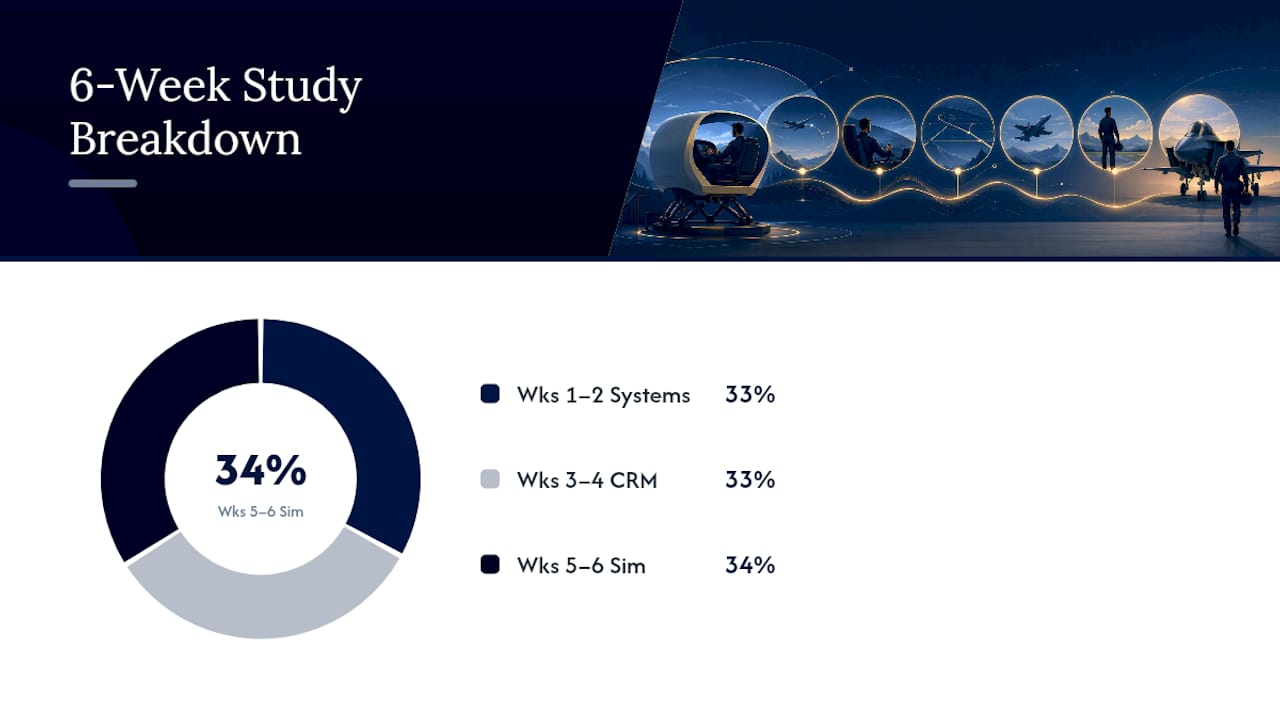
- Weeks 1 and 2: systems and memory items. Refresh flows, limitations, and memory items cold, then rebuild your SOP muscle memory with slow, deliberate flow practice rather than speed.
- Weeks 3 and 4: CRM and low-fidelity scenarios. Pair up with a line partner for timed briefing drills and walk through scenario scripts without a sim, focusing purely on communication and task assignment.
- Weeks 5 and 6: full-mission simulator sessions. Run at least one non-graded full-mission profile with a structured debrief, then a second session targeting whatever weaknesses that debrief surfaced.
Each simulator session needs a stated objective before you strap in. “Practice the profile” is not a plan. “Nail the pressurization checklist sequence and verbalize every CRM handoff” is one you can actually grade yourself against afterward.
Pro Tip: If your schedule only gives you two weeks, skip straight to Week 5’s structure: one full-mission session focused on weak areas, one CRM-only partner drill, and a systems refresh the night before. Compressed prep still works if it’s focused prep.
If simulator hours are limited, prioritize the session type that exposes the biggest gap. A pilot rusty on manual flying gains more from a raw-data hand-flying session than another checklist walkthrough. A pilot who flies smoothly but communicates poorly under stress gains more from a CRM-heavy scenario than another systems review. Simulator Center’s research-backed priorities for airline assessment prep breaks down how to weigh those trade-offs when sim time is the scarce resource.
Sim Day: Before, During, and After
What you do in the hours around the simulator session matters almost as much as what happens inside it.
Before the session:
- Review the flight plan, weather, and any known aircraft quirks the night before, not in the parking lot.
- Refresh limitations and memory items one final time, then stop studying. Cramming an hour before degrades recall more than it helps.
- Arrive rested. A pilot running on four hours of sleep flies the profile fine and blows the CRM score because patience is the first thing fatigue takes.
During the session:
- Make callouts loud and clear even when you’re certain the other pilot already knows. Examiners score what they hear, not what you assume was communicated.
- Stay in your role. Task-shifting into your crewmate’s job because you’re faster at it undermines the CRM model the whole check is built around.
- Treat examiner prompts as information, not accusations. A question about your fuel state is a cue to reassess, not a signal you did something wrong.
After the session:
- Debrief immediately while details are fresh, using a simple structure: what was the objective, what actually happened, and what’s the one measurable fix before next time.
- Write that fix down. A vague “communicate better” note is useless in three weeks. “State altitude and heading changes before executing them” is something you can actually check off.
CRM Drills and Communication Scripts Worth Rehearsing
Crew coordination is trainable the same way a checklist flow is trainable, through repetition of specific, short exercises rather than vague talk about “better teamwork.”
- Run a five-minute preflight briefing drill where each pilot states their plan for the departure, expected threats, and the other pilot’s role, out loud, every time you practice.
- Time-box a CRM role-play: give yourselves ninety seconds to divide tasks after a simulated failure announcement, then critique whether the split actually made sense.
- Practice short, assertive phrasing instead of long explanations. “I have controls, working the checklist” beats a rambling narration every time.
- Rehearse disagreement scripts. Knowing how to say “I don’t agree with that plan, here’s why” without conflict is a skill most pilots never practice until the sim forces it.
Pro Tip: Record your CRM drills on your phone once a week. Hearing your own callouts played back exposes filler words and hesitation you don’t notice in the moment.
Handling Task Saturation When Failures Stack Up
Task saturation, not any single failure, is usually what actually derails an LOE. Training tips from AOPA on prioritization point to the same pattern: pilots don’t get overwhelmed by one problem, they get overwhelmed by a second and third problem arriving before the first one is resolved.
A simple triage sequence keeps you ahead of that stacking effect:
- Aviate first. Confirm the aircraft is stable before touching anything else.
- Navigate second. Know where you are and where you’re going before adding tasks.
- Communicate third. Tell your crew, then ATC, once the first two are under control.
- Checklist last. Run the appropriate checklist once the situation is stable enough to execute it correctly rather than rushed.
Build the habit with constrained-communication drills that limit radio calls to essentials only, and degraded-automation sessions where you hand-fly through a compounding failure instead of leaning on autopilot to buy thinking time.
Pre-LOE Documentation and Personal Readiness Checklist
Logistics failures are entirely avoidable, and they still happen constantly.
- Confirm your medical certificate, license, and any required endorsements are current and physically accessible, not just remembered as “probably fine.”
- Bring a concise, one-page summary of your recent simulator currency and recency, formatted the way Simulator Center’s logbook audit guide describes, so an examiner can verify it in seconds rather than flipping through a full logbook.
- Eat a real meal beforehand. A four-hour sim session on an empty stomach erodes decision-making faster than most pilots expect.
- Give yourself time to acclimate to the sim bay’s temperature and seating before the briefing starts, rather than settling in during the first scenario.
How Simulator Center Approaches LOE Readiness
Some type-rating and recurrent programs run on Level D full-motion simulators, the same fidelity class used in the scenarios described above, with instruction led by current and former airline captains and examiners. That combination matters because the failure modes that sink an LOE, weak CRM communication, hesitant checklist sequencing, poor task prioritization, are exactly what structured sim time and a detailed instructor debrief are built to correct. Programs like the Boeing 737 Level D sessions are designed around full-mission profiles rather than isolated maneuvers, which mirrors how the actual evaluation is scored.
— Jake
Book LOE Prep Sessions With Simulator Center
This training provides real Level D full-motion hours flown with an instructor who has sat in the examiner’s seat. If you have a specific weakness, manual flying, systems recall, CRM communication, a block of targeted simulator training sessions closes that gap faster than another round of chair-flying.

Pilots with limited time before a check usually get the most out of a focused simulator block built around their weakest scenario type. Pilots needing deeper remediation, or coming off a rough recurrent cycle, often benefit more from a full type-rating refresher that rebuilds systems knowledge and flows from the ground up. Foreign-licensed pilots working toward a US role can also start their FAA license conversion process alongside sim prep rather than treating them as separate steps.
Reach out through the admissions team to walk through your timeline and current recency, and they’ll help you pick the session length and aircraft type that actually matches what your next LOE will test.
Sources
- Transport Canada — AQP overview (LOE context)
- American Institutes for Research — Airline pilots’ experiences and reactions to their check rides
- Simple Flying — Pilot emergency training guide
FAQ
What Does LOE Mean in Aviation?
LOE stands for Line Oriented Evaluation, a simulator-based check that grades a full flight profile rather than isolated maneuvers, assessing both technical execution and crew resource management under the Advanced Qualification Program framework.
How Do I Prepare for a Pilot Assessment Like an LOE?
Focus preparation on three areas: SOP flow mastery, CRM communication drills with a partner, and full-mission simulator repetition that mirrors the scenario types you’ll actually face. A structured six-week plan covering systems review, CRM practice, and graded sim sessions, like Simulator Center’s simulator training, builds all three simultaneously.
What Is the 3 to 1 Rule for Pilots?
The 3 to 1 rule is a descent planning guideline: lose roughly 3 nautical miles of distance per thousand feet you need to descend, used to judge whether a descent will make an approach comfortably or require a steeper adjustment. It’s a mental math tool pilots apply during descent planning, including under the time pressure an LOE scenario can create.
What Do Pilots Making High Six-Figure Salaries Have in Common?
Pilots earning toward the higher end of airline pay scales are typically senior wide-body captains at major carriers, a position reached after extensive recurrent checks, type ratings, and consistent LOE and proficiency performance. Type ratings on wide-body aircraft, such as an Airbus A330 type rating, are typically a prerequisite step toward those senior captain seats.
Is an LOE Harder Than a Traditional Checkride?
Neither format is inherently harder. A nationwide AIR survey found pilots rated LOEs and Maneuver Validations as roughly equally effective for measuring performance. The LOE simply tests different skills, full-mission decision-making and crew coordination, rather than isolated maneuver execution.