
One Year M-1 Ceiling: F-1 vs M-1 Visas for Flight Training

F-1 covers academic degree programs and language training, with strong work options like CPT and OPT built in. M-1 covers vocational and technical programs, excludes language-only study, and caps work rights and total stay far more tightly. If you want a degree, flexibility to transfer, and post-study work time, choose F-1. If you need a focused vocational certificate and plan to head home afterward, M-1 usually fits.
TL;DR:
- F-1 students generally have access to on-campus work, CPT, and OPT, while M-1 students cannot work during their studies and have limited practical training options.
- Academic programs eligible for F-1 include degrees from SEVP-certified institutions, including language training, whereas M-1 covers vocational or technical certificates like flight or culinary courses.
- F-1 allows staying under Duration of Status with flexible transfers and extensions, unlike M-1, which is capped at one year and requires leaving the U.S to change programs.
- Post-graduation, F-1 students have a 60-day grace period to leave or switch statuses, while M-1 students only have 30 days before losing legal status.
- Always confirm a program’s visa sponsorship type before enrolling, especially in vocational fields like flight training, to ensure your work and stay limits align with your career plans.
Table of Contents
- M1 Vs F1 Visa: The Core Differences at a Glance
- What Counts as Academic vs. Vocational Study
- Duration of Status vs. a Fixed Program Length
- Work Rules: What You Can and Can’t Do
- Documents You Need Before the Visa Interview
- Switching Programs or Changing Your Visa Category
- Dependents and What Happens After Your Program Ends
- Choosing the Right Visa for Your Goals
- What This Means for Flight and Vocational Training Specifically
- My Take on Picking Between These Two
- A Practical Path for Vocational Flight Training Candidates
- Sources
M1 Vs F1 Visa: The Core Differences at a Glance
The two visas split along one line: academic versus vocational. F-1 is built for colleges, universities, and language institutes, while M-1 is built for flight schools, technical institutes, and other hands-on training that doesn’t lead to a college degree. That single distinction drives almost every other rule that follows, from how long you can stay to whether you can work a single hour on campus.
Here’s the breakdown that matters most when you’re comparing the two:
| Factor | F-1 Visa | M-1 Visa |
|---|---|---|
| Program type | Academic degrees, colleges, universities, language training | Vocational or technical, non-degree programs |
| Work authorization | On-campus work, CPT, OPT (plus STEM OPT extension) | No work during study; limited practical training after |
| Duration | Duration of Status (D/S) while enrolled | Fixed program length plus practical training, up to one year |
| Grace period | 60 days after program completion | 30 days after program completion |
| Transfers | Flexible, managed through SEVIS updates | Restricted; often requires leaving the U.S. to change programs |
A few things jump out once you see it laid out this way. F-1 students get on-campus employment, CPT, and OPT, while M-1 students get none of that during their studies. The one-year ceiling on M-1 also means it was never designed for anything beyond a short, targeted training stint.
Who tends to pick which:
- F-1 fits you if you’re pursuing a bachelor’s, master’s, or doctoral degree, or if you want language training before enrolling in a degree program.
- F-1 fits you if you eventually want U.S. work experience through OPT, possibly leading to H-1B sponsorship.
- M-1 fits you if you’re enrolling in a vocational certificate, like an aviation maintenance program or a flight training course that isn’t part of a degree.
- M-1 fits you if you plan to complete a short, defined program and return home immediately afterward.
What Counts as Academic vs. Vocational Study
Not every school can sponsor either visa. Your institution has to be SEVP-certified, and you can check that status directly through the Department of Homeland Security before you apply anywhere. If a school isn’t on that list, it can’t issue the I-20 form you need for either visa category.
Academic programs eligible for F-1 include four-year universities, community colleges, and standalone language training institutes. That last category matters: F-1 is the only path for students who want intensive English study before starting a degree.
Vocational programs eligible for M-1 look different. Think flight schools, culinary institutes, cosmetology programs, or technical certificate courses. The F-1 and M-1 nonimmigrant student rules draw a hard line here: M-1 explicitly excludes language-only programs, no exceptions.
Here’s a wrinkle worth knowing: some schools bundle vocational instruction into a degree track and sponsor it under F-1 instead of M-1. A flight training program attached to an aviation bachelor’s degree, for example, might issue an F-1 I-20 rather than an M-1 one. That single detail changes your entire work-authorization picture, so never assume a hands-on program automatically means M-1.
Duration of Status vs. a Fixed Program Length
F-1 gives you something called Duration of Status, or D/S. In plain terms, you stay as long as you remain enrolled and your Designated School Official (DSO) keeps your SEVIS record active. Extensions happen through the school directly, without a separate USCIS filing in most cases.
M-1 works nothing like that. You’re admitted for your program’s stated length, plus any authorized practical training, plus a 30-day window to leave the country. That total can’t exceed one year, and extending beyond your original timeframe means filing Form I-539 with USCIS, which isn’t guaranteed and applies only to narrow circumstances.
The practical fallout: if you’re eyeing a vocational program that might run long or shift in scope, the M-1 one-year ceiling can box you in fast. F-1’s D/S model gives you room to breathe if your academic plans change mid-stream, transfer schools, or add a semester. That flexibility alone pushes many students toward F-1 even when a vocational track would technically work.
Work Rules: What You Can and Can’t Do
This is where the two visas diverge the most, and where students get burned the most often.
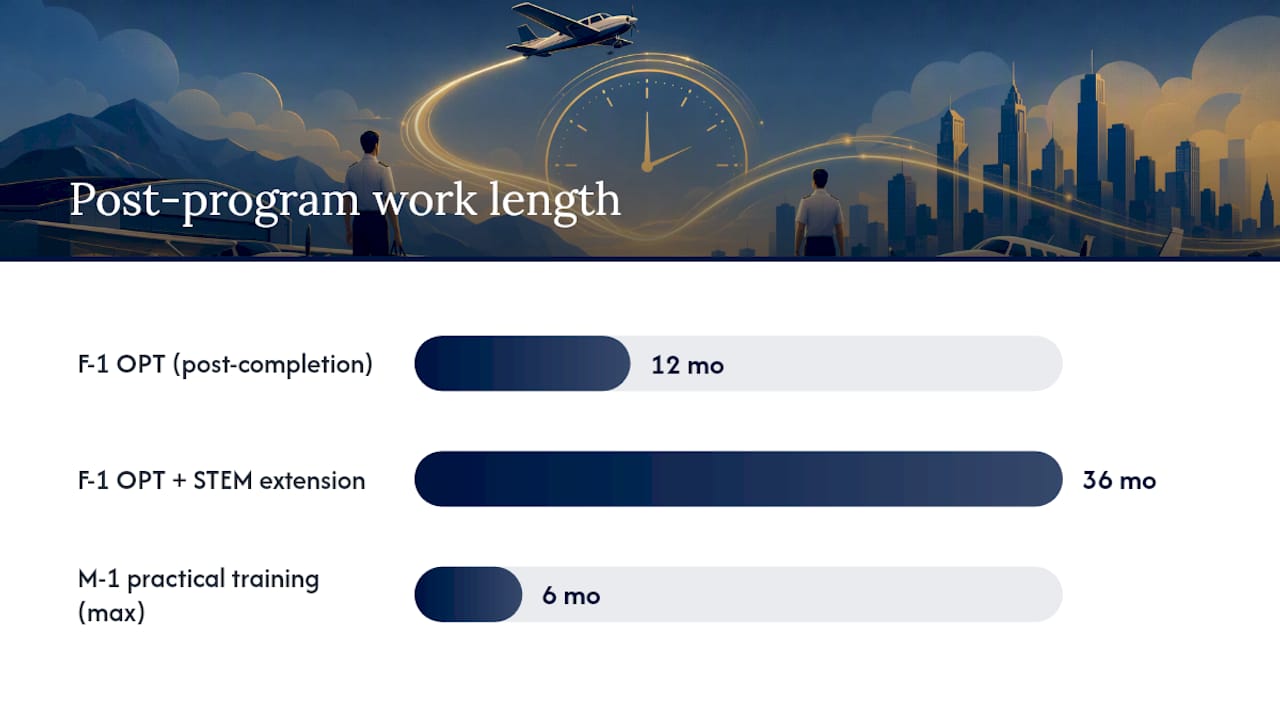
F-1 students have real, structured paths to employment. On-campus jobs are allowed from day one. CPT lets you work off-campus if it’s tied directly to your curriculum. OPT gives you up to 12 months of post-completion work, and STEM graduates can extend that by another 24 months. Those three tools are a major reason degree-seekers gravitate toward F-1: they build a bridge toward employer sponsorship that M-1 simply doesn’t offer.
M-1 students face the opposite situation. No work is permitted during the program, period. After completion, you get a narrow practical training window: one month of authorization for every four months of full-time study, capped at six months total. That window requires sign-off from both your DSO and USCIS before you touch a paycheck.
- Unauthorized employment on either visa can trigger immediate loss of status.
- Your DSO must report any work authorization changes into SEVIS before you start.
- M-1 practical training must relate directly to your field of study.
- Budget for the entire program length using savings or sponsor funds. Neither visa lets you count on work income to cover tuition or living costs.
Pro Tip: If a vocational program’s brochure mentions “on-the-job training,” ask specifically whether that time counts against your six-month M-1 practical training cap. Schools don’t always volunteer this detail, and students sometimes discover the limit only after they’ve already used most of it.
Documents You Need Before the Visa Interview
Getting from acceptance letter to visa stamp involves a specific sequence, and skipping a step usually means delays.
- Secure admission to an SEVP-certified school and receive your Form I-20.
- Pay the I-901 SEVIS fee online and keep the receipt.
- Complete Form DS-160 and schedule your consular interview.
- Gather your passport, I-20, SEVIS fee receipt, academic transcripts, and proof of funds.
- Prepare evidence of your intent to return home after completing the program.
That last point trips up more applicants than anything else on this list. Consular officers weigh nonimmigrant intent heavily, and property ownership, a job offer waiting at home, or close family ties often carry more weight in the interview than your grades ever will. Keep your documentation concise. Officers move through interviews quickly, and a thick folder of loosely organized paperwork rarely helps your case.
Switching Programs or Changing Your Visa Category
F-1 students can transfer schools with relative ease. Your new school updates your SEVIS record, your current school releases it, and you continue your program without leaving the country. Changing majors or degree levels within F-1 status works similarly.
M-1 offers none of that flexibility. Changing your educational objective while on M-1 typically means leaving the United States and applying for a new visa from abroad, including if you want to switch into F-1 status. There’s no in-country change-of-status option for shifting from a vocational track to an academic one.
If you suspect your plans might shift mid-program, talk to your DSO before you enroll, confirm whether your target school even accepts M-1 transfers, and build in the time and cost of leaving the country if a switch becomes necessary.
Dependents and What Happens After Your Program Ends
Both visas let you bring family along. F-1 dependents hold F-2 status; M-1 dependents hold M-2 status. Neither category permits employment, and M-2 dependents face tighter restrictions on enrolling in their own academic study compared to F-2 dependents, who can take recreational or avocational courses.
The bigger difference shows up after graduation. F-1 students get a 60-day grace period to wrap up affairs, travel, or transition to another status. M-1 students get just 30 days. In both cases, that window is your chance to depart, begin a different visa process, or, if eligible, transition to another category. Miss it, and you risk falling out of status entirely.
Choosing the Right Visa for Your Goals
Run through a short list of questions before you commit to either path. What credential do you actually need: a degree, or a specific vocational skill? Do you want to work in the U.S. after finishing, even briefly? How long will your program realistically take, including any likely delays? Are you the type of student who might change direction once you’re actually in the classroom?
Two quick scenarios illustrate how this plays out. A student aiming for a computer science degree, followed by OPT and eventually an H-1B sponsorship, belongs on F-1 without question. A student enrolling in a six-month vocational certificate with a clear plan to return home right after belongs on M-1, and trying to force that situation into F-1 usually backfires with the consular officer.
- Ask the school’s DSO directly whether they issue F-1 or M-1 I-20s for your specific program.
- Confirm your program’s total length against the M-1 one-year ceiling before enrolling.
- Ask whether any portion of your training counts as practical training time.
Pro Tip: Before enrolling anywhere, ask the admissions office point-blank which visa category they sponsor for your exact program, not just for the school in general. Some institutions run both F-1 degree tracks and M-1 vocational tracks under the same roof, and the answer changes your entire timeline.
What This Means for Flight and Vocational Training Specifically
Aviation training sits right at this fork in the road. Whether a flight program issues an F-1 or M-1 I-20 depends on whether it’s bundled into a degree or offered as a standalone vocational certificate, so confirm this with the school before you commit to anything.
Simulator Center LLC works with pilots pursuing type ratings and license conversions, using Level D full-motion simulators and instruction aligned with international aviation standards. For students weighing vocational flight paths, the practical question isn’t just F-1 versus M-1. It’s whether your training program’s visa sponsorship matches your actual career timeline, since M-1’s one-year ceiling and limited practical training window can cut short plans built around longer U.S. training sequences.
My Take on Picking Between These Two
If you’re choosing between a degree and a vocational credential, don’t overthink it: F-1 wins for almost anyone who wants work options or flexibility, and M-1 only makes sense for a tightly scoped, short-term skill with a clear return-home plan. Before you enroll anywhere, verify the school’s SEVP status, confirm which I-20 type they’ll issue, and line up your financial documentation early. When your situation is anything but straightforward, loop in your DSO or an immigration attorney rather than guessing. And whichever visa you hold, never work off the books. It’s the fastest way to lose status over something entirely avoidable.
— Jake
A Practical Path for Vocational Flight Training Candidates
If you’re weighing a vocational flight training route, Simulatorcentertraining gives you a way to build toward advanced certification without navigating that path alone. Compared to piecing together training across multiple providers, you get instruction from veteran airline captains, access to Level D full-motion simulators, and a curriculum built around international aviation standards, all under one roof.
Simulatorcentertraining’s programs cover various type ratings, including A320, B737, and A330, ATR 42/72 training, and FAA license conversion courses for pilots holding foreign credentials. Each of these maps to specific vocational training needs, whether you’re converting an existing license or building toward a new type rating from scratch. Before enrolling, confirm with your chosen program whether it issues an F-1 or M-1 I-20, since that detail determines your work authorization and total allowable stay.
If you’re ready to move forward, visit the admissions page to review enrollment requirements, or check out Boeing 737 type rating training to see how the coursework lines up with your visa timeline. For visa-specific enrollment questions, reach out to admissions directly, and pair that conversation with guidance from TrovaCampus’s enrollment documentation resources if you need a broader checklist for international student paperwork.