
LOFT Training for Professional Flight Crews: A Complete Guide
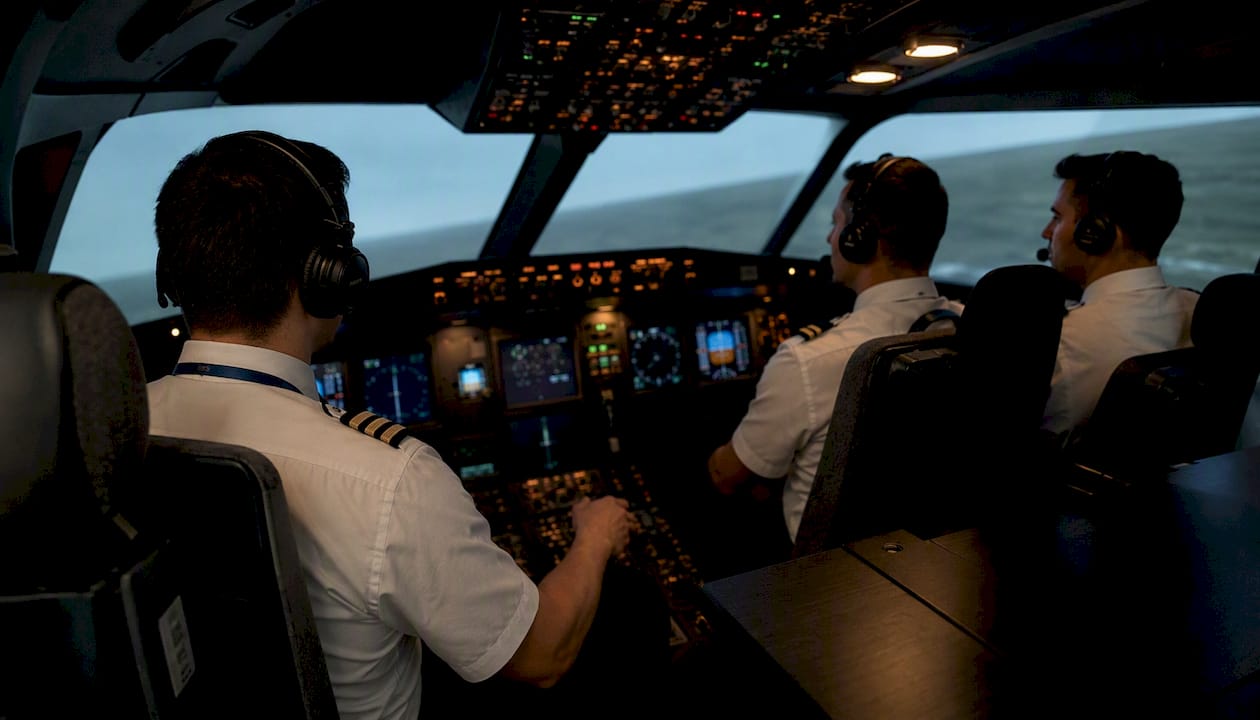
Line-oriented flight training (LOFT) is a simulator-based, non-punitive, full-crew scenario program designed to validate operational procedures and sharpen crew resource management under realistic line conditions. Rooted in NASA human-factors research and codified in U.S. aviation through FAA Advisory Circular 120-35C, LOFT is not a check ride. It is a structured learning event where the debrief matters as much as the flight itself. For crews and operators, the single most important thing to understand is this: arrive with a learning mindset, fly the scenario as you would fly the line, and treat the debrief as the real training.
Table of Contents
- What is LOFT and where did it come from?
- How does U.S. regulatory guidance govern LOFT programs?
- How should you design a LOFT scenario that actually works?
- Why is the LOFT debrief the most important part of the session?
- How does LOFT differ from a proficiency check or line check?
- How should crews prepare for a LOFT session?
- How do you measure whether your LOFT program is actually working?
- How Simulatorcentertraining runs LOFT and Level D programs
- Key Takeaways
- What most LOFT programs get wrong
- Train with Simulatorcentertraining’s Level D LOFT program
- Useful sources
What is LOFT and where did it come from?
LOFT emerged in the mid-1970s as a gate-to-gate simulator approach built around a straightforward insight: pilots were getting plenty of maneuver practice, but almost no practice managing the operational complexity of a real line flight. Abnormal checklists, ATC pressure, dispatch decisions, fatigue, and crew coordination all happen simultaneously on the line. None of them happened in a traditional simulator session. FAA AC 120-35C traces this gate-to-gate concept directly to the need for crews to practice CRM and technical integration in a realistic operational context, not in isolation.
NASA-industry research formalized the shift. The foundational work established LOFT as a training technology that synthesizes high-fidelity aircraft simulation with high-fidelity line-operations simulation, concentrating specifically on command, leadership, and resource management. That framing still holds today.
The core principles that define a properly run LOFT session:
- Non-punitive: Results cannot be used to grade, discipline, or evaluate individual crewmembers.
- Uninterrupted: AC 120-35C is explicit that repositioning the simulator or repeating problems undermines authenticity. Deficiencies get documented and addressed in remedial training, not mid-session.
- Representative line segments: Scenarios draw from real operational data, accident reports, and normal line conditions, not from artificial maneuver sequences.
- Full-crew participation: LOFT is a crew event. Individual performance is observed, but the session is designed to surface how the crew functions as a system.
- CRM integration: Human factors, communication, decision-making, and workload management are embedded in every scenario, not treated as add-ons.
SKYbrary’s LOFT summary puts it plainly: LOFT validates training programs and operational procedures, not individual crewmembers. That distinction shapes everything from how scenarios are written to how instructors facilitate the debrief.
How does U.S. regulatory guidance govern LOFT programs?
FAA AC 120-35C is the primary regulatory reference for any U.S. operator designing or scheduling line operational simulations. It defines four LOS event types: recurrent LOFT, qualification LOFT, SPOT (Special Purpose Operational Training), and LOE (Line Operational Evaluation). Each has a distinct purpose, and operators must understand which event type they are scheduling before they design a scenario.
The minimum session length is one of the most commonly misunderstood requirements. Recurrent and qualification LOFT must be scheduled for at least four hours of simulator or FTD crewmember training time. That four hours is not flight time alone. It includes cockpit preparation, preflight activities, crew briefings, interactions with dispatch and ground agencies, and reasonable time for problem-solving. Operators who treat the four-hour minimum as “four hours of flying” are miscounting.
AC 120-35C also ties LOFT to Advanced Qualification Program (AQP) and Appendix H frameworks, which means scenario objectives must be documented against specific CRM and technical competencies. That documentation is what makes LOFT credit auditable.
| Regulatory Item | Requirement / Guidance |
|---|---|
| Minimum session duration | At least 4 hours (includes prebrief, cockpit prep, flight, debrief) |
| Interruptions | Prohibited except in extreme circumstances; no repositioning or problem repeats |
| Approved equipment | Full flight simulator or FTD meeting applicable qualification level |
| Grading | Non-punitive; no individual pass/fail determination |
| Deficiency handling | Document and arrange remedial training after the session |
| AQP/Appendix H linkage | Scenario objectives must map to documented CRM and technical competencies |
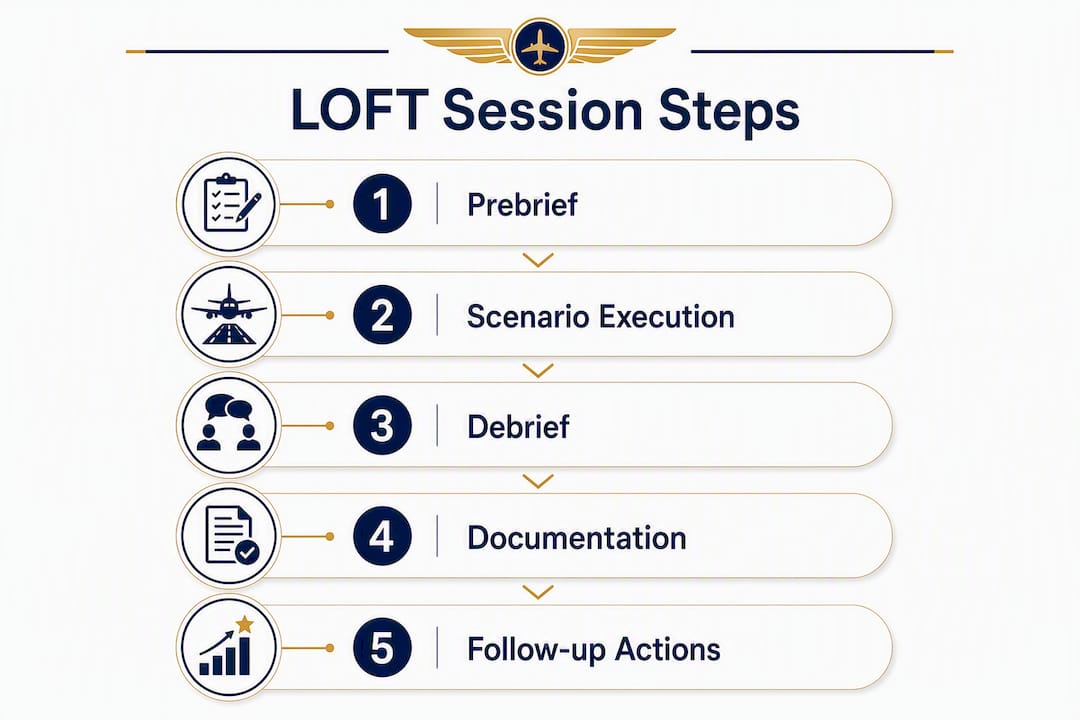
Pro Tip: Before each LOFT session, create a one-page scenario objective sheet that maps each planned inject to a specific AQP competency or CRM behavior indicator. This single document makes your program auditable and gives the debrief facilitator a structured reference point.
How should you design a LOFT scenario that actually works?
Scenario design is where most LOFT programs either succeed or quietly fail. The difference between a LOFT session that produces genuine learning and one that feels like a rehearsed check ride usually comes down to three things: scenario sourcing, inject sequencing, and the instructor’s discipline to stay out of the way.

Choosing the right scenario type
AC 120-35C defines three training-focused LOS types. Qualification LOFT is used during initial or upgrade training to validate that a crew can manage a representative line flight with the full range of normal, abnormal, and emergency procedures. Recurrent LOFT is the standard annual or semi-annual event for line crews, focused on maintaining CRM proficiency and surfacing any drift from standard operating procedures. SPOT is a targeted session addressing a specific operational issue, such as a new procedure, a fleet-wide safety concern, or a recently identified systemic gap.
Use qualification LOFT when a crew is transitioning to a new aircraft or seat. Use recurrent LOFT to keep line crews sharp and to validate that your training program is actually working. Use SPOT when your SMS or safety data identifies a specific issue that needs targeted attention before the next recurrent cycle.
Design principles that hold up in practice
SKYbrary notes that LOFT scenarios should be developed from realistic sources, including accident reports and operational data, specifically to surface systemic training or procedural gaps. That is not a suggestion. Scenarios built from generic “what-ifs” tend to produce generic crew responses. Scenarios built from real events produce the kind of recognition-primed decision-making that actually transfers to the line.
Key design principles:
- Representativeness: The route, weather, ATC environment, and dispatch interactions should mirror what crews actually encounter on the line.
- Unrehearsed anomalies: Crews must not know what is coming. Pre-briefing the abnormals defeats the purpose.
- Workload pacing: Stack injects to create realistic time pressure, but avoid artificial complexity that turns the session into a maneuver test.
- ATC and dispatch realism: Use realistic phraseology, realistic delays, and realistic ground interactions. A LOFT session with a silent ATC environment is not a line simulation.
Simulator fidelity
Level D full-flight simulators are the gold standard for LOFT. They provide the motion cueing, visual fidelity, and systems accuracy needed to make scenario injects feel operationally real. For transport-category aircraft, Level D is strongly preferred and often required under AQP. High-fidelity simulators also allow instructors to introduce realistic injects, including ATC conflicts, dispatch calls, and other traffic, without breaking scenario immersion.
A practical scenario checklist
Before any LOFT session begins, the scenario package should include:
- Route and weather briefing materials (realistic, not sanitized)
- Planned injects with expected crew actions documented (for debrief reference only, not crew review)
- Allowed time accelerations identified in advance (taxi, cruise segments)
- CRM and technical competency objectives mapped to each inject
- Debrief guide with facilitator prompts
Sample scenario sketches:
Normal plus abnormal: Departure from a busy hub with a realistic weather reroute, followed by a hydraulic system anomaly during cruise. The crew must coordinate with dispatch, manage workload, and execute the abnormal checklist while maintaining situational awareness on the rerouted arrival.
Emergency scenario: Engine failure on initial climb at a field with limited emergency services. The scenario tests crew communication, task sharing, and decision-making under time pressure, with an ATC environment that introduces realistic delays.
CRM-heavy scenario: A fatigued crew on a late-night arrival with a captain who is anchoring on an incorrect weather picture. The scenario is designed to surface how the first officer manages upward communication and how the crew resolves conflicting situational assessments.
The instructor’s role throughout is facilitator, not interrupter. Pacing the scenario means knowing when to let the crew work through a problem and when a time acceleration is appropriate. It does not mean stepping in to correct errors mid-flight.
Why is the LOFT debrief the most important part of the session?
NASA’s foundational research is unambiguous on this point: LOFT’s effectiveness depends heavily on facilitative debriefing that encourages open communication and crew self-reflection. Without a skilled debrief, the simulator session is just an expensive flight. The debrief is where mistakes become durable learning.
A practical debrief structure that works:
- Crew self-debrief first. Before the instructor says anything, ask the crew to walk through the session themselves. What went well? Where did they feel the workload spike? What would they do differently? This step is not optional. It surfaces the crew’s own mental model and reveals gaps the instructor might not have noticed.
- Instructor facilitation. The instructor’s job is to ask questions, not deliver verdicts. “What were you thinking when the hydraulic light came on?” produces more learning than “You were slow on that checklist.”
- Evidence review. Use voice recordings, video replay, or data traces where available. Concrete evidence removes defensiveness and grounds the conversation in what actually happened.
- Behavioral and technical analysis. Separate CRM behaviors from technical execution. A crew can fly a perfect checklist and still have a communication breakdown worth addressing, and vice versa.
- Action items. Every debrief should end with documented action items: what the crew will do differently, what the training department should review, and whether any systemic issues need escalation to SMS.
Key facilitator prompts that open reflection rather than close it:
- “Walk me through your decision at that point.”
- “What information were you working with when you made that call?”
- “How did the workload feel during that segment?”
- “What would you want the other crew position to know about that moment?”
The most common debrief failure is the instructor who treats LOFT like a check ride debrief, delivering a list of errors with grades attached. SKYbrary’s guidance is direct: LOFT must not be used to check individual performance. When crews sense they are being evaluated, they stop being honest, and the learning stops with it.
Pro Tip: Record a short audio note immediately after each scenario segment, before the formal debrief begins. Note two or three specific crew behaviors, with timestamps if possible. This keeps the debrief grounded in evidence rather than impressions, and it gives you a paper trail for any remedial training referrals.
A concrete example of a debrief discovery that changed practice: a recurrent LOFT session revealed that three separate crews on the same fleet were using an informal callout sequence that differed from the published SOP during approach. None of the crews had flagged it. The debrief surfaced it because the facilitator asked open questions rather than checking boxes. The result was a targeted SPOT session and an SOP clarification that addressed the drift before it became an incident.
How does LOFT differ from a proficiency check or line check?
The confusion between LOFT and evaluative events costs crews and operators real learning value. When a crew walks into a LOFT session expecting a check ride, they perform for the instructor instead of flying the line. The session becomes a rehearsal, and the non-punitive environment that makes LOFT work disappears.
| Dimension | LOFT | LOE | Proficiency Check / Line Check |
|---|---|---|---|
| Primary purpose | Training and CRM development | Evaluative, validates AQP competencies | Individual performance evaluation |
| Grading | Non-punitive, no pass/fail | Competency-based scoring | Pass/fail or proficiency rating |
| Interruptions | Prohibited except extreme circumstances | Limited, per AQP design | Permitted for safety or evaluation |
| Scenario source | Representative line operations | Representative line operations | Maneuver-based or line-based |
| Crew focus | Full crew as a system | Full crew, individual competencies scored | Individual crewmember |
| Typical duration | Minimum 4 hours including debrief | Minimum 4 hours including debrief | Varies by regulatory requirement |
| Deficiency handling | Document, remedial training after | May trigger additional evaluation | Immediate retraining or check failure |
The practical rule: if the outcome of the session can affect a pilot’s certificate, qualification, or employment status, it is not LOFT. LOFT is strictly a training tool. Use LOE when you need to validate AQP competencies against a documented standard. Use a proficiency check when regulatory currency requires individual evaluation. Use LOFT when you want to improve how your crew functions as a system.
How should crews prepare for a LOFT session?
The single biggest mistake crews make is preparing for LOFT the way they prepare for a check ride. They review maneuver profiles, rehearse callouts, and arrive hoping not to make mistakes. That mindset produces exactly the wrong behavior in the simulator.
LOFT is designed to surface how you actually fly, not how you perform under observation. The preparation that matters is operational, not theatrical.
Mindset first:
- Accept that anomalies will happen and that your job is to manage them, not prevent them.
- Treat every decision as a learning opportunity, not a test item.
- Remember that the debrief is where the value lives. Arrive ready to reflect honestly.
Prebrief checklist:
- Review the route and weather for the planned scenario (if provided in advance).
- Confirm role assignments and CRM objectives with your crew before entering the simulator.
- Review relevant abnormal and emergency procedures, not to rehearse them, but to refresh your mental model.
- Discuss crew communication norms: how you will call out concerns, how you will manage task sharing under pressure.
- If your operator uses dispatch simulation, review how you typically interact with dispatch on the line.
In-session behaviors that improve learning:
- Verbalize your decisions as you make them. “I’m prioritizing the checklist over the ATC call because…” gives the debrief facilitator something concrete to work with.
- Use standard callouts consistently, even when the scenario feels chaotic.
- If you notice a crew coordination issue mid-flight, note it mentally for the debrief rather than trying to resolve it in a way that breaks the scenario flow.
- Avoid asking the instructor to repeat or reposition. AC 120-35C is clear that repositioning undermines authenticity.
Common mistakes to avoid:
- Requesting a rehearsal of the abnormal before the session begins.
- Giving defensive answers in the debrief (“I knew what I was doing, but…”).
- Treating the instructor’s silence as approval rather than as facilitation.
- Underestimating the CRM injects because they feel “soft” compared to technical failures.
Pro Tip: Before the session, agree with your crew on one specific CRM behavior you both want to practice, whether that’s upward communication, task sharing during high workload, or cross-checking decisions. Having a shared learning goal makes the debrief far more productive.
How do you measure whether your LOFT program is actually working?
A LOFT program that produces no measurable output is a scheduling exercise, not a training program. Operators who treat LOFT as a compliance checkbox miss its most valuable function: surfacing systemic gaps before they become incidents.
Outcome metrics worth tracking
- CRM behavior indicators: Frequency and quality of crew cross-checks, communication clarity during high-workload segments, and upward communication events.
- Procedure adherence rates: How often crews deviate from SOPs during scenario injects, and whether those deviations are consistent across multiple crews.
- Decision timelines: How long crews take to recognize and respond to abnormal situations. Consistent delays across crews point to training gaps, not individual performance issues.
- Corrective training events triggered: How many LOFT sessions result in a referral for remedial training or a SPOT session. A program producing zero referrals is either running scenarios that are too easy or not documenting deficiencies honestly.
Observation and documentation
| Metric | What to Track | Why It Matters |
|---|---|---|
| Session duration | Actual vs. planned (minimum 4 hours) | Regulatory compliance |
| Scenario injects completed | Number planned vs. executed | Scenario integrity |
| CRM behavior observations | Documented per debrief | Trend analysis across crews |
| Documented action items | Per session, per crew | Auditable remedial training path |
| Remedial training referrals | Number and type | Program effectiveness indicator |
| SMS escalations | Issues flagged to safety management | Systemic gap identification |
Linking LOFT to SMS
AC 120-35C frames LOS as an integration point between human factors, CRM, and technical operations. That framing has a direct implication for safety management: LOFT findings should feed your SMS risk register, not sit in a training folder. When multiple crews show the same procedural drift in LOFT scenarios, that is a systemic signal. It should trigger an SMS review, a targeted SPOT session, and potentially an SOP revision.
The most operationally useful LOFT programs map scenario objectives directly to SMS risk categories and produce auditable action items that feed remedial training and SOP updates. That loop, from scenario design to debrief to SMS to corrective action, is what separates a program that improves safety from one that simply meets a regulatory requirement.
Pro Tip: Assign each debrief action item a unique tracking number and link it to the relevant SMS risk category before the crew leaves the simulator. This takes two minutes and makes your program auditable in any FAA review.
How Simulatorcentertraining runs LOFT and Level D programs
Simulatorcentertraining operates Level D full-motion simulators for the A320, B737, A330, ATR 42/72, and Boeing 757/767, covering the aircraft types most commonly involved in U.S. commercial and regional operations. Sessions are available for recurrent LOFT, qualification LOFT, SPOT, and LOE preparation, as well as type rating support and FAA license conversion assistance.
Instruction is delivered by veteran airline captains with direct line experience on the aircraft types they teach. That matters for LOFT specifically because scenario realism depends on instructors who know what a real line flight looks like, including the ATC environment, dispatch pressures, and the operational decisions crews actually face. The instructor team designs scenarios aligned with AC 120-35C requirements, mapping each inject to documented CRM and technical competency objectives.
Scheduling is flexible, with near-year-round availability and concierge-level logistical support for pilots traveling from outside the local area. For international pilots seeking FAA alignment, Simulatorcentertraining also provides FAA license conversion services, which can be combined with LOFT or type rating sessions to build a complete qualification pathway.
Debrief documentation follows the auditable format AC 120-35C recommends: session objectives, observed behaviors, action items, and remedial training referrals where applicable. Operators can use this documentation directly in their SMS reporting cycles.
Key Takeaways
LOFT training is a non-punitive, crew-focused simulator program that validates procedures and CRM through realistic line scenarios, and its value is almost entirely determined by the quality of the debrief that follows.
| Point | Details |
|---|---|
| LOFT is training, not evaluation | Sessions are non-punitive; results cannot be used for individual grading or disciplinary action. |
| Minimum session duration | Recurrent and qualification LOFT sessions must be scheduled for at least four hours, including prebrief, flight, and debrief. |
| Debrief drives the learning | NASA research confirms that facilitative debriefing is the mechanism that converts simulator experience into durable crew improvement. |
| SMS integration is the multiplier | Linking LOFT findings to your SMS risk register turns individual session data into systemic safety improvements. |
| Simulatorcentertraining offers Level D LOFT | Veteran airline captains and Level D simulators across A320, B737, A330, ATR 42/72, and B757/767 fleets, aligned with AC 120-35C. |
What most LOFT programs get wrong
The conventional wisdom says LOFT works because it puts crews in realistic scenarios. That is true, but it is the smaller half of the story. The larger half is that LOFT works when the debrief is treated as a structured learning conversation, not a performance review.
Most programs underinvest in debrief facilitation. Instructors who are excellent pilots often default to telling crews what they did wrong, which is exactly the wrong approach. The moment a crew feels evaluated, the non-punitive environment collapses. They stop being honest about their decision-making, and the debrief becomes a defense exercise rather than a learning one.
There is also a structural problem worth naming: operators who schedule LOFT to meet a regulatory minimum, without mapping scenario objectives to SMS data or CRM competency frameworks, are producing paperwork, not safety. The four-hour minimum is a floor, not a target. A well-designed LOFT program uses scenario data to identify drift, surface systemic gaps, and feed corrective action cycles. That requires intentional design before the session and disciplined documentation after it.
The crews who get the most from LOFT are the ones who arrive genuinely curious about their own performance, not the ones who arrive hoping to look good. That mindset shift is something instructors can actively encourage, starting with how they frame the prebrief.
Train with Simulatorcentertraining’s Level D LOFT program
Simulatorcentertraining gives professional crews something most recurrent programs cannot: Level D simulator fidelity on the specific aircraft you fly, with instructors who have logged real line hours on those same types. That combination produces LOFT scenarios that feel operationally authentic, not like textbook exercises.

Sessions cover recurrent LOFT, qualification LOFT, SPOT, and LOE preparation across the A320, B737, A330, ATR 42/72, and B757/767. Scheduling is flexible, with concierge support for pilots coordinating travel and logistics. Every session is documented to AC 120-35C standards, with debrief action items formatted for direct use in operator SMS reporting.
To review instructor credentials, course structures, and available simulator types, visit the instructor and resources page. To start the enrollment process or book a simulator block, go directly to admissions.
Useful sources
The following primary and practitioner references were used to build this article. Each is worth bookmarking if you are designing or auditing a LOFT program.
- FAA Advisory Circular 120-35C: The primary U.S. regulatory reference for LOS design and implementation. Covers LOFT, SPOT, LOE, session minimums, interruption rules, and AQP integration. This is the document your training department should have open when designing any LOS program.
- NASA NTRS: Guidelines for Line-Oriented Flight Training: The foundational human-factors research that established LOFT as a CRM-focused training technology. Essential reading for anyone designing debrief facilitation frameworks or making the case for LOFT investment.
- SKYbrary: Line-Oriented Flight Training: A practitioner-level summary of LOFT principles, non-punitive intent, and scenario design guidance. Useful as a quick reference and for training department orientation materials.
- Simulatorcentertraining simulator training overview: Details on Level D simulator availability, aircraft types, and session structures for U.S.-based crews seeking LOFT and recurrent training options.