
First Time Pilots: Two Week Plan to Pass First Airline Type Rating
A type rating certifies you to fly one specific aircraft, and getting your first one is the single biggest technical hurdle between a fresh license and an airline seat. The one move that separates candidates who pass on schedule from those who don’t: know the aircraft’s flows, callouts, and QRH cold before you ever touch a simulator. Budget several weeks and, without employer sponsorship, a significant training cost.
TL;DR:
- A first airline type rating typically takes six to nine weeks, requiring extensive simulator training and a final skills test, with costs often in the mid- to high five figures if self-funded.
- The training emphasizes mastering aircraft systems, procedural flows, and crew resource management through repeated simulator scenarios and real aircraft practice.
- Eligibility prerequisites generally include a commercial or airline transport license, current medical, instrument rating, MCC or equivalent experience, and ICAO English Level 4 proficiency.
- The most common first-rated aircraft are the Airbus A320 family and Boeing 737, with type availability dictated mainly by job offers rather than personal choice.
- Preparation weeks in advance, including reviewing the QRH, memorizing flows, and practicing callouts, significantly improve performance and reduce stress during the course.
Table of Contents
- What Does a First Airline Type Rating Actually Cover?
- What Are the Prerequisites for a First Airline Type Rating?
- How Long Does a First Type Rating Take, and What Does It Cost?
- What Happens in the Simulator and Base Training Phases?
- How Should You Prepare in the Weeks Before Training?
- What Are the Most Common Mistakes on a First Type Rating Course?
- Which Aircraft Do First-Time Candidates Usually Get Rated On?
- How Do Type Rating Requirements Differ by Regulator?
- How Much Does a First Type Rating Change Your Career Trajectory?
- What Is Airline-Specific Differences Training After a Type Rating?
- How Do You Choose the Right First Type Rating for Your Career?
- Why Simulator Center’s Model Fits First-Time Type Rating Students
- Ready to Start Your First Type Rating? Here’s Where to Begin
- Where to Verify Official Requirements
- Sources
- FAQ
What Does a First Airline Type Rating Actually Cover?
A type rating course runs through three distinct phases, and each one tests something different. Ground school comes first, usually one to two weeks, covering aircraft systems, limitations, and normal/abnormal procedures. You’re not expected to memorize the airplane. You’re expected to understand why the systems behave the way they do, because that understanding is what lets you diagnose a failure at 3 a.m. over the ocean instead of freezing.
Simulator training follows, typically in a Level D full-motion device, and this is where flows and procedures get drilled into muscle memory. FAA Advisory Circular AC 61-89 lays out the generic curriculum structure most training providers follow, aligning sim sessions with specific practical test standards rather than open-ended practice.
Base or line training comes last for pilots without prior jet time, putting you in the actual aircraft (or an equivalent supervised environment) for takeoffs, landings, and circuits under an examiner’s eye.
Each phase builds toward the same three learning goals:
- Systems knowledge deep enough to troubleshoot, not just recite
- Procedural flows that become automatic under time pressure
- Crew resource management (CRM) that holds up when the abnormal drill gets thrown at you unannounced
The skills test itself, or checkride, evaluates all of this together. Examiners aren’t just watching whether you land the airplane. They’re watching how you brief, how you divide tasks with your first officer or captain, and whether your callouts match the aircraft’s standard operating procedures under a simulated engine failure or system malfunction.
What Are the Prerequisites for a First Airline Type Rating?
Paperwork problems disqualify more candidates late in the process than actual flying skill does, so sort this before you enroll, not during ground school.
At minimum, you’ll need:
- A Commercial Pilot License (CPL), Airline Transport Pilot License (ATPL), or Multi-crew Pilot License (MPL)
- A current Class 1 medical certificate
- A valid instrument rating
- Multi-Crew Cooperation (MCC) training or equivalent multi-crew experience, required for most first multi-pilot type ratings
- ICAO English Level 4 proficiency or higher, generally mandatory for international operations
The specific thresholds shift depending on which regulator governs your license. EASA requires at least 70 hours of pilot-in-command time in airplanes plus a multi-engine instrument rating before you can start a first multi-pilot type rating course. That 70-hour figure catches pilots off guard more than almost any other requirement, because it’s easy to assume total flight time counts rather than PIC time specifically.
Pro Tip: Pull your logbook totals and separate PIC hours from dual and observer time at least a month before applying. Discovering a shortfall the week before ground school starts is a scheduling nightmare.
Under U.S. rules, 14 CFR §61.31 specifies that large aircraft and turbojet-powered airplanes legally require a type rating before you can act as pilot in command, which is the regulatory hook that makes this whole process mandatory rather than optional for airline work.
How Long Does a First Type Rating Take, and What Does It Cost?
Most first type rating courses run somewhere between six and nine weeks from the first day of ground school to the checkride, though that window compresses or stretches depending on how the training provider schedules simulator slots and how many re-sits a candidate needs along the way.
A realistic timeline breaks down roughly like this:
- Ground school: one to two weeks of systems and procedures classroom work
- Simulator training: three to five weeks, typically split across a dozen or more sessions
- Base or line training: one to two weeks, aircraft-dependent
- Skills test: a single evaluation session near the end
Cost is where things get genuinely variable. Self-funded first type ratings commonly land in the low-to-mid five figures, and that figure moves based on a handful of factors:
- Aircraft type (widebody ratings generally cost more than narrowbody)
- Number of simulator hours included versus purchased separately
- Examiner fees, which vary by country and provider
- Accommodation if the training center isn’t near home
- Extra sim sessions if you need remedial practice before the checkride
Employer-sponsored pathways change this math entirely. Many regional and mainline carriers cover tuition for cadets and new hires, which is why a growing share of first-time candidates never see a training invoice directly. If you’re self-funding, a detailed breakdown like the one in this B737 type rating cost guide is worth reading before you commit to a provider, since sim-hour add-ons and re-sit fees are where budgets quietly balloon.
What Happens in the Simulator and Base Training Phases?
Simulator days follow a rhythm that repeats itself enough times that it becomes second nature by week three: a pre-brief covering the day’s scenarios, two to four hours in the box running maneuvers and abnormal drills, then a debrief where the instructor walks through what worked and what didn’t.
- Pre-brief sets expectations for the session, including which failures or scenarios you’ll face
- Simulator run puts you through normal procedures first, then layers in abnormal or emergency scenarios
- Debrief captures specific feedback, often tied to a scoring rubric covering procedures, automation management, and CRM
Examiners and instructors watch for a few things consistently: how you manage the flight management computer under pressure, whether your flows survive a surprise failure, and whether you’re talking to your crew member or just flying in silence. A common early mistake is over-relying on automation to compensate for shaky manual flying, which examiners flag quickly because it signals you don’t understand what the automation is doing underneath.
Pro Tip: Write down every debrief comment the same day, word for word if possible. Patterns show up after three or four sessions that aren’t obvious after just one, and spotting them early gives you time to fix a habit before it becomes a checkride problem.
Base training, where required, strips away the simulator’s forgiveness. Real aircraft, real weather, real consequences for a rushed checklist. It’s shorter than the sim phase but tends to be where confidence either solidifies or cracks.
How Should You Prepare in the Weeks Before Training?
Preparation that starts two weeks out, rather than two days out, is what separates candidates who arrive calm from candidates who arrive overwhelmed by information they should have absorbed already.
Two weeks before ground school:
- Read through the Quick Reference Handbook (QRH) cover to cover at least once, noting sections you don’t understand rather than skimming past them
- Memorize the aircraft’s normal flows (before-start, after-start, taxi, before-takeoff) so they’re automatic, not something you’re reconstructing mid-checklist
- Practice basic performance computations (takeoff and landing distance, weight and balance) by hand, since automation failures during training scenarios often force you back to manual math
- Set a daily target, even something as modest as 30 minutes of flow rehearsal, and hold to it
48 hours before the checkride:
- Do a final pass through your weakest procedures only, not a full review of everything
- Rehearse callouts out loud, even sitting at your kitchen table, since verbalizing a flow is different from just thinking it
- Get a full night’s sleep both nights, not just the one immediately before
Active recall beats passive reading for this material. Quiz yourself on system limitations rather than rereading the manual, and pair up with another candidate to run flows against each other if your course allows it. A structured simulator training program that builds debrief habits into every session tends to produce sharper instincts than solo study alone, because feedback catches errors you don’t know you’re making.
Pro Tip: Simulate callouts at home using a printed checklist and a kitchen timer. The goal isn’t memorization, it’s building the rhythm of speaking under time pressure, which is exactly what breaks down first when the sim throws a surprise at you.
What Are the Most Common Mistakes on a First Type Rating Course?
Procedural lapses cause more failed checkrides than raw flying skill ever does. A missed callout, a skipped checklist item, a flow interrupted and never finished properly, these small gaps compound fast under evaluation pressure.
Instructors flag a few patterns as red flags for remedial training:
- Over-reliance on automation instead of understanding what the automation is doing
- Weak CRM, particularly one pilot dominating the flight deck instead of working as a crew
- Inconsistent flows that change slightly session to session instead of stabilizing
- Poor time management during briefings, leaving no buffer before a scenario starts
Before checkride day, run through a short readiness list: documents current and in hand, weakest procedures reviewed one final time, a full night’s sleep, and a short warm-up sim session if your provider offers one. If you don’t pass on the first attempt, most training providers schedule a remedial block focused specifically on the failed items rather than repeating the entire course, so a setback here isn’t the career derailment it can feel like in the moment.
Which Aircraft Do First-Time Candidates Usually Get Rated On?
The aircraft you get rated on first usually comes down to which airline hired you, not personal preference, but a few types dominate first-officer hiring across the industry.
The Airbus A320 family is probably the most common first type rating globally, thanks to how widely low-cost and regional carriers operate the CEO and NEO variants. The Boeing 737, in its various generations including the 737 Classic, runs a close second and dominates hiring at many U.S. and international carriers. Both airframes share a philosophy of extensive automation paired with hand-flying skill, which is exactly why examiners probe automation dependency so heavily during checkrides.
Regional operators frequently start pilots on the ATR 42/72 turboprop family, a common entry point for pilots building hours before a jump to jets, or on smaller regional jets depending on the carrier’s fleet. Widebody type ratings like the Airbus A330 or Boeing 757/767 are less common as a true first rating, since most airlines prefer pilots build narrowbody experience first, though direct-entry captain hires sometimes skip straight to widebody depending on the carrier’s staffing needs.
The practical takeaway: your first type rating is rarely a free choice. It’s dictated by the job offer in front of you, which is exactly why flexibility and readiness matter more than fixating on one specific airframe.
How Do Type Rating Requirements Differ by Regulator?
The core structure of ground school, simulator training, and a skills test stays consistent worldwide because most authorities build their rules around ICAO Annex 1 standards. The details underneath differ enough to matter.
The FAA ties the requirement directly to aircraft category under 14 CFR §61.31, mandating a type rating for large aircraft and turbojet-powered airplanes, and leans on Advisory Circular 61-89 for curriculum guidance that training providers follow closely.
EASA takes a more prescriptive approach on prerequisites, specifying the 70-hour PIC minimum and MCC completion for first multi-pilot ratings under Part-FCL, with less flexibility for training providers to substitute equivalent experience.
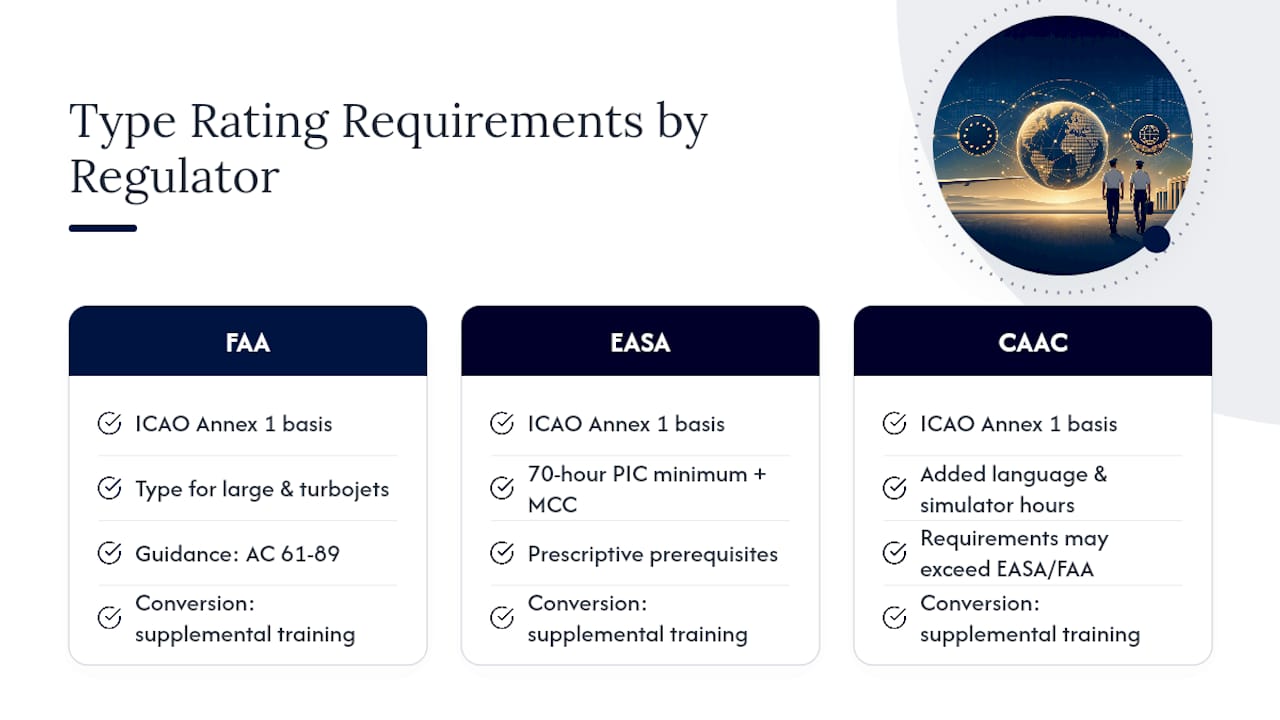
China’s CAAC generally mirrors ICAO frameworks but layers on additional domestic requirements around language proficiency and simulator hour minimums that can exceed what EASA or the FAA require, particularly for foreign-licensed pilots converting into the Chinese system.
For pilots holding a license from one authority who need to operate under another, conversion programs exist specifically to bridge these gaps rather than requiring a full restart. A pilot converting an EASA license to FAA standards or moving from ICAO credentials to an FAA ATP typically needs targeted supplemental training rather than repeating an entire type rating course from scratch.
How Much Does a First Type Rating Change Your Career Trajectory?
A type rating is the credential that turns a licensed pilot into a hirable one for a specific fleet, and the career impact shows up almost immediately in the hiring process itself.
Airlines screening candidates for first-officer slots consistently prioritize applicants who already hold a type rating on their fleet, because it shortens the airline’s own training pipeline and reduces onboarding cost. A pilot who arrives type-rated on the aircraft they’ll fly skips straight to the airline’s differences training instead of a full initial course, which matters enormously to an airline’s scheduling and cost structure.
Beyond the immediate hiring bump, the first type rating also sets a trajectory. Pilots who type-rate on a widely operated aircraft like the A320 or 737 keep more doors open for lateral moves between carriers later, since so many airlines operate those families. A first rating on a less common type can still open doors, but the pool of airlines flying that exact aircraft is smaller by definition.
There’s also a confidence dimension that’s easy to underrate. Passing your first type rating checkride proves, to yourself as much as to any hiring manager, that you can absorb an entirely new aircraft’s systems and procedures under real evaluation pressure. That’s a skill you’ll use again every time you upgrade to a new fleet later in your career.
What Is Airline-Specific Differences Training After a Type Rating?
Your type rating certifies you on the aircraft. It doesn’t certify you on how a specific airline operates that aircraft, and that gap gets closed through differences training once you’re hired.
Differences training typically runs a few days to a couple of weeks, far shorter than the original type rating course, and covers the airline’s specific standard operating procedures, its particular checklist phrasing, its dispatch and fuel policies, and any avionics or cockpit configuration quirks unique to that carrier’s fleet. Two airlines flying the same A320 variant can still run meaningfully different callout sequences or automation philosophies, and differences training is where you absorb that.
This phase usually blends classroom or computer-based instruction with a handful of simulator sessions, then wraps with a line check once you’re flying actual passenger sectors under supervision. It’s generally treated as a lower-stakes evaluation than the original type rating checkride, since you’ve already proven you can fly the aircraft. The focus shifts to operational fluency within that specific airline’s culture and procedures.
How Do You Choose the Right First Type Rating for Your Career?
The honest answer is that most pilots don’t choose their first type rating in isolation, they choose the job offer, and the aircraft comes attached to it. But when you do have a choice, hiring trends should drive the decision more than personal preference for one airframe over another.
Narrowbody ratings on the A320 or 737 families generally offer the broadest career flexibility, since the sheer number of airlines operating those fleets keeps future job options open. If you’re weighing multiple offers and one puts you on a widely operated type, that’s usually the stronger long-term play even if the other offer looks marginally better on paper today.
Regional turboprop ratings like the ATR 42/72 remain a practical stepping stone for pilots building hours toward a mainline jet position, and shouldn’t be viewed as a lesser path. Many mainline captains flying widebodies today started exactly there.
If you’re already holding a foreign license and eyeing a specific market, factor conversion timelines into your planning early. A pilot converting a DGCA license to FAA standards needs to sequence that conversion alongside type rating training, and doing both simultaneously rather than sequentially can shave meaningful time off your path to a cockpit seat.
Why Simulator Center’s Model Fits First-Time Type Rating Students
Most of the failure points covered above, weak flows, shaky CRM, over-reliance on automation, trace back to training that didn’t build enough repetition under realistic pressure. That’s the gap Level D full-motion simulators exist to close, and it’s the foundation of how Simulatorcentertraining structures its programs.
Instruction comes from current and former airline captains and examiners, not generic instructors reading a script, which matters most in the debrief, where the difference between a good session and a wasted one is whether the feedback is specific enough to act on. Programs are built to align with international aviation authority standards, so training translates across regulatory systems rather than boxing candidates into one narrow pathway.
Students often describe the structured curriculum as the reason they felt ready on day one at their airline, not just technically qualified but operationally comfortable. That kind of readiness is the actual goal of a first type rating, beyond just passing the checkride.
— Jake
Ready to Start Your First Type Rating? Here’s Where to Begin
If you’re weighing your first type rating right now, the choice usually comes down to which aircraft your job offer, or your job target, points toward. Simulatorcentertraining runs A320, B737, and A330 type rating programs on Level D full-motion simulators, plus the ATP-CTP course many U.S.-bound pilots need before their airline transport pilot certificate. Newly hired first officers on a 737 fleet typically start with the type rating track; pilots without a jet background often pair type rating training with ATP-CTP first.
Before you apply, gather your current license, medical certificate, logbook totals (PIC hours specifically, not just total time), and MCC completion record if you have one. Admissions teams typically handle scheduling and documentation logistics to streamline the enrollment process for pilot training programs. Start by reviewing the full type rating program lineup to match your target aircraft, then reach out through the admissions page to lock in a start date and confirm which documents your specific rating requires.
Where to Verify Official Requirements
For the exact regulatory language behind anything covered here, go straight to the primary sources. The FAA’s Advisory Circular 61-89 lays out curriculum expectations for U.S. type rating courses, while 14 CFR §61.31 defines exactly which aircraft legally require one. EASA pilots should reference the Part-FCL easy access rules for prerequisite hours and MCC requirements. For broader context on how ICAO frames type ratings internationally, the Wikipedia overview is a reasonable starting point before digging into your own authority’s rulebook.
Sources
- AC 61-89e — Pilot Certificates: Aircraft Type Ratings (FAA)
- EASA easy access rules — Aircrew (Part-FCL)
- 14 CFR § 61.31 - Type rating requirements (e-CFR / Cornell LII)
- What Is a Type Rating and When Do You Need One? - Aviation News
FAQ
What Is a Female Pilot Called?
A female pilot is simply called a pilot. Aviation licensing, type ratings, and job titles carry no gender-specific terminology under FAA, EASA, or ICAO frameworks.
What Is the Hardest Part of a First Airline Type Rating?
Most pilots find the simulator phase hardest, specifically maintaining consistent procedural flows while managing an abnormal scenario and crew communication simultaneously. Ground school is information-heavy but rarely the failure point; it’s applying that information under time pressure that trips people up.
What Pilots Make $500,000 a Year?
Senior widebody captains at major international carriers, particularly those flying long-haul routes with significant seniority, can reach compensation in that range at some carriers, though this sits at the very top of the pay scale and isn’t typical even for experienced captains. It reflects decades of seniority progression, not entry-level first-officer pay following a first type rating.
Why Do Pilots Say “Pan Pan”?
Pilots use “pan pan,” repeated three times, to declare an urgency situation that isn’t yet a life-threatening emergency, distinguishing it from “mayday,” which signals immediate grave danger. It’s part of standardized radio phraseology taught during type rating and CRM training so air traffic control immediately understands the severity level.
How Much Does a First Type Rating Cost?
Self-funded first type ratings commonly run in the low-to-mid five figures, varying by aircraft type, sim hours included, and examiner fees, as detailed in industry cost breakdowns. Simulatorcentertraining’s specific program pricing is available directly through its type rating page, since costs vary by aircraft and course structure.