
14 CFR Recurrent Training for Pilots: Simulator Credit & Checklist
The FAA requires flight crewmembers under Part 121 and Part 135 to complete recurrent ground and flight training within the preceding 12 calendar months to remain qualified. Pilots in command flying under Part 121 face a tighter clock: an additional recurrent flight training event every 6 calendar months. Recurrent training must also cover extended envelope maneuvers, and when those tasks require a full flight simulator, the device has to be qualified for that specific exercise, not just qualified in general.
TL;DR:
- Pilots must complete recurrent ground training within 12 months and an additional flight training event within 6 months if in command under Part 121.
- Recurrent ground hours range from 15 for reciprocating, 19 for turboprops, to 24 for jets, with possible reductions if approved by the FAA.
- Simulator fidelity for extended envelope maneuvers must meet specific qualification standards; not all Level D simulators qualify for every task.
- Part 135 operators have more discretion in tailoring recurrent training hours and content, but still require documented knowledge reviews.
- Always verify the simulator’s qualification for mandated maneuvers and keep personal training records to avoid compliance lapses.
Table of Contents
- What Are the FAA Recurrent Training Requirements Under 14 CFR?
- How Many Hours Does Recurrent Training Actually Require?
- Why Does Simulator Fidelity Matter for Recurrent Credit?
- Part 121 vs. Part 135: Who Decides What “Adequate” Means?
- Recurrent Training Compliance Checklist for Pilots and Training Managers
- How a Level D Simulator Program Maps to These Rules
- Ready for Recurrent Training or an FAA Conversion? Here’s Where to Start
- Sources
- FAQ
What Are the FAA Recurrent Training Requirements Under 14 CFR?
The core rule lives in 14 CFR § 121.433, and it sets the clock every airline pilot flies against. Flight crewmembers must complete recurrent ground and flight training within the preceding 12 calendar months. Miss that window and you’re not current, regardless of how recently you flew a line trip.
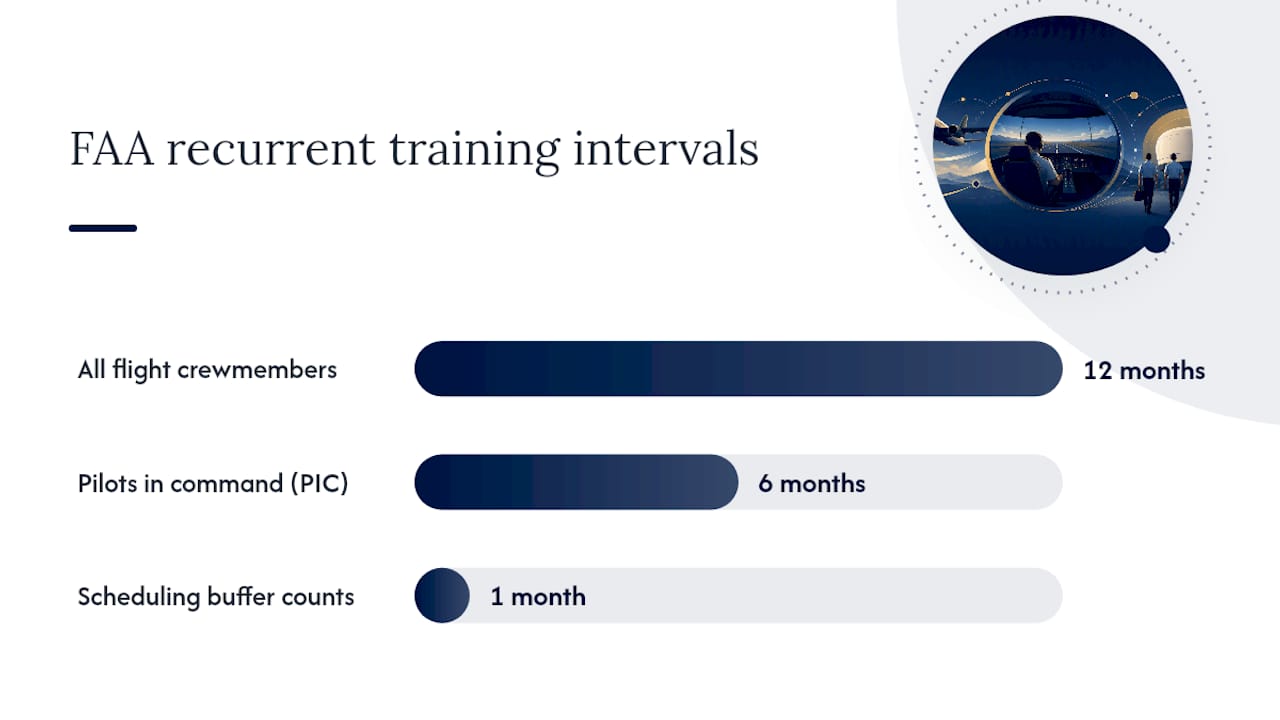
Pilots in command carry an extra obligation under Part 121: a recurrent flight training event within the preceding 6 calendar months, layered on top of the 12-month cycle. That’s not redundant paperwork. It reflects the FAA’s view that command authority demands more frequent hands-on validation than a first officer’s seat requires.
A few practical rules govern how that calendar actually works:
- Training completed in the calendar month before it’s due, or the calendar month after, generally counts as completed in the month it was due, giving schedulers a buffer.
- A proficiency check can sometimes substitute for recurrent flight training, but the substitution has limits. Mandated tasks like extended envelope training under 14 CFR § 121.423 aren’t always waivable through a check alone.
- Approved full flight simulator (FFS) courses may satisfy part of the recurrent flight training requirement, provided the course meets minimum training hour standards under 14 CFR § 121.409.
For pilots converting a foreign license or holding a type rating from another authority, this is the regulatory backbone everything else in this article builds on.
How Many Hours Does Recurrent Training Actually Require?
Programmed hours for recurrent ground training vary by aircraft group under 14 CFR § 121.427, and the differences are bigger than most pilots expect walking in.
By the numbers: Group I reciprocating aircraft require 15 programmed hours. Group I turbopropeller aircraft require 19 hours. Group II jets require 24 hours, unless an operator has an approved reduction under §121.405.
That jump from 15 to 24 hours reflects system complexity, not bureaucratic padding. Jets bring more automation modes, more failure scenarios, and more decision points to review each cycle.
Ground training content isn’t just a lecture and a nap. It has to include a knowledge review or quiz covering required subject areas, and PIC-specific leadership and command training has to recur at least every 36 months, a requirement that grew out of the Crewmember and Aircraft Dispatcher Training final rule. Key elements include:
- Aircraft systems and limitations review specific to the pilot’s fleet
- Regulatory and operational policy updates since the last cycle
- Leadership, command, and crew resource management content on the 36 month cadence
Pilots who’ve already completed an ATP-CTP course will notice recurrent curricula increasingly echo that academic content, since the FAA has pushed operators toward aligning recurrent material with ATP-CTP competencies rather than treating them as separate tracks.
Why Does Simulator Fidelity Matter for Recurrent Credit?
Not every simulator can legally give you credit for every maneuver. That distinction trips up more pilots than the calendar rules do.
Rulemaking tied to the Federal Register’s 2016 FSTD qualification update raised the fidelity bar for extended envelope tasks: full stall, stick pusher activation, upset recovery, tailplane icing, and gusting crosswind approaches. These maneuvers now require validated simulation performance that older, lower-fidelity devices simply can’t replicate accurately. The rule aligned Part 60 technical standards more closely with ICAO Document 9625, closing a gap that had existed between US and international simulator standards for years.
A device being “Level D” doesn’t automatically mean it’s approved for every task on that list. Qualification is maneuver-specific, and operators have to demonstrate the device replicates each exercise to standard before crediting it. Before you sit down for a recurrent session, verify:
- The device’s qualification statement specifically lists the extended envelope tasks you need
- The course outline shows those mandated maneuvers, not just a generic simulator block
- You receive post-session documentation confirming which tasks were completed and validated
Pro Tip: Ask your training provider for the FSTD’s qualification basis letter before your session, not after. If a maneuver isn’t listed, no amount of instructor sign-off makes that credit valid. Programs built around LOFT scenarios tend to handle this better, since line-oriented flight training naturally forces the extended envelope tasks into realistic operational context rather than isolated drills.
Part 121 vs. Part 135: Who Decides What “Adequate” Means?
Part 121 spells out exact programmed hours and mandated content, leaving little room for operator interpretation. Part 135 works differently: certificate holders are responsible for ensuring pilots are adequately trained, but the FAA gives them more latitude to determine what “adequate” looks like for their operation, based on FAA legal interpretation guidance on certificate holder responsibilities.
That flexibility cuts both ways. A well-run Part 135 operator can tailor recurrent training tightly to its actual fleet and mission profile. A weaker one can under-deliver and still technically comply, since the regulation doesn’t hand-pick a required hour count the way §121.427 does for airlines. Part 135 training still requires knowledge review components, even without a fixed hour minimum.
For pilots changing employers or converting a foreign license, this difference matters immediately:
- Ask any Part 135 operator for their written training program, not just a verbal summary of “what we usually do”
- Confirm whether recurrent content includes a documented knowledge review, since that’s required regardless of hour count
- Compare a Part 121 carrier’s programmed hours against §121.427 directly. If they’re below the baseline, ask about an approved reduction under §121.405
Foreign pilots pursuing an FAA license conversion often assume all US operators train identically. They don’t, and Part 135’s operator-determined model is exactly where that assumption breaks down.
Recurrent Training Compliance Checklist for Pilots and Training Managers
Staying current isn’t complicated, but it does require someone actually watching the calendar. Here’s the sequence that keeps pilots and training departments out of trouble:
- Identify your base month. This is the calendar month your recurrent cycle anchors to, and every future session gets measured against it.
- Schedule inside the window. Complete training in your base month, or use the month-before/month-after grace period, but don’t rely on that grace period as a default plan.
- Collect documentation immediately. Keep completion certificates for ground training, proficiency checks, and any simulator task validations tied to extended envelope maneuvers.
- Request FSTD qualification statements for any device used for mandated maneuver credit, before the session if possible.
- Flag a lapse the moment it happens. If recurrent training slips past its window, requalification typically requires refresher ground and flight training, and in some cases supervised line experience, before returning to unsupervised operations.
Pro Tip: Build a personal tracking sheet independent of your employer’s system. Training departments make administrative errors too, and you’re the one who loses currency if a date gets logged wrong. The CRM and recordkeeping practices that Part 135 operators use for compliance documentation apply just as well to an individual pilot’s personal records.
How a Level D Simulator Program Maps to These Rules
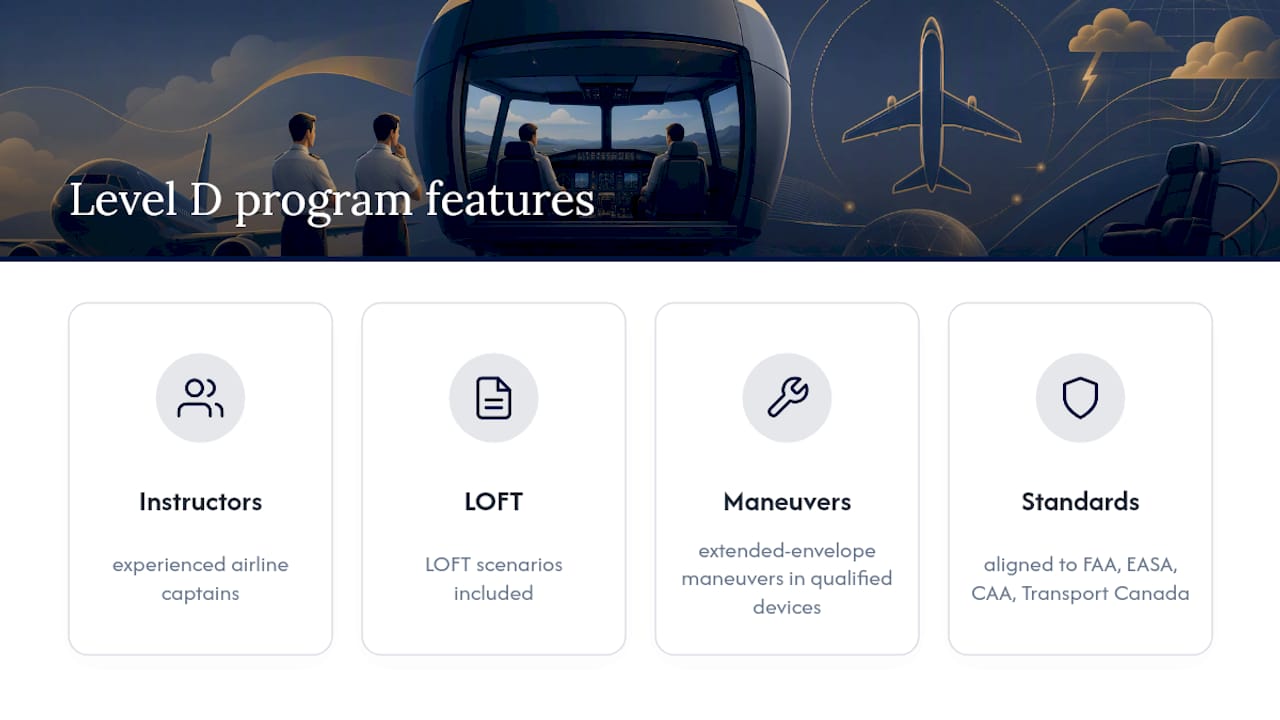
Training providers build recurrent and type rating curricula to meet CFR requirements, often using Level D full-motion devices with instruction from experienced airline captains. Programs incorporate LOFT scenarios, extended envelope maneuvers in devices qualified for those specific tasks, and leadership and command content aligned with the 36-month cadence carriers expect. Curricula are structured to align with FAA, EASA, CAA, and Transport Canada standards, which matters most for foreign pilots converting toward an FAA certificate.
Documentation isn’t an afterthought here. Pilots leave sessions with records that match what a certificate holder or FAA inspector will actually ask to see.
— Jake
Ready for Recurrent Training or an FAA Conversion? Here’s Where to Start
Recurrent training compliance gets simpler when one provider handles the syllabus, the simulator time, and the paperwork together instead of you piecing it together from three different vendors. Simulator Center LLC runs Level D simulator training across the A320, A330, B737, B737 Classic, B757/767, and ATR 42/72 fleets, with veteran airline captains delivering instruction that maps directly to the extended envelope and command requirements covered above.

If you’re a foreign pilot working through an ICAO, EASA, or DGCA to FAA license conversion, the center coordinates scheduling, documentation, and checkride logistics as part of the program rather than leaving you to chase each piece separately. Pilots preparing for airline hiring can also start with the ATP-CTP course to align academic training with the recurrent content carriers now expect. Prospective trainees are encouraged to request course syllabi or check simulator availability to understand how schedules align with recurrent training deadlines.
Sources
The regulatory language behind this article comes directly from primary federal sources:
- 14 CFR § 121.433 - Training required. | LII / Legal Information Institute
- FAA legal interpretation / guidance (certificate holder responsibilities)
FAQ
What Is the FAA’s Recurrent Training Interval?
Flight crewmembers under Part 121 and Part 135 must complete recurrent ground and flight training within the preceding 12 calendar months. Pilots in command under Part 121 also need an additional recurrent flight training event within the preceding 6 calendar months.
Can a Proficiency Check Replace Recurrent Flight Training?
Sometimes, but not always. Certain mandated tasks, including extended envelope maneuvers under §121.423, have limited or no substitution allowance, so a proficiency check alone may not satisfy the full requirement.
How Many Hours Does Recurrent Ground Training Require?
Programmed hours depend on aircraft group under §121.427: 15 hours for Group I reciprocating aircraft, 19 hours for Group I turbopropeller, and 24 hours for Group II jets, unless an operator has an approved reduction.
Does Part 135 Follow the Same Hour Requirements as Part 121?
No. Part 135 certificate holders are responsible for ensuring pilots are adequately trained but have more flexibility in setting hours, unlike Part 121’s prescriptive programmed-hour model under §121.427.
What Should I Ask a Training Provider Before Booking Recurrent Simulator Time?
Ask for the FSTD’s qualification statement confirming it’s approved for the specific extended envelope maneuvers you need, plus a course outline listing mandated tasks. Simulator Center LLC provides Level D simulator sessions with documentation covering both.