
Part 135 Operators: 5 CRM Pillars and the Records POIs Demand

CRM training requirements come primarily from 14 CFR § 135.330, FAA AC 120-51D/E, and EASA implementation guidance for European operators. The core mandate is straightforward: approved initial training before line duty, recurrent training on a repeating cycle, and a curriculum covering PIC authority, communication, teamwork, workload management, situational awareness, and decision making. The immediate action item for any operator is to map that curriculum against your Advisory Circular and CFR checklist, document instructor sign-off, and get it in front of your POI before you assume you’re compliant.
TL;DR:
- Operators must map their CRM curriculum to regulatory elements and obtain instructor sign-off before submitting for POI approval.
- Recurrent CRM training should incorporate full-mission simulator LOFT scenarios with intact crews and standardized facilitators for effective assessment.
- Training must cover core topics like PIC authority, communication, team building, workload management, and aeronautical decision-making with scenario blending for multiple objectives.
- CRM training extends to dispatchers, flight attendants, and maintenance personnel, with cycle frequency set by the operator’s approved program, not just initial onboarding.
- Simulator providers like Simulator Center specialize in delivering fully documented LOFT exercises and taped debriefs that meet regulator standards for recurring CRM practice.
Table of Contents
- What Regulations Govern CRM Training Requirements?
- What Core Topics Must CRM Curriculum Cover?
- Who Needs CRM Training, and How Often?
- How Should CRM Training Be Delivered and Assessed?
- What Records and Approvals Do Operators Need?
- A Practical Checklist to Turn Requirements Into a Program
- How a Simulator Provider Fits Into Recurrent CRM Practice
- Where Operators Get CRM Training Wrong
- Where Simulator Center Fits Into Your CRM Program
- Sources
- FAQ
What Regulations Govern CRM Training Requirements?
Part 135 operators answer to a specific rule: 14 CFR § 135.330 requires an approved CRM program with both initial and recurrent components, and it names the minimum curriculum elements outright, rather than leaving them to interpretation.
FAA AC 120-51D fills in the “how.” It describes recommended program components, from classroom indoctrination through recurrent practice using LOFT and taped feedback, and it treats reinforcement as a continuous operational habit rather than a once-a-year checkbox. The later revision, AC 120-51E, broadens the definition of CRM itself: effective use of all available resources, human, hardware, and information, and it extends that expectation to dispatchers, flight attendants, and maintenance personnel, not just the flight deck.
EASA takes a different regulatory path but lands close to the same place. Its CRM training implementation guidance recommends practices that complement, rather than duplicate, national rules.
Applicability differs by certificate type:
- Part 121 operators face the most detailed CRM program requirements, tied closely to AC 120-51 guidance.
- Part 135 operators fall directly under §135.330, with POI approval as the gatekeeper.
- Operators outside U.S. jurisdiction typically follow EASA or ICAO-aligned frameworks, which share the same core elements under different labeling.
What Core Topics Must CRM Curriculum Cover?
Regulators don’t leave curriculum design to guesswork. Section 135.330 and the FAA’s advisory guidance point to five recurring pillars, each with its own practical objective:
- Authority of the pilot in command. Training must clarify command decision-making authority and how crew input factors into it without eroding it.
- Communication. Covers both internal exchanges (flight deck to cabin) and external ones (ATC, dispatch, maintenance), with emphasis on assertiveness and inquiry.
- Team building and coordination. Exercises need to cross functional lines, connecting flight deck, cabin crew, dispatch, and maintenance rather than training each group in isolation.
- Workload and time management, situational awareness, fatigue and stress countermeasures. These get grouped because they interact: a fatigued crew loses situational awareness faster under workload pressure.
- Aeronautical decision-making. Scenarios should reflect the operator’s actual aircraft types and route structure, not a generic template.
Pro Tip: Map each curriculum module to at least two regulatory elements at once. A scenario built around a diversion decision naturally exercises both communication and workload management, which gives you double credit when you present the curriculum matrix to your POI.
Who Needs CRM Training, and How Often?
CRM training requirements extend well beyond the two pilots up front. AC 120-51E explicitly includes flight attendants, dispatchers, and maintenance personnel where their roles intersect crew coordination, and SKYbrary’s overview confirms training applies at multiple career stages, not just once at hire.
- Initial indoctrination happens before a crewmember begins operating duties, covering the full curriculum baseline.
- Recurrent training repeats on a cycle set by your approved program, reinforcing skills rather than reteaching them from zero.
- Appointment and upgrade triggers apply when a pilot moves to captain, joins as a new hire, or transitions to a different aircraft type.
- Credit for prior training is possible under FAA guidance, but your POI has discretion over how much prior CRM instruction counts toward your program.
How Should CRM Training Be Delivered and Assessed?
Regulators favor practice over lecture, and the evidence backs that preference. LOFT and full-mission simulator sessions with taped feedback give instructors behavior-specific data that a classroom discussion simply can’t produce, and AC 120-51D recommends them explicitly for recurrent training.
Acceptable delivery methods, in rough order of regulatory preference:
- Full-mission simulator LOFT scenarios, ideally run with intact crews rather than mixed-and-matched pilots.
- Flight training devices (FTDs), which work for lower-fidelity scenario practice when full-motion time isn’t available.
- Role-play and classroom exercises, sufficient for initial indoctrination but weak as a standalone recurrent method.
- Structured debrief sessions, which turn taped feedback into an actual learning event instead of a formality.
Assessment should track specific performance areas, AC 120-51D names communication, decision making, team building, workload management, and situational awareness, using pre/post measures and systematic instructor observation rather than a single pass/fail grade.
Statistic Callout: The FAA’s own advisory guidance treats instructor and check airman standardization as a precondition for credible assessment, not an optional add-on. A program with strong LOFT scenarios but unstandardized facilitators produces inconsistent, hard-to-defend evidence during a POI review.
What Records and Approvals Do Operators Need?
Every crewmember’s file needs initial and recurrent completion dates, instructor sign-off, and LOFT tape references where applicable.
For approval, FAA Notice N_8900.209 walks POIs through the Part 135 review process, including OpSpec templates A037 and A038 for basic operators and rules for crediting a pilot’s prior voluntary CRM training.
Build your submission package around these items:
- A curriculum matrix mapping each module to its specific CFR or AC element.
- Facilitator and check-airman qualification records.
- Assessment rubrics tied to the performance areas above.
- Training schedules showing initial, recurrent, and upgrade triggers.
- SOP language and ops briefing notes showing CRM reinforcement between formal training events.
A Practical Checklist to Turn Requirements Into a Program
Converting the regulatory text into an actual training calendar takes five sequential steps:
- Map every required element from §135.330 and your applicable AC to a named curriculum module, no orphaned regulatory language.
- Schedule recurrent LOFT or simulator sessions with intact crews whenever staffing allows, since scenario realism drops fast with substitute crewmembers.
- Standardize your facilitators before you standardize your curriculum. Inconsistent instructors undermine even well-designed scenarios.
- Set measurable assessment metrics upfront, pre/post surveys, behavioral markers, instructor scorecards, so you’re not improvising evidence after the fact.
- Update SOPs and ops briefings to reference CRM concepts routinely, closing the gap between training day and flight day.
Pro Tip: Build your assessment rubric before you finalize your LOFT scenario script. Working backward from “what behavior do we need to observe” produces sharper scenarios than writing the scenario first and hoping the right behaviors show up.
How a Simulator Provider Fits Into Recurrent CRM Practice
Full-mission Level D simulator sessions give operators a controlled way to run LOFT scenarios that hit multiple CRM elements in a single exercise, communication and workload management in the same diversion scenario, for instance. Taped feedback turns those runs into the specific, observable evidence regulators expect, and it only works when facilitators are trained to debrief consistently rather than narrate the flight back to the crew.
Instructor standardization matters as much as scenario design. Facilitators need calibrated observation skills, not just flight instruction credentials, for assessments to hold up under review.
Where Operators Get CRM Training Wrong
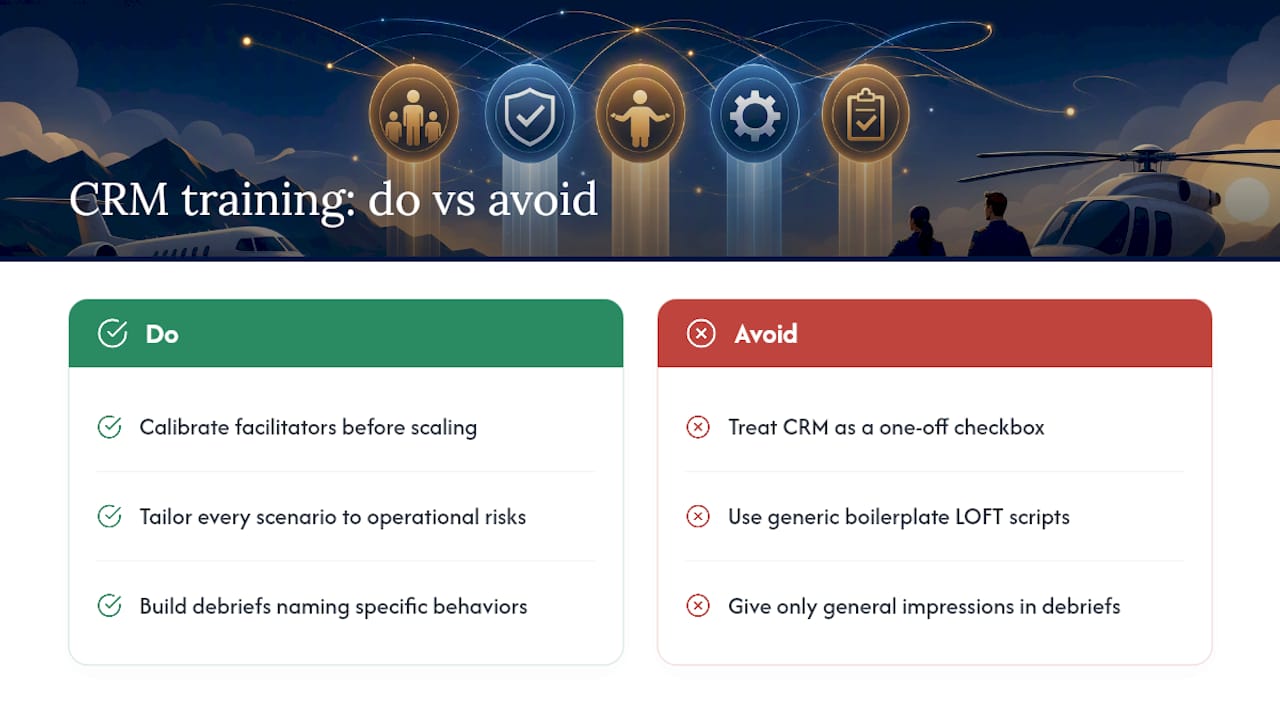
The most common failure isn’t a missing curriculum element. It’s treating CRM as a classroom module that gets checked off once and forgotten, rather than a skill that needs recurrent, full-crew practice to stay sharp. Generic scenarios are the second trap: a boilerplate LOFT script that ignores your specific aircraft type and route risk profile tends to fall apart during a POI review, because it’s obviously not tailored.
The fix isn’t complicated, but it takes discipline. Calibrate your facilitators before you scale your program, tailor every scenario to your actual operational risks, and build debriefs that name specific behaviors instead of general impressions. Operators who skip that last step end up with taped feedback nobody actually reviews.
— Jake
Where Simulator Center Fits Into Your CRM Program
Some training providers specialize in delivering the recurrent, simulator-based segment of CRM training, focusing on practical execution aspects reviewed by regulators rather than the entire compliance documentation. Full-motion Level D simulator sessions run with instruction from current and former airline captains, which means the facilitators running your LOFT scenarios and taped debriefs have flown the exact scenarios they’re now evaluating.

To be clear, this is a training provider option, not a regulatory endorsement. Your POI still approves your curriculum and your recordkeeping. But if you need full-mission LOFT time, taped feedback, and facilitation that holds up to instructor standardization scrutiny, Simulator Center’s Boeing 737 simulator training and broader type rating programs cover the aircraft types most operators run. If you’re building out an ATP-CTP program alongside CRM integration, that’s a natural place to start the conversation about scheduling and scope.
Sources
For the regulatory text itself, start with 14 CFR § 135.330 and FAA AC 120-51D. Part 135 operators pursuing POI approval should also read FAA Notice N_8900.209. International operators can cross-reference EASA’s CRM implementation guidance, ICAO materials, and SKYbrary’s CRM summary for a concise overview.
- 14 CFR § 135.330 - Crew resource management training.
- AC 120-51D - Crew Resource Management Training
- CRM Training Implementation | EASA
FAQ
What Are the Core CRM Training Requirements?
Operators need an approved program with initial and recurrent training covering PIC authority, communication, team building, workload management, situational awareness, fatigue and stress effects, and aeronautical decision-making, per 14 CFR § 135.330.
What Are the 7 CRM Skills?
Most frameworks group CRM skills around communication, leadership and command authority, workload management, situational awareness, decision-making, team building, and stress and fatigue management, the same categories named in FAA guidance.
Who Needs Recurrent CRM Training, and How Often?
Anyone in a crew coordination role, flight crew, and often dispatchers and flight attendants, needs recurrent training on the cycle set by the operator’s approved program, plus additional training triggered by upgrades or aircraft transitions.
Can Prior CRM Training Count Toward New Requirements?
Yes, under FAA guidance in Notice N_8900.209, but the amount of credit given is at the POI’s discretion and depends on documentation quality.
Does Simulator Center Provide CRM-Aligned Training?
Simulator Center delivers the full-motion simulator and LOFT component of CRM practice, including taped feedback and facilitated debriefs, through its simulator training programs, though final program approval remains with the operator’s POI.