
B737 Type Rating Cost: A Practical Guide for Pilots

A self-funded initial B737 type rating in the United States typically runs at a cost that varies widely, with most programs targeting entry-level candidates at the lower end of that spectrum. The single biggest cost driver is simulator time: specifically, whether a program uses a Level D full-motion simulator and how many hours are included in the package price. Add lodging, travel, and examiner fees, and the all-in number climbs fast.
Here is what the fee usually covers at most U.S. providers:
- Ground school and CBT: Typically several days of classroom or computer-based instruction
- Simulator blocks: Multiple hours on a Level D or Level C full-motion simulator
- Examiner and checkride fees: Scheduled FAA-approved checkride at program end
- Course materials: Manuals, QRH, and study resources
What it usually does not cover: lodging, travel, line familiarization, and rescheduling fees. Those add-ons are where budgets quietly blow past the headline price. Simulator Center LLC, an FAA-aligned provider operating Level D full-motion simulators, publishes its B737 program details and inclusions so pilots can compare line by line before committing.
Table of Contents
- How much does a B737 type rating cost by program type?
- What does the course cover, and how long does it take?
- How do Boeing 737 variants change training scope and cost?
- How do you choose the right U.S. B737 training center?
- Financing options and ways to lower your net cost
- Three sample budgets for common pilot scenarios
- What Simulator Center LLC includes in its B737 programs
- What does the timeline from enrollment to FAA checkride look like?
- What happens after you complete the B737 type rating?
- Key Takeaways
- The costs pilots consistently underestimate
- Authoritative sources and next-step links
- Simulatorcentertraining puts you in the Level D simulator faster
How much does a B737 type rating cost by program type?
The price you pay depends heavily on which program you actually need. Initial ratings, differences endorsements, and recurrent checks are priced differently and cover different ground.

| Program Type | Low | Typical | High | What Pushes the Price Up |
|---|---|---|---|---|
| Initial type rating (self-funded) | $12,000 | $25,000 | $40,000 | Level D sim, senior instructors, included examiner fees |
| Upgrade / differences training | $4,000 | $10,000 | $14,000 | Variant complexity, added LOFT scenarios |
| Recurrent / proficiency check | $1,500 | $3,000 | $6,000 | Simulator availability, examiner scheduling |
Broader industry cost models show totals reaching high levels when programs include extended lodging, line familiarization, and bespoke failure scenarios. That upper range is real, but it reflects depth of training rather than a certification requirement.
Breaking the fee into line items gives a clearer picture of where the money actually goes:
- Simulator training: — Substantial portion of cost depending on included hours and sim level
The spread on simulator training is the one that matters most. A program quoting $8,000 for sim time and one quoting $30,000 are not offering the same thing. Hourly rates on a Level D full-motion simulator run significantly higher than on a Level C device, and “wet” hours (with a qualified instructor in the seat) cost more than “dry” hours (solo practice time).
Pro Tip: Ask every provider two questions before comparing quotes: How many simulator hours are included, and are they wet or dry? A package that looks cheaper often includes fewer wet hours, which means you pay extra to finish the syllabus.
What does the course cover, and how long does it take?
A typical U.S. B737 type rating includes 7–14 days of ground instruction and about 25–40 hours of Level D full-motion simulator time, culminating in an FAA-approved checkride. The exact split depends on the provider’s syllabus and whether the program runs as an accelerated intensive or a spread-out schedule.
Training moves through four phases:
- CBT and ground school: Systems knowledge, normal and abnormal procedures, limitations, and QRH familiarization
- Fixed-base simulator (FBS) or flight training device (FTD): Procedures practice before entering the full-motion device
- Full-flight simulator (FFS) blocks: Maneuvers, instrument approaches, engine failures, and LOFT scenarios
- Proficiency check and FAA checkride: Final evaluation with an FAA-designated examiner
Accelerated vs. spread-out scheduling:
- 2-week intensive: Ground school and sim blocks run back-to-back; checkride scheduled at the end of week two. Best for pilots who can take consecutive time off work.
- 4–6 week schedule: Ground school in week one, simulator blocks spread across remaining weeks. Works better for pilots managing part-time availability or travel logistics.
FAA Part 142-approved training centers operate under a structured, approved syllabus that the FAA has reviewed. Part 61 or Part 141 delivery is also possible but less common for type ratings. The practical difference for scheduling: Part 142 centers often have dedicated simulator blocks reserved for their programs, which reduces calendar gaps. One real scheduling risk is simulator and examiner availability, which can create multi-week holding periods between training completion and checkride. Budget for that possibility.
How do Boeing 737 variants change training scope and cost?
The B737 family spans three distinct generations: the Classic (300/400/500), the NG (600/700/800/900), and the MAX (7/8/9/10). Each requires different training, and booking the wrong program is a common, costly mistake.
| Training Scenario | Scope | Key Differences | Cost Impact |
|---|---|---|---|
| Initial NG type rating | Full rating | All systems, all procedures | Full price ($12k–$25k) |
| NG to MAX differences | Shorter add-on | MCAS, updated avionics, MEL/QRH changes | Typically $4k–$10k add-on |
| Classic to NG differences | Moderate | Avionics, FMC, handling differences | Varies; often $6k–$14k |
| Initial Classic type rating | Full rating | Older avionics, different FMC | Full price, sometimes lower sim cost |
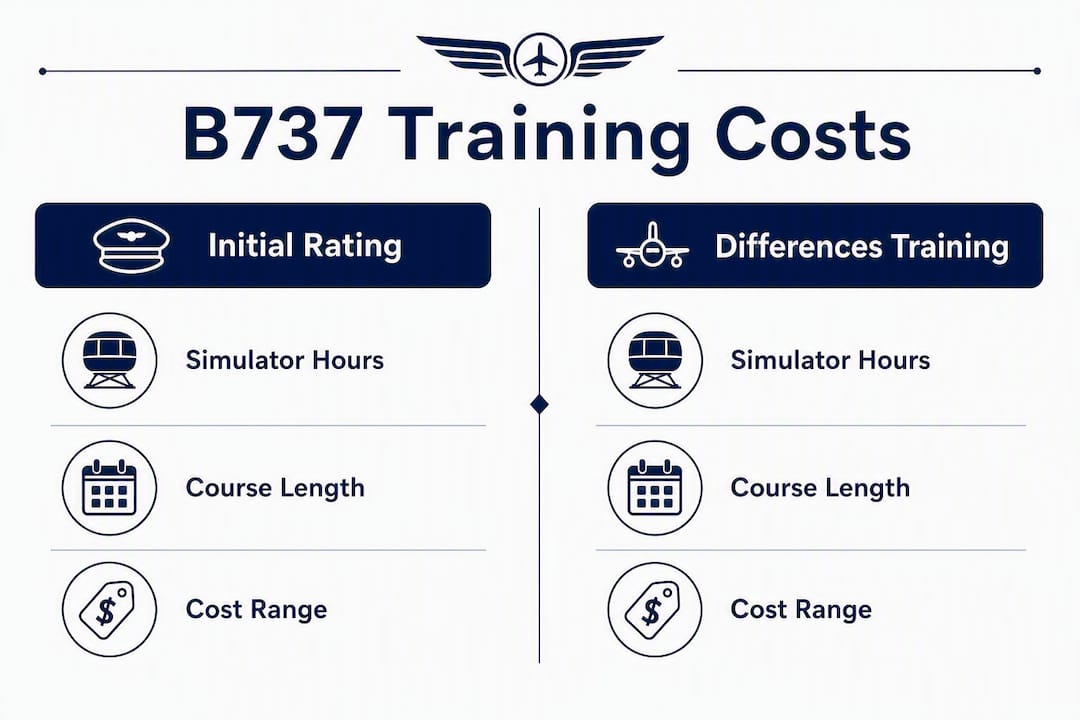
The NG is the most common target for pilots entering narrowbody airline operations. MAX differences training is mandatory for any pilot moving to MAX line operations, even if they already hold an NG type rating. Some providers bundle the MAX endorsement into their NG programs; others charge it as a separate add-on. Confirm this before you sign anything.
Classic training is worth a separate look for pilots targeting specific regional or cargo operators. Simulatorcentertraining offers a dedicated B737 Classic type rating program that covers the variant-specific systems and procedures distinct from the NG syllabus.
How do you choose the right U.S. B737 training center?
Provider selection is where pilots lose money most often: they pick on headline price, skip the verification steps, and end up paying for make-up sessions or rebooking fees. These are the non-negotiables to check before you pay a deposit.
Non-negotiables:
- FAA Part 142 approval (or documented FAA-accepted syllabus for Part 61 delivery)
- Simulator level clearly stated: Level D or Level C, not just “full-motion”
- Number of dedicated simulator instructors and their airline background
- Examiner access: Is a designated examiner (DPE) included, or do you arrange your own?
- Written syllabus with specific hour counts, not “up to X hours” language
Questions to ask every provider:
- Are simulator hours wet or dry, and what is the hourly split?
- Are examiner fees included in the quoted price?
- How many LOFT scenarios and failure events are covered?
- What is the cancellation and rescheduling policy, and are there fees?
- What happens if you need additional simulator time to meet proficiency standards?
Red flags to walk away from:
- “Up to X hours” with no stated minimum
- No written syllabus provided before payment
- Simulator level unspecified or described vaguely as “advanced”
- Examiner fees listed as “not included” with no estimate
- No published cancellation policy
Simulator level and FAA approvals are the primary price levers in any honest comparison. A provider that cannot tell you exactly which simulator they use and what its FAA qualification level is should not be on your shortlist.
Financing options and ways to lower your net cost
The full price of a B737 type rating is real, but few pilots pay it all at once or out of pocket without some form of support.
Common funding paths:
- Deposit plus installment plans: Many providers accept a deposit (typically 20–30% of the course fee) with the balance split across training milestones
- Third-party financing: Aviation-specific lenders and general personal loan products; compare APR carefully against the training timeline
- Employer sponsorship or airline bond: Regional and major carriers sometimes sponsor type rating costs in exchange for a service bond (typically 12–36 months of employment)
- GI Bill benefits: Eligible U.S. veterans can apply VA education benefits toward FAA-approved training programs; confirm the specific program’s VA approval status before enrolling
- Employer reimbursement: Some pilots negotiate partial reimbursement as a condition of a new hire offer, particularly when transitioning between fleet types
Tax treatment: Self-employed pilots may be able to deduct type rating costs as a business expense when the training maintains or improves skills required in their current work. W-2 employees face more restrictions. This is a nuanced area; confirm your specific situation with a tax professional before filing.
Negotiation tactics that actually work: Ask for a written breakdown of every included and optional line item. Bundle simulator blocks if you need both initial and recurrent training. Ask whether paying in full upfront unlocks a discount.
Pro Tip: Always confirm whether your deposit is refundable and under what conditions. Some providers market “flexible” payment terms but hold deposits as non-refundable after 48–72 hours. Get the refund policy in writing before you transfer any money.
The European market offers a useful reference point: standalone B737 type ratings in Europe typically fall between €7,800 and €30,000, illustrating strong regional price variation. For U.S.-based pilots, transatlantic travel, lodging, and examiner portability costs often close that gap significantly.
Three sample budgets for common pilot scenarios
These budgets translate the price ranges above into concrete numbers for three realistic pilot profiles. Use them as planning baselines, not guarantees.
| Line Item | Profile A: Self-Funded Initial | Profile B: CPL Upgrade / Differences | Profile C: Airline-Sponsored |
|---|---|---|---|
| Course fee (ground + sim) | $12,000–$25,000 | $4,000–$14,000 | Included |
| Examiner / checkride fees | $1,500–$3,000 | $1,500 | Included |
| Travel (flights, ground) | $800 | $500 | — |
| Lodging (2 weeks) | $1,000–$6,000 | $900 | — |
| Incidentals / materials | $400 | $300 | $300 |
| Contingency buffer (10%) | $1,400–$3,000 | $700–$1,400 | $300 |
| Estimated Total | $16,000–$34,300 | $7,900–$18,100 | ~$600 |
Profile A reflects a zero-time or low-time pilot self-funding an initial NG type rating at a mid-tier U.S. provider with a Level D simulator. Profile B covers an experienced CPL holder adding a differences endorsement or upgrading from Classic to NG. Profile C shows an airline-bonded candidate where the carrier covers direct costs; the pilot’s out-of-pocket is limited to personal incidentals and a service bond commitment of typically 12–36 months.
A contingency buffer is recommended to cover potential extra costs like make-up simulator sessions, rescheduling fees, and additional lodging during any holding period between training completion and checkride. Skipping that buffer is the single most common budgeting mistake pilots make.
What Simulator Center LLC includes in its B737 programs
Simulatorcentertraining’s Boeing 737 type rating program is built around a Level D full-motion simulator and instruction from veteran airline captains, with an FAA-aligned syllabus designed for both initial candidates and pilots upgrading between variants.
What the program includes:
- Level D full-motion simulator access for all FFS training blocks
- FAA-aligned syllabus covering normal, abnormal, and emergency procedures
- Instruction from experienced airline captains with examiner-level knowledge
- Organized examiner scheduling so pilots do not have to source their own DPE
- Logistical support for international students, including FAA license conversion guidance
Enrollment steps:
- Submit your application and pilot documentation (logbook, medical, existing certificates)
- Confirm your program type (initial NG, Classic, differences, or recurrent)
- Reserve your simulator block and ground school dates
- Complete pre-course CBT and study materials before arrival
Foreign-trained pilots can combine the B737 type rating with an FAA license conversion, consolidating both processes into a single training visit. For pilots who need additional Level D simulator hours beyond the standard program, B737 simulator sessions are available as standalone blocks.
What does the timeline from enrollment to FAA checkride look like?
From the day you submit your application to the day you hold an FAA type rating endorsement, the typical timeline spans several weeks, depending on scheduling and availability. Here is how that breaks down:
- Week 1: Application review, document verification, pre-course CBT assigned
- Weeks 1–2: Ground school (systems, procedures, limitations)
- Weeks 2–4: Full-motion simulator blocks (FBS, FFS, LOFT scenarios)
- Weeks 3–5: Proficiency check and examiner scheduling
- Week 4–8: FAA checkride and endorsement issuance
The variable is examiner availability. At busy training centers, examiners book out weeks in advance. If your checkride gets pushed, you may need to extend lodging or return for a second trip. Booking at a center with an on-staff or regularly scheduled DPE compresses this timeline considerably.
What happens after you complete the B737 type rating?
Passing the checkride earns you an FAA type rating endorsement on your Airline Transport Pilot (ATP) or Commercial Pilot certificate. That endorsement is what airlines verify when reviewing your application for a B737 fleet position.
Most U.S. regional and major carriers require the type rating to be current and paired with a valid first-class medical and an ATP certificate. Some carriers also require a minimum number of hours in type before line operations, which means additional simulator or line training after the initial rating. The type rating itself does not expire, but the associated instrument currency and recurrent training requirements do: expect a proficiency check every six months once you are on line.
From a hiring standpoint, holding a B737 type rating before applying to a carrier that flies the 737 family is a genuine differentiator. It signals that you are ready to enter initial operating experience (IOE) faster, which reduces the carrier’s training cost. That is a real advantage in a competitive applicant pool.
Key Takeaways
A self-funded initial B737 type rating in the United States typically involves substantial costs, with simulator hourly rates being one of the largest cost drivers in any program.
| Point | Details |
|---|---|
| Typical U.S. price range | Initial ratings at most providers cost $12,000–$25,000, with total expenses including lodging rising to $16,000–$34,000 depending on location and extras. |
| Biggest cost lever | Level D simulator hours and whether they are wet (instructor-led) or dry determine most of the price gap between providers. |
| Confirm variant and program type | Initial NG, Classic, and MAX differences training are priced differently; booking the wrong one wastes money. |
| Budget a 10% contingency | Make-up sessions, rescheduling fees, and examiner delays are common; a buffer prevents a budget shortfall at the worst moment. |
| Simulatorcentertraining | Offers Level D full-motion B737 programs with FAA-aligned syllabi, veteran airline captain instructors, and organized examiner scheduling. |
The costs pilots consistently underestimate
Most pilots research the headline course fee and stop there. The real budget surprises come from three places that rarely appear in a provider’s marketing: simulator cancellation fees, examiner availability delays, and insufficient LOFT scenarios.
Simulator cancellation fees are the quiet killer. A provider that charges $500–$1,500 for a last-minute reschedule can turn a minor scheduling conflict into a significant expense. Read the cancellation policy before you sign, not after.
Examiner availability is the timeline risk nobody talks about until it happens to them. At centers without a dedicated DPE relationship, pilots sometimes wait two to four weeks after completing training before a checkride slot opens. That means extended lodging, possible return travel, and a gap where your simulator currency starts to fade. A center with organized examiner scheduling is not a luxury feature; it is a direct cost-control mechanism.
The LOFT scenario question is subtler. Programs that include only the minimum required scenarios leave pilots less prepared for the unexpected events that show up in real checkrides and line operations. Asking specifically how many LOFT events and failure scenarios are included before you book is the single best way to compare training depth across providers without paying for it twice.
One practical way to lower net cost without cutting corners: confirm exactly which scenario types are in the syllabus, then negotiate bundled LOFT blocks if you need more. Paying for an extra two hours of targeted LOFT upfront costs far less than a failed checkride and a make-up session.
Authoritative sources and next-step links
The cost estimates and training hour figures in this article draw from the following sources:
- Boeing 737 type rating | FullFlightSims: Ground school duration, simulator hour ranges, and variant differences training details
- Boeing 737 Type Rating Cost | Cost Insider: Broad industry cost model, high-end program pricing, and cost-driver analysis
- Type rating guide: A320 and B737 costs | AirMappr: Line-item cost breakdowns and scheduling buffer guidance
- B737 type rating cost Europe | AirMappr: European pricing context and regional variation data
- What is a Type Rating? | Wayman Aviation: Type rating requirements and process overview
- 14 CFR Part 61.31 | eCFR: FAA regulatory requirements for type ratings
For pilots ready to act: the Simulatorcentertraining B737 program page covers full program details, and the admissions page walks through the enrollment process step by step.
Simulatorcentertraining puts you in the Level D simulator faster
Pilots who have done the research know what separates a program worth paying for from one that looks good on paper: a Level D full-motion simulator, instructors who have actually flown the line, and an examiner relationship that does not leave you waiting weeks for a checkride slot. Simulatorcentertraining delivers all three in one place.
The B737 program is built for pilots who want to move efficiently from enrollment to endorsement without chasing down examiners, sourcing their own DPE, or discovering mid-course that their “included” simulator hours ran out. Veteran airline captains run the instruction. The FAA-aligned syllabus covers initial NG, Classic, and differences training. International pilots can combine the type rating with an FAA license conversion in a single visit, cutting total travel and lodging costs significantly.
Ready to confirm dates and reserve your simulator block? Visit the admissions page to submit your documents and lock in your training schedule.