
7 Drills Evaluators Want in Airline Interview Sim Profiles for Pilots

An airline interview sim profile is a scored simulator session, typically 30 to 60 minutes, built around standard maneuvers like a raw-data ILS or an engine failure on departure. The single biggest priority isn’t flying the numbers perfectly. It’s demonstrating threat and error management and crew resource management under pressure. Two things you can start doing tonight: brief every action out loud, and call out every deviation the instant you see it.
TL;DR:
- Simulator sessions focus on demonstrating threat and error management, with scoring based on communication, decision-making, and workload handling.
- Candidates should practice structured drills like raw-data approaches, threat mitigation, CRM communication, and debriefing to excel in assessments.
- Effective preparation involves weekly repetition, including callout discipline, engine failure procedures, and briefing scripts, with a strong emphasis on rest before the test.
- Most failures stem from poor communication during high-workload moments, not flying precision, making CRM and verbalization crucial for success.
- Mock simulator training with professional coaching enhances performance by providing realistic evaluation experiences and targeted feedback.
Table of Contents
- What Does an Airline Interview Sim Profile Include?
- How Do Airlines Score TEM, CRM, and Workload Management?
- What’s the Best Way to Practice Before the Session?
- How Should You Structure Your Sim Debrief?
- How Coached Mock Sims Close the Gap Before Interview Day
- Why Most Candidates Prepare for the Wrong Test
- Book a Mock Sim Session to Practice Your Profile
- Sources
- FAQ
What Does an Airline Interview Sim Profile Include?
The session almost always opens with a brief, usually 10 to 15 minutes, where you walk the evaluator through your plan for the departure, the approach, and how you’ll handle a threat if one shows up. Examiner guidance across authorities consistently recommends building enough time into that brief for the candidate to set expectations before the aircraft ever moves, since a rushed brief tends to predict a rushed flight.
The flying portion itself runs 30 to 60 minutes, and it’s built from a small, recognizable set of building blocks. Almost every airline draws from the same pool:
- A SID or departure with an early turn, often hand flown to raw data
- General airwork: steep turns, stalls or approach to stall, unusual attitude recovery
- A holding pattern entry, frequently with a non-standard entry angle
- A raw-data ILS or RNAV approach with no flight director
- An engine failure, either on departure or during the approach, followed by a go-around
- A non-precision approach that forces manual descent planning
Assessors aren’t grading you on whether the needle stays centered. They’re watching whether you catch a 10-knot airspeed decay before it becomes a stall warning, whether you verbalize the missed approach point before you get there, and whether your scan recovers after a distraction. A clean ILS flown in silence often scores worse than a slightly rougher one flown with constant, accurate callouts.
How Do Airlines Score TEM, CRM, and Workload Management?
Modern sim assessments are competency based, following frameworks tied to ICAO’s CBTA model, which grades operational thinking rather than raw handling precision alone. That’s a meaningful shift from older check-ride formats, and it changes what you should be rehearsing.
Threat and error management, or TEM, is the backbone. It means naming a threat before it bites you and stating your mitigation out loud. Examples that score well:
- “Convective activity building west of the field. I’ll request a deviation now rather than wait.”
- “We’re heavy and hot on this approach. I want extra spacing before we configure.”
- “Crosswind’s near limits. I’m briefing a go-around trigger at 500 feet if we’re not stabilized.”
CRM markers matter just as much: a real pre-departure briefing with your sim partner, closed-loop communication (“confirm gear down, three green” answered with “gear down, three green, confirmed”), and workload sharing when things get busy. Silence during a high-workload phase is one of the most common reasons evaluators mark down candidates whose actual flying was technically fine, according to practitioner accounts of airline assessment days.
Pro Tip: If you catch yourself heads-down for more than a few seconds during a busy phase, say so out loud. “I’m heads down programming the FMC, you have the radios” shows monitoring awareness even when your hands are occupied.
Automation monitoring rounds out the picture. Evaluators want to see you cross-check what the autopilot and flight director are actually doing against what you told them to do, not just trust the magenta line. That “monitoring mindset” separates candidates who fly the airplane from candidates who manage the airplane.
What’s the Best Way to Practice Before the Session?
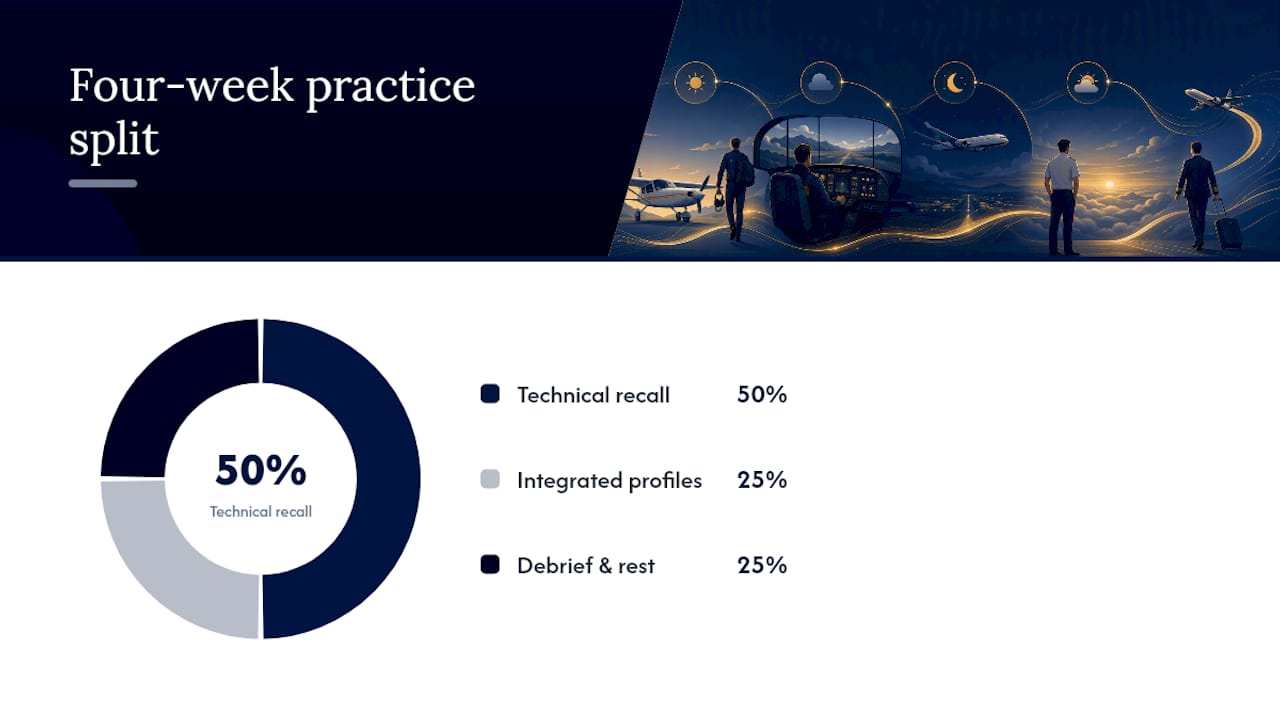
Give yourself structured, repeatable sessions rather than random chair-flying. A four-week runway works well if you have one: weeks one and two on raw technical recall, week three on integrated profiles with a partner, week four on debrief rehearsal and rest.
Seven drills cover almost everything airlines actually test:
- Pitch and power memory. Drill the numbers for climb, cruise, descent, and approach configurations until they’re automatic, not calculated.
- Holding entries. Practice direct, teardrop, and parallel entries on a whiteboard or app until you can call the entry type in under three seconds.
- Raw-data ILS. Fly it with the flight director caged. This is where most candidates lose points from over-reliance on automation.
- FMC or FMS edits. Rehearse reroutes and hold entries into the box while talking through what you’re doing.
- Engine-failure immediate actions. Memory items cold, then practice verbalizing them while flying, since silent memory items don’t score CRM points.
- Steep turns. Nail the pitch and bank coordination without chasing the altimeter.
- Missed approach briefing. Brief the miss before every single approach, even when you’re confident you’ll land.
If you have a sim partner, run a two-minute briefing script before every session: roles, threats you both expect, and how you’ll handle a go-around call. It mirrors exactly what evaluators watch for at the door, before the session even starts.
In the final 24 hours, protect your rest above everything else. Confirm your documents the night before, run one mental lap of the full profile, and stop drilling maneuvers. Fatigue erodes CRM performance faster than it erodes raw stick skills. For hands-on repetition against a real profile, a mock sim session built around your target aircraft beats another night of armchair flying.
How Should You Structure Your Sim Debrief?
The debrief often carries as much weight as the flying itself. Research on simulation debrief practices shows that structured self-assessment, naming a specific cause and proposing a concrete fix, signals exactly the learning orientation evaluators want to see.
Use a three-step template every time:
- Open with what went right. Name one or two specifics, not a generic “I think it went okay.”
- Name one issue and its root cause. “I over-controlled heading changes on the ILS by using large aileron inputs instead of letting the roll damp out” beats “my scan was a little off.”
- State your fix. “Next time I’ll make smaller corrections and hold them longer before adjusting again.”
If something genuinely went wrong mid-flight, don’t bury it and hope the evaluator missed it. Naming it yourself, with the cause and the fix, almost always scores better than silence.
How Coached Mock Sims Close the Gap Before Interview Day
Reading about raw-data approaches and TEM phrasing only gets a candidate so far. The gap closes in a simulator, under a coach who can flag the exact moment your scan broke down or your briefing skipped a threat.
Simulatorcentertraining runs training on Level D full-motion simulators, the same fidelity standard used across type-rating and airline assessment prep, with instruction from veteran airline captains who have sat on the other side of the evaluation. That combination maps directly onto what this article covers:
- A tailored mock profile that mirrors the maneuvers airlines actually test, on the aircraft you’re targeting
- A facilitated debrief where an instructor validates or corrects your own root-cause analysis
- CRM coaching focused on briefing structure, callouts, and workload sharing, not just stick-and-rudder polish
Three groups get the most out of booking a session: pilots facing their first airline sim assessment, pilots transitioning between aircraft types who need to rebuild pitch and power memory fast, and pilots converting a foreign license who need a structured bridge into FAA standards.
Why Most Candidates Prepare for the Wrong Test
Most sim prep advice still treats the session like a check ride: fly the needles, hit the altitudes, and hope precision carries you. That advice is outdated. Evaluators using competency-based frameworks are grading how you think under threat, not how tightly you hold a localizer.
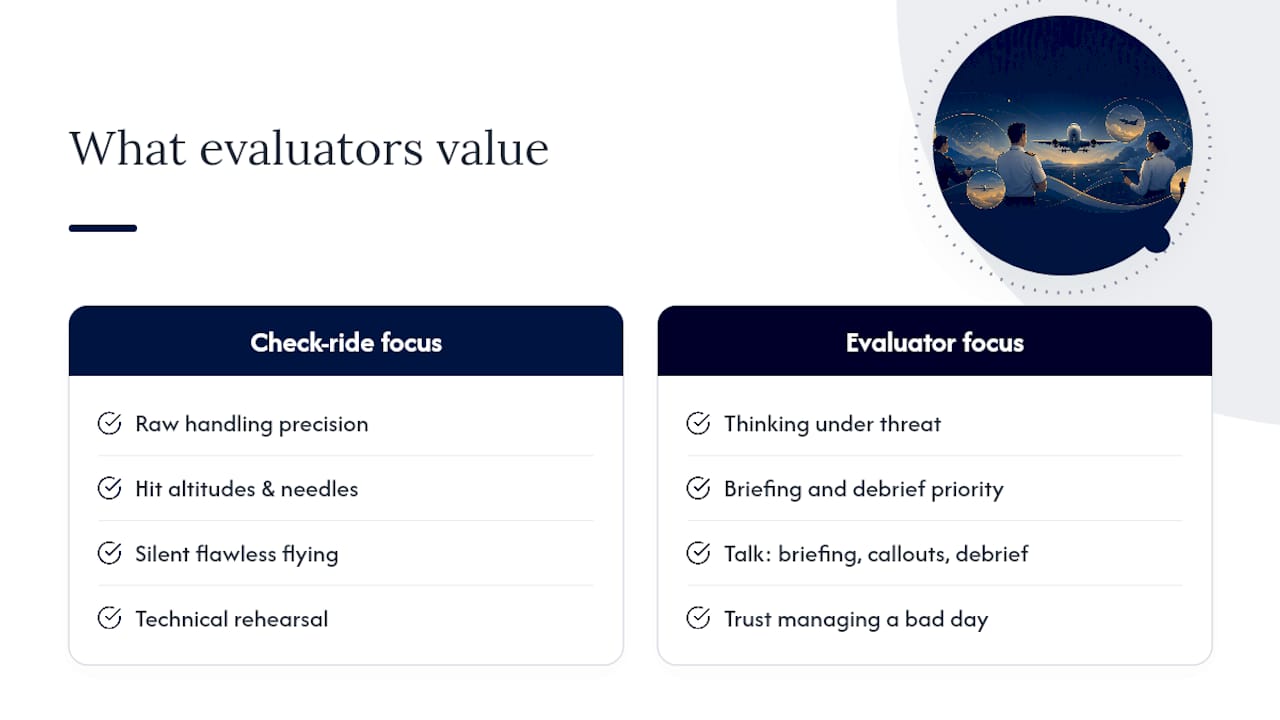
The conventional wisdom oversells raw handling and undersells the briefing and the debrief, the two moments that bookend the actual flying and reveal the most about how a candidate operates. A pilot who flies a mediocre approach but briefs the threat, catches the deviation, and owns it cleanly in debrief will usually beat a pilot who flies a flawless approach in total silence.
If you take one thing from this, prioritize the drills that force you to talk: briefing scripts, callout discipline, and debrief phrasing. Technical rehearsal matters, and you should still drill your pitch and power numbers until they’re automatic. But airlines aren’t hiring the best hands in the room. They’re hiring the pilot they trust to manage a bad day at 35,000 feet, and that trust gets built in how you communicate, not just how you fly.
— Jake
Book a Mock Sim Session to Practice Your Profile
Simulatorcentertraining gives you the one thing self-study can’t: a real Level D simulator running a profile built to mirror what airlines actually test, with a veteran airline captain watching every callout and every briefing gap.
A booked session typically includes a mock profile matched to your target aircraft, a tailored pre-flight briefing where the instructor sets expectations the way an evaluator would, and a facilitated debrief that checks your root-cause analysis against what actually happened in the flight. That last part is where most candidates learn the most, since it’s easy to misjudge your own performance without a second set of trained eyes.
If you’re heading into an assessment on the Airbus or Boeing families, the simulator training page is the fastest way to see available aircraft and book a session. Pilots who also need a type rating or an FAA license conversion alongside interview prep can review the type-rating programs or the FAA license conversion options to plan both at once.
Sources
These documents define the frameworks behind modern airline sim assessments:
- ICAO working paper on competency-based training and assessment (CBTA)
- FAA AC 120-35D: Flightcrew Member Line Operational Simulations
FAQ
How Long Does an Airline Sim Assessment Last?
Most sessions run 30 to 60 minutes of actual flying, plus a separate briefing beforehand. The exact length varies by airline and aircraft type, but the maneuver set stays fairly consistent across programs.
What’s the Most Common Reason Candidates Fail?
Silence during high-workload phases is one of the most frequent scoring problems, even when the flying itself is technically sound. Evaluators using competency-based frameworks weigh CRM and communication as heavily as handling accuracy.
How Much Does Coaching Actually Help?
Facilitated debriefs, where an instructor checks your self-assessment against what really happened, tend to produce stronger learning signals than solo practice alone. A mock sim through Simulatorcentertraining’s simulator training program pairs that debrief with a Level D profile matched to your target aircraft.
How Long Should a Debrief Take?
Keep it tight: one or two specific positives, one issue with a named root cause, and one concrete fix. Three to five minutes is usually enough if you go in with the structure ready rather than improvising it.
Does Simulatorcentertraining Publish Its Prices?
Pricing for simulator sessions and type-rating programs is available directly through Simulatorcentertraining rather than listed publicly on this page. Reach out through the simulator training page for current rates on your target aircraft.