
Beat Airline Assessment: 3 Research Backed Priorities, Sim Metrics
Passing an airline assessment day comes down to three things: sharp aptitude test performance, simulator handling that holds up under pressure, and a ready bank of STAR interview stories. Candidates who drift into the day hoping personality alone carries them usually stall out at the psychometric stage or freeze in the sim. Start today: run one timed mock aptitude test and draft two STAR stories before you close this tab. Everything below explains how to build each piece properly.
TL;DR:
- Passing the assessment requires consistent performance across aptitude tests, simulator handling, and behavioral interviews, with no reliance on personality alone.
- Practice focused on the airline’s specific testing platform, simulate under fatigue, and review errors thoroughly to build durable skills for psychometric and aptitude stages.
- Objective simulator metrics such as altitude stability, heading accuracy, and CRM communication are measurable predictors of success, making early, realistic practice essential.
- Develop concise STAR stories tailored to common airline questions, ensuring answers are well-rehearsed, measurable, and align with personality questionnaires.
- Long assessment days demand physical and mental preparation, including adequate sleep, proper nutrition, hydration, comfortable clothing, and strategic breaks to maintain performance.
Table of Contents
- What Happens During Airline Assessment Preparation and the Assessment Day Itself
- How Do You Prepare for the Aptitude and Psychometric Tests?
- What Do Assessors Look for in the Simulator Stage?
- How Do You Build Strong STAR Answers for Airline Interviews?
- What Do Assessors Watch for During Group Exercises?
- How Long Should You Prepare Before an Airline Assessment?
- What Happens After Assessment Day, and How Should You Read Feedback?
- How Should You Prepare Physically Before Assessment Day?
- What Scores or Benchmarks Do Assessors Actually Use?
- A Pilot’s Perspective on the Mental Game
- Close Your Prep Gaps With Coached Simulator Time
- Key Studies and Guides for Deeper Reading
- Sources
- FAQ
What Happens During Airline Assessment Preparation and the Assessment Day Itself
A typical assessment day runs several hours and moves through four distinct stages, each testing something different but all feeding into a single composite score, according to a process guide covering assessment-day structure. Assessors aren’t grading each stage in isolation. They’re watching whether your composure in the morning’s aptitude test matches your composure in the afternoon interview.
- Psychometric and aptitude testing: lasting over an hour, usually first
- Group exercise: typically a brief session occurring mid-morning
- Simulator assessment: lasting a variable duration depending on the airline and aircraft type
- Behavioral and technical interview: usually lasts about an hour and is typically last
Assessors also log softer signals throughout the day: how you treat administrative staff, whether your energy holds up after lunch, and whether your story in the interview matches the person they watched in the group task. Airline recruiters who run these days consistently flag small non-technical behaviors as the difference between a strong candidate and a borderline one, based on a detailed hour-by-hour walkthrough of assessment days. Consistency across stages matters more than brilliance in any single one.
How Do You Prepare for the Aptitude and Psychometric Tests?
Most airlines filter candidates through browser-based platforms like CUT‑E, COMPASS, or AON before anyone sets foot in a sim. These tests assess numeric reasoning, verbal comprehension, spatial awareness, working memory, and divided attention, often under a countdown clock that increases pressure.
- Run timed, adaptive practice blocks of moderate duration rather than casual untimed drills.
- End each block with a 10-minute review of exactly which questions you missed and why, since spaced recall of errors turns a one-time correction into a durable skill.
- Practice on the actual platform your target airline uses when you can. Familiarity with CUT‑E’s interface, a common early-stage filter for many airlines, removes avoidable errors that have nothing to do with your actual aptitude.
- Build pacing habits now. If a section gives you 20 questions in 8 minutes, practice that ratio, not a relaxed version of it.
Pro Tip: Do your hardest aptitude practice block in the late afternoon, not the morning. That’s when you’ll actually be tested, and your brain needs to know what tired-but-focused feels like.
What Do Assessors Look for in the Simulator Stage?
The simulator stage isn’t just a technical checkpoint. It’s the part of the day producing the most objective data on you. Assessors track manual handling precision, instrument scan discipline, workload management under distraction, and crew resource management, meaning how you communicate and delegate with whoever sits next to you.
The numbers behind sim scoring: Objective flight metrics like altitude deviation, heading accuracy, and bank-angle stability correlate with training evaluation outcomes at roughly r ≈ 0.70, according to a meta-analysis of pilot training success predictors. That’s a strong relationship for aviation research, and it means sim performance isn’t a vague impression assessors form. It’s measurable.
That correlation holds up over repeated sessions, too. Research on flight simulator performance metrics shows objective sim measures stay stable across sessions and reliably distinguish stronger handling from weaker handling, which is exactly why airlines lean on simulator data instead of gut feel during selection.
- Book realistic sim time well before your assessment, not the week of.
- Practice both pilot-flying and pilot-monitoring roles, since assessors want to see you handle both.
- Debrief every session against measurable tolerances (heading deviation, altitude drift) rather than a vague “how did that feel” conversation.
- Replicate the specific scenarios your target airline is known to run, if that information is available.
Simulator Center’s Level D sessions, run with instruction from veteran airline captains, are built around exactly this kind of metric-based debrief. Structured A320 simulator training or B737 simulator sessions give candidates the chance to practice PF and PM roles with an instructor recording the same handling data assessors will be watching for.
Pro Tip: Ask your instructor to call out your heading and altitude deviations out loud during the session, not just in the debrief. Hearing the number in real time trains you to self-correct faster than reviewing it afterward.
How Do You Build Strong STAR Answers for Airline Interviews?
The STAR format (Situation, Task, Action, Result) works because it forces brevity and a measurable outcome, two things panicked candidates tend to lose under pressure. A good STAR answer runs 60 to 90 seconds. Longer than that, and you’ve lost the interviewer’s attention and probably your own thread.
Build stories around these recurring question categories:
- Conflict with a colleague or crew member and how you resolved it
- A decision made under time pressure with incomplete information
- A mistake you made and specifically what you changed afterward
- A moment requiring crew resource management or clear delegation
- A technical or regulatory scenario testing your systems knowledge
Personality questionnaires, often completed earlier in the process, get cross-checked against your interview answers. If your questionnaire says you’re collaborative but your STAR stories are all “I decided, I fixed it, I saved the day,” that mismatch gets noticed.
Pro Tip: Write your STAR stories down word for word once, then never read them again. Rehearsing from memory instead of a script keeps your delivery natural instead of recited.
What Do Assessors Watch for During Group Exercises?
Group tasks measure whether you communicate under social pressure, not whether you’re the loudest voice in the room. Assessors score communication clarity, balanced leadership, active listening, and whether the group actually stays on task.
- Make short, structured contributions instead of long monologues.
- Summarize the group’s options out loud before pushing a decision.
- Actively invite quieter members into the conversation.
- Anchor your suggestions to the exercise’s actual constraints, not personal preference.
The common failure mode isn’t silence. It’s over-talking, interrupting, or trying to “win” a task that was never designed to have a winner. A candidate who steers the group toward a decision without dominating it scores far better than one who does all the talking and calls it leadership.
How Long Should You Prepare Before an Airline Assessment?
Your timeline depends on where you’re starting from.
- Cadet or low-hours track (8 to 12 weeks): Weeks 1 to 3, build aptitude test fluency with three timed sessions a week. Weeks 4 to 8, add two sim sessions monthly and start drafting STAR stories, aiming for eight solid stories by week 8. Weeks 9 to 12, run full mock assessment days, including a group exercise with peers if possible.
- Experienced or type-rated track (2 to 4 weeks): Week 1, refresh aptitude test pacing with two timed sessions. Week 2 to 3, book focused sim sessions targeting your weakest handling metrics. Final week, run two full mock interviews and tighten your STAR bank.
- If you don’t pass on the first attempt, most airlines set a retest window of 6 to 12 months. Use that time to target the specific stage you struggled with rather than re-practicing everything equally.
What Happens After Assessment Day, and How Should You Read Feedback?
Most airlines respond within two to four weeks, though timelines vary widely by carrier and hiring volume. Feedback, when it’s offered at all, tends to be brief: a stage-level pass or fail rather than a detailed breakdown of every metric. Don’t expect a coach’s report. Expect a short email.
If you’re offered any feedback, read it literally rather than emotionally. “Did not meet the required standard in the simulator assessment” is a specific signal pointing you toward handling precision or CRM communication, not a verdict on whether you’ll ever make it as a pilot. Candidates who get rejected at one stage often assume the whole assessment was a wash. It usually wasn’t. The psychometric score, the group exercise notes, and the interview impression are typically scored and filed separately, even when the overall outcome is a no.
If no specific feedback is given, which is common, treat the entire day as a diagnostic. Write down, within 24 hours while memory is fresh, exactly which moment felt shaky. Was it the third section of the numeric reasoning test where you ran out of time? A moment in the sim where you lost the instrument scan during a distraction? An interview question where your answer trailed off without a clear result? That self-assessment is more useful than most official feedback you’ll receive.
Reapplying too soon, before addressing the specific weak point, is the most common mistake candidates make after a rejection. Most airlines’ retest windows exist precisely so you have time to close that gap, not so you can retake the exact same test with the exact same preparation.
How Should You Prepare Physically Before Assessment Day?
Assessment days are long, and fatigue affects decision-making in ways most candidates underestimate. A 6 to 9 hour day with high cognitive load in the morning and social and technical performance demands in the afternoon is a fundamentally different challenge than a one-hour job interview, and your body needs to be ready for that shape of day.
Sleep matters more than any last-minute cramming. Get a full night’s sleep for at least two nights before the assessment, not just the night immediately prior, since sleep debt compounds and one good night rarely undoes two bad ones. Avoid introducing anything new to your routine on assessment morning, including a different breakfast, a new caffeine dose, or an unfamiliar supplement.
Hydration and steady blood sugar carry more weight than people expect. A candidate who skips breakfast and runs on coffee alone tends to hit a mental wall by the simulator stage, right when precision matters most. Bring water and a light snack if breaks allow it, and pace your caffeine rather than front-loading it, since a crash mid-interview is worse than a slow start.

Dress for a full day of movement and sitting rather than just the interview portion. Layer your clothing since assessment center temperatures vary, and comfortable shoes matter more during a day that may include walking between rooms or standing during a group exercise briefing. None of this is dramatic.
What Scores or Benchmarks Do Assessors Actually Use?
Airlines increasingly score against competency-based frameworks rather than relying on gut instinct, using observable behaviors tied to IATA and ICAO competency models. This shift toward measurable indicators, rather than subjective impressions, changes the criteria for passing at each stage, according to a study on competency-based assessment methods in flight training.
For aptitude tests, many airlines use percentile thresholds within a mid to high range depending on role, though exact cutoffs are rarely published. Consistency across sub-tests matters as much as any single high score. A candidate who scores well on numeric reasoning but poorly on divided attention may still fail the overall stage.
For simulator assessments, benchmarks center on the same objective metrics referenced earlier: heading deviation, altitude stability, and bank-angle control, alongside a qualitative CRM score covering communication and workload distribution. A candidate who flies within tolerance but never speaks to their partner will often score lower than one who flies slightly rougher but communicates clearly and catches their own errors out loud.
For group exercises, assessors typically use a simple rubric: did the candidate contribute meaningfully, listen actively, and help the group reach a reasoned outcome. Dominating the conversation or staying silent both score poorly.
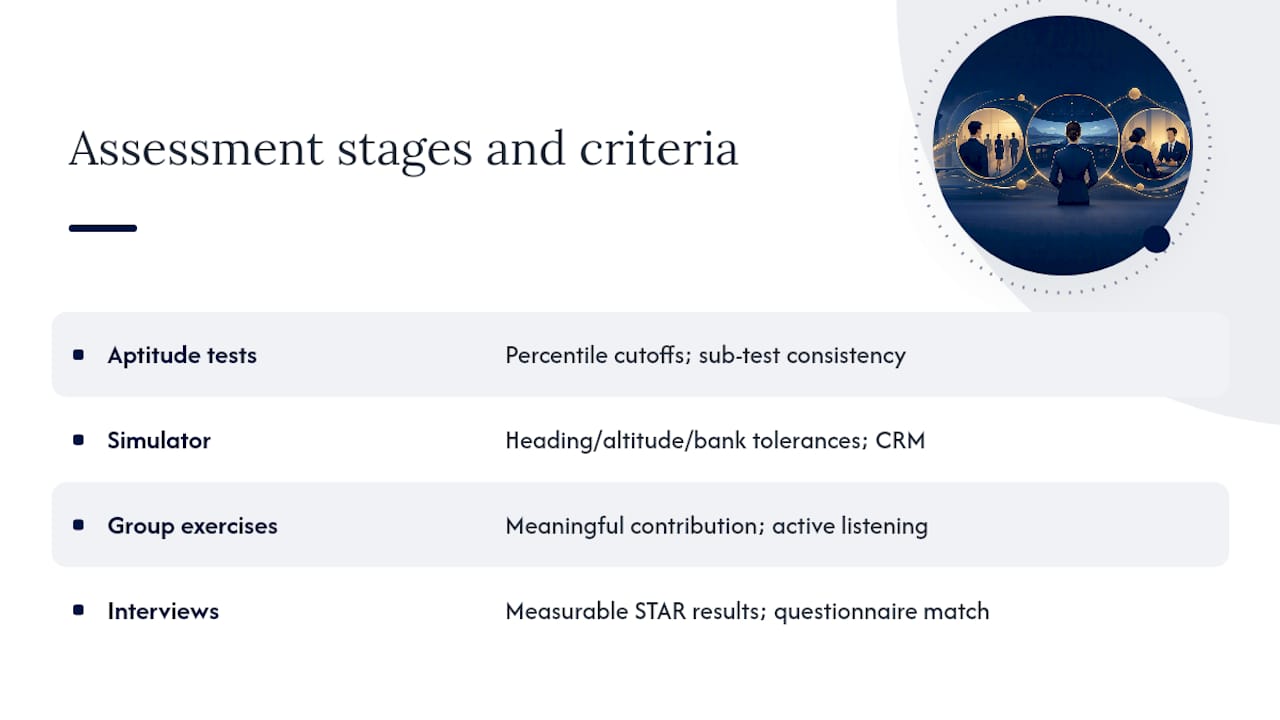
For interviews, assessors look for specific, measurable outcomes in your STAR answers and consistency with your personality questionnaire results from earlier in the day. Vague answers without a clear result read as unprepared, regardless of how confident the delivery sounds.
A Pilot’s Perspective on the Mental Game
The candidates who fall apart late in an assessment day almost never fail because they lack the technical skill. They fail because nobody warned them how much a 7-hour day drains the exact judgment they need most in the final interview. Pacing yourself, and treating the debrief after every practice sim session as seriously as the flying itself, builds the kind of consistency assessors are actually scoring for.
Pro Tip: Schedule a short break with water and food between your sim session and your interview, even if the assessors don’t formally offer one. A clear head in the last hour matters more than most candidates realize.
— Jake
Close Your Prep Gaps With Coached Simulator Time
Aptitude practice and STAR stories you can build on your own. Realistic simulator handling under CRM pressure is harder to fake without real stick time, and it’s the stage where objective metrics decide the outcome. Level D full-motion sessions with instruction from experienced airline captains are built specifically to mirror what assessors measure: instrument scan discipline, workload management, and clear PF/PM communication.
A single coached session gets you a real debrief against measurable tolerances, not a vague “that felt fine” conversation. Whether you’re prepping for an A320 or B737 assessment, book a block simulator session or start with admissions to talk through which type rating or prep track fits your timeline. If you’re earlier in your training and want a broader curriculum resource, the instructor-led training resources page is a good next stop.
Key Studies and Guides for Deeper Reading
- Meta-analysis linking simulator metrics to training success: the core research behind sim-based selection.
- Competency-based assessment methods study: how airlines score observable behaviors.
- Assessment day process guide: stage timing and structure.
- Formation PNC recruitment resource: broader airline recruitment context.
Sources
- Predicting Aircraft Pilot Training Success: A Meta-Analysis
- Airline assessment day process guide (2026)
- Objective assessment of pilot aptitude using flight simulator performance metrics in aviation training
- Competency-based assessment methods in flight training (2023 study)
FAQ
How Do You Pass an Airline Assessment Day?
Focus preparation on three areas: timed aptitude test practice, realistic simulator sessions with CRM communication, and a rehearsed bank of STAR interview stories, since assessors score consistency across all four stages rather than any single strong moment.
What Disqualifies a Candidate From an Airline Assessment?
Common disqualifiers include failing to meet minimum psychometric test percentiles, unsafe or wildly inconsistent simulator handling, and behavior in group exercises or interviews that contradicts earlier personality questionnaire results. Medical certification issues can also disqualify candidates before the assessment stage even begins.
Can You Become a Pilot if You Struggle With Math?
Aptitude tests do include numeric reasoning sections, but they test applied problem solving under time pressure rather than advanced math. Focused, timed practice on the specific test format your airline uses, such as CUT‑E or COMPASS, closes most of that gap for candidates who aren’t naturally strong in math.
What Do Pilots Earning the Highest Salaries Have in Common?
The highest-paid pilots are typically senior captains at major airlines flying widebody aircraft on long-haul international routes, with decades of seniority and relevant type ratings. Reaching that level starts with passing the same assessment-day fundamentals covered here, then building type ratings and seniority over years.
How Should You Practice for the Simulator Stage Specifically?
Book coached sim sessions well before your assessment date, practice both pilot-flying and pilot-monitoring roles, and debrief every session against objective metrics like heading and altitude deviation rather than a general impression, since simulator performance metrics predict training outcomes more reliably than instinct alone.