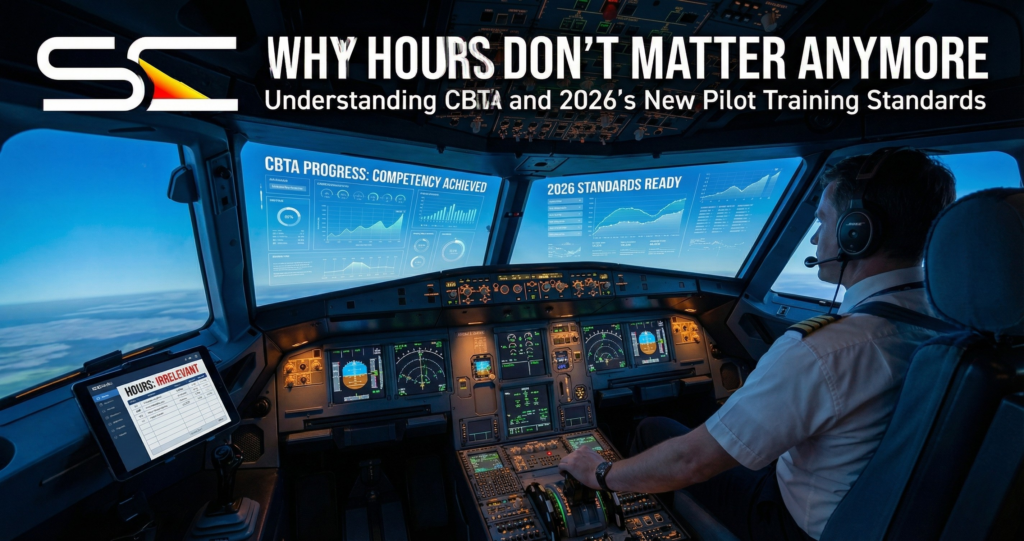
he aviation industry is undergoing its most significant shift in decades as the focus moves from “how many hours you’ve flown” to “how well you actually fly.” Understanding CBTA and 2026’s new pilot training standards is now essential for any aspiring or transitioning pilot looking to secure a seat in a modern cockpit. As global regulators move away from rigid hourly requirements, a new era of safety and proficiency-based education has arrived.
The Death of the “Magic Number”: Why 1,500 Hours is No Longer the Benchmark
For years, the “1,500-hour rule” acted as a gatekeeper for the airline industry. It was based on the simple assumption that more time in the air automatically equaled a safer pilot. However, the industry has realized that not all hours are created equal.
The Limitations of Traditional Time-Based Training
Traditional training often focuses on repeating maneuvers until they meet a specific tolerance. Once a student hits a certain number of hours, they are moved to the next phase. The flaw in this system is that a student might “pass” a checkride by memorizing steps without truly understanding the underlying logic of the aircraft or the environment.
Experience vs. Competence: Why “Flying in Circles” Doesn’t Prepare You
You can fly 1,000 hours in perfect weather in a simple Cessna and still be unprepared for a dual-engine failure in a heavy jet during a thunderstorm. Airlines have found that “high-hour” pilots often struggle with complex automation and high-stress decision-making if their experience was gained in non-challenging environments.
How the 2026 Regulatory Shift is Formalizing Quality Over Quantity
As of 2026, international aviation bodies have officially pivoted. The goal is no longer to “time-build” but to “skill-build.” New standards prioritize exposure to complex scenarios early in a pilot’s career, ensuring that every hour logged contributes directly to the specific skills needed for commercial operations.
What is CBTA? Defining the New Gold Standard in Aviation Training
Competency-Based Training and Assessment (CBTA) is a methodology that focuses on what a pilot can do rather than just what they know. It shifts the evaluation from a simple “Pass/Fail” on a maneuver to a deep dive into a pilot’s behavioral performance.
The ICAO Framework: Moving from Task-Based to Behavior-Based Evaluation
The International Civil Aviation Organization (ICAO) has defined CBTA as training that is tailored to the individual. Instead of a one-size-fits-all syllabus, instructors look for specific “observable behaviors.” If a student masters a skill quickly, they move on. If they struggle, the training adapts to fix that specific gap.
The 9 Core Pilot Competencies
Under the new 2026 standards, pilots are graded on nine specific areas:
- Application of Procedures: Following the rules and using checklists.
- Communication: Clear, concise exchange of information.
- Aircraft Flight Path Management (Manual): Hand-flying skills.
- Aircraft Flight Path Management (Automation): Managing the computers.
- Leadership and Teamwork: Working effectively with a crew.
- Problem Solving and Decision Making: Choosing the safest path forward.
- Situational Awareness: Knowing what is happening around the aircraft.
- Workload Management: Staying ahead of the plane during busy phases.
- Knowledge: Understanding the technical systems and regulations.
Threat and Error Management (TEM): The Heart of Modern Safety
CBTA places a heavy emphasis on TEM. This involves teaching pilots to anticipate potential problems (threats) and recognize mistakes (errors) before they become accidents. It acknowledges that humans will make mistakes; the “competent” pilot is the one who catches them.
The 2026 CBTA Mandate: What Pilots and Flight Schools Need to Know
The year 2026 marks a “hard line” for many global regulators. While the transition has been gradual, new mandates now require flight academies to prove they are teaching competency, not just counting hours.
FAA vs. EASA: Comparing the 2026 Implementation Timelines
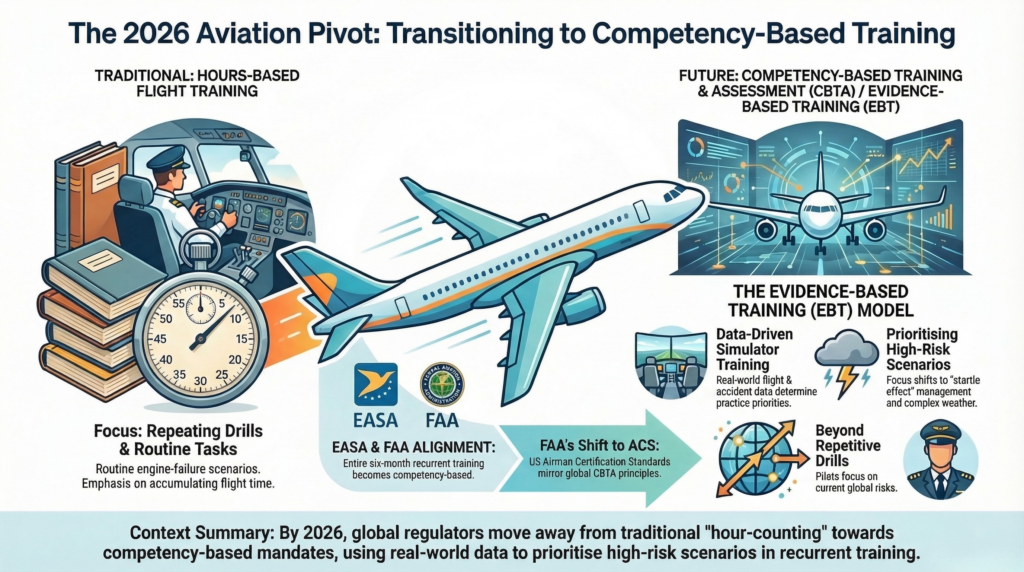
In Europe, EASA has fully integrated CBTA into its “Evidence-Based Training” (EBT) modules for airlines. In the United States, the FAA has moved toward the Airman Certification Standards (ACS), which mirrors CBTA principles. By 2026, both regions have aligned their “recurrent” training—the training active pilots do every six months—to be entirely competency-based.
The Rise of the Evidence-Based Training (EBT) Model
EBT uses data from real-world flights and accidents to determine what should be practiced in the simulator. Instead of practicing an engine failure every single time, a pilot might spend more time on “startle effect” management or complex weather diversions based on what the global data suggests is currently the highest risk.
Beyond the Cockpit: The Role of Simulators and VR in CBTA
Training for the “worst-case scenario” is impossible in a real airplane—it’s too dangerous and too expensive. This is where advanced technology becomes the hero of CBTA.
High-Fidelity Simulations: Training for “Black Swan” Events
Modern simulators allow pilots to experience total hydraulic failure, mountain waves, or catastrophic weather in a controlled environment. CBTA requires these scenarios because they test a pilot’s “Non-Technical Competencies” like leadership and decision-making under extreme pressure.
The 2026 Tech Integration: Using AI Analytics and VR
By 2026, the best training centers, such as Simulator Center LLC, use AI-driven analytics to track a pilot’s eye movements and reaction times. This data tells instructors exactly why a pilot missed a cue. VR (Virtual Reality) is also being used for “procedural trainers,” allowing students to sit in a virtual cockpit at home to build muscle memory before they ever step into an expensive simulator.
How CBTA Changes the Airline Hiring Process
If you are applying for a job in 2026, your logbook is only the first page of your resume. Airlines now want to see your “competency profile.”
From Logbooks to Performance Data
Major carriers are now requesting data from a candidate’s flight school that shows their progression across the nine core competencies. They want to see a “trend of improvement” rather than just a total number of hours.
The “Competency Passport”
The industry is moving toward a digital “Competency Passport.” This is a record that follows a pilot from their first solo flight to their retirement. It lists every simulator session, every strength, and every area that needed extra work. This transparency allows airlines to hire with much higher confidence.
The Financial Reality: Is CBTA More Expensive?
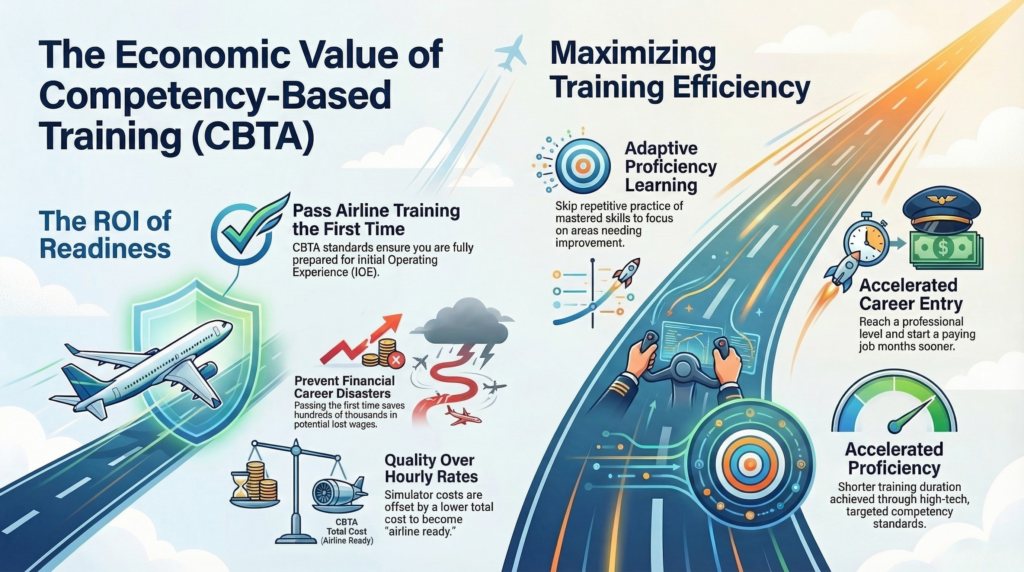
A common concern is that high-tech training costs more. While the hourly rate for a simulator might be higher than an old Cessna, the total cost of becoming “airline ready” often drops.
The “ROI of Readiness”
When you train under CBTA standards, you are less likely to fail an airline’s “Initial Operating Experience” (IOE). Failing an airline training program is a career-ending financial disaster. Investing in CBTA-compliant training at places like Simulator Center LLC ensures you pass the first time, saving hundreds of thousands in potential lost wages.
Training Efficiency
Because CBTA is adaptive, you don’t spend time practicing things you have already mastered. This “accelerated proficiency” can actually shorten the time it takes to reach a professional level, getting you into a paying job months sooner than a traditional program might.
How to Choose a CBTA-Ready Flight School in 2026
Not all flight schools have upgraded their methods. To ensure your career is future-proof, you need to look for specific signs of a modern training environment.
Questions to Ask Your Flight Instructor
- “How do you grade my performance beyond just staying within altitude tolerances?”
- “Do you incorporate Threat and Error Management into every briefing?”
- “Does this school use data or AI to track my progress across the 9 core competencies?”
Transitioning to a CBTA Curriculum
If you started training under the old “hours-based” system, don’t worry. You can transition by seeking out specialized training centers. Simulator Center LLC specializes in bridging this gap, providing the high-fidelity simulator time and expert coaching needed to align your skills with 2026’s airline expectations.
Summary: The Future of Aviation Safety is Personal
The move to CBTA is the most positive change in aviation history. It treats pilots like the complex, skilled professionals they are, rather than just operators of a machine. By focusing on your core competencies and utilizing the latest simulation technology, you aren’t just logging hours—you are building a foundation for a long, safe, and successful career.
If you are ready to move beyond the logbook and start training for the real world, Simulator Center LLC is your partner in excellence. Whether you are a student pilot or an experienced captain, their state-of-the-art facilities and CBTA-focused instructors will ensure you meet and exceed the 2026 standards.
Contact Simulator Center LLC today to schedule your competency assessment.
People Also Ask (FAQ)
Does the 1,500-hour rule still exist in 2026?
Yes, the legal requirement for certain certificates still exists, but airlines now use CBTA metrics to decide who among those high-hour pilots gets hired. Hours are the “minimum,” but competency is the “requirement.”
Can I fail a CBTA program?
CBTA is designed to be “continuous.” Instead of a single pass/fail test, you receive constant feedback. If you do not meet a competency, the training continues until you do. It focuses on mastery, not just survival.
Why is 2026 a significant year for pilot training?
2026 is the year many global aviation authorities (like ICAO and EASA) have fully implemented mandates for Evidence-Based Training and CBTA across commercial operations and flight academies.
Are simulators better than real planes for CBTA?
For specific competencies like “Problem Solving” and “Threat Management,” simulators are superior because they can safely recreate dangerous scenarios that you could never experience in a real aircraft.
How does CBTA help with pilot mental health?
By focusing on “Non-Technical Competencies” like workload management and communication, pilots are better equipped to handle stress, leading to less burnout and better mental resilience in the cockpit.
Is Simulator Center LLC’s training recognized by airlines?
Yes. Simulator Center LLC focuses on the core competencies that modern airlines look for