Getting your type rating in 2 weeks is the ultimate goal for many career-minded pilots looking to jump into the cockpit of a Boeing 737 or Airbus A320. While a standard course can take over a month, accelerated programs offer a high-speed path for those who meet specific criteria. Understanding the eligibility requirements is the first step toward fast-tracking your aviation career.
Understanding Type Rating Fundamentals
Before diving into the “how,” it is important to understand the “what.” A type rating is a technical certification required by the FAA (Federal Aviation Administration) and EASA (European Union Aviation Safety Agency) for any pilot to fly an aircraft that weighs over 12,500 pounds or is powered by a turbojet engine.
- Theory vs. Practice: You aren’t just learning how to “fly” the plane; you are learning how to manage its complex systems. Training is split between ground school and high-fidelity flight simulators.
- The 12-Month Rule: To keep your rating active, you must remain “current.” This typically involves a proficiency check every 12 months to ensure your skills haven’t decayed.
- Family Ratings: Some type ratings cover multiple aircraft models within a “family,” such as the Boeing 737-700, 800, and 900.
The Standard vs. Accelerated Path
The traditional route to a type rating usually spans four to six weeks. This timeline allows for a steady pace of classroom learning followed by simulator sessions. However, for pilots on a deadline, the 2-Week “Fast Track” (10–14 days) is a popular alternative.
In a 14-day program, the training is high-intensity. You should expect a total immersion environment with 8 to 12-hour training days. This condensed format leaves little room for error or “off days,” making it essential to choose a provider like Simulator Center LLC that uses Level D full-motion simulators to maximize every hour of training.
Eligibility: Who Qualifies for the 14-Day Timeline?
Not every pilot is eligible for a 14-day footprint. This shortened timeline is generally reserved for those who already have a strong foundation in professional flight operations.
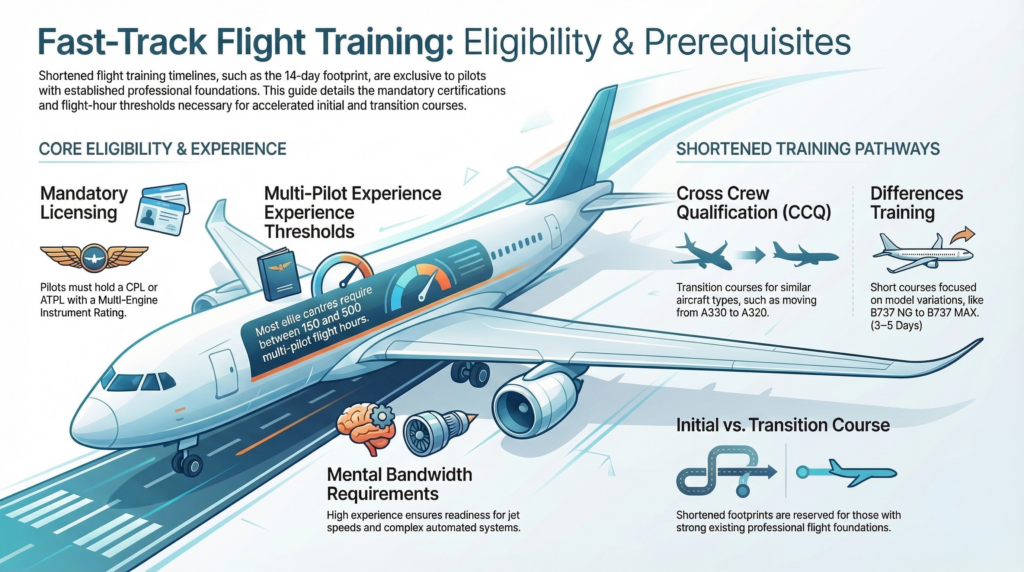
- The Prerequisites: At a minimum, you must hold a Commercial Pilot License (CPL) or Airline Transport Pilot License (ATPL) with a Multi-Engine Instrument Rating.
- Cross Crew Qualification (CCQ): If you already hold a rating in a similar aircraft (e.g., transitioning from an Airbus A330 to an A320), you may qualify for a shortened “transition” course.
- Differences Training: If you only need to learn the variations between models (like moving from a B737 NG to a B737 MAX), the course might be as short as three to five days.
- Experience Thresholds : Most elite training centers require a minimum of 150 to 500 hours of multi-pilot flight time before allowing a student into an accelerated initial program. This ensures you have the “mental bandwidth” to handle jet speeds and automated systems.
The Regulatory Divide: FAA vs. EASA Timelines
The rules for how fast you can get rated often depend on which country issued your license.
FAA (USA): The FAA allows for significant flexibility through Part 142 training centers. If a school has “Self-Testing Authority,” they can use their own in-house examiners, which cuts out the weeks of waiting for a government inspector to become available.
EASA (Europe): EASA is often more rigid regarding “ground hours.” Even for experienced pilots, there are mandatory minimums for theoretical knowledge that must be met before the checkride.
Simulator Center LLC specializes in helping pilots navigate these differences, offering programs that align with both FAA and international standards.
Critical Success Factors: Can YOU Handle It?
The “2-week rating” is often called “drinking from a firehose.” To succeed, you must manage a massive cognitive load.
- Pre-Study is Mandatory: The 14-day clock is a bit of a trick. In reality, your training starts 30 days before you arrive through Computer-Based Training (CBT). If you haven’t mastered the cockpit layout and basic flows before Day 1, you will likely fall behind.
- The Checkride Bottleneck: Even if you finish your training in 10 days, you aren’t “rated” until you pass the checkride. Accelerated programs succeed because they schedule examiners well in advance, ensuring no time is wasted sitting in a hotel room.
Cost Analysis: Is Faster Actually Cheaper?
At first glance, an accelerated course might look more expensive because of the “premium” for specialized instruction. However, you must look at the total “cost to complete.”
- Living Expenses: Spending 14 days in a hotel versus 45 days can save you thousands in lodging and food.
- Opportunity Cost: For a pilot, time is literally money. Getting to your airline job three weeks earlier means three weeks of senior-level pay and seniority numbers.
- The “Failure Tax”: Rushing into a program you aren’t ready for can lead to a failed checkride. This stays on your record and requires expensive retraining. It is vital to be honest about your readiness before signing up.
How to Choose an Accelerated Training Center
If you have decided that the 2-week path is for you, your choice of school is the most important decision you will make.
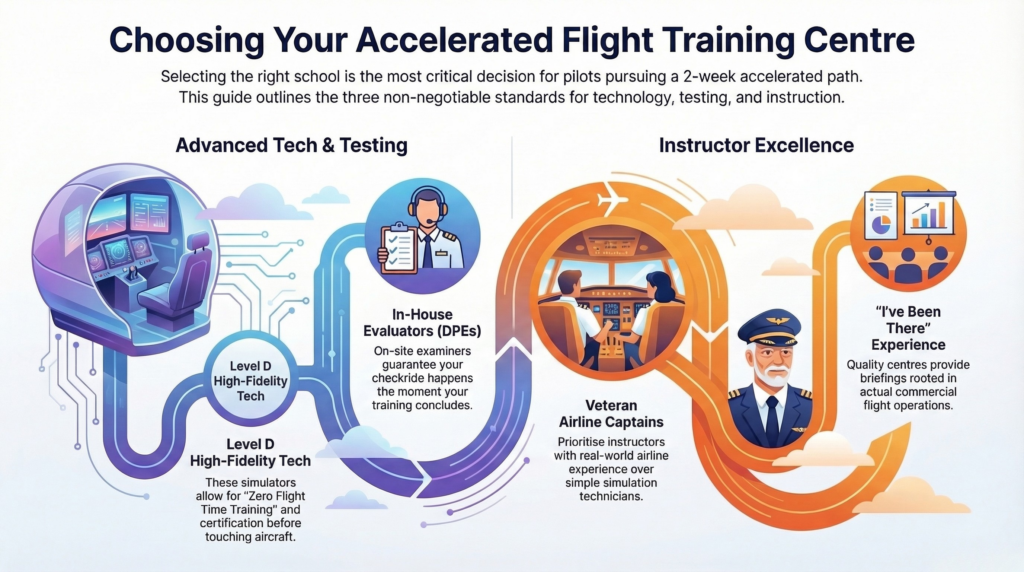
- In-House Evaluators: Look for centers that have their own Designated Pilot Examiners (DPEs). This guarantees your checkride will happen the moment your training ends.
- High-Fidelity Tech: Ensure the center uses Level D simulators. These are the highest grade of simulation, allowing for “Zero Flight Time Training” where you can be certified without ever touching the actual aircraft until your first passenger flight.
- Instructor Pedigree: You want instructors who are veteran airline captains, not just “sim technicians.” At Simulator Center LLC, the instructors bring real-world “I’ve been there” experience to the briefing room.
Conclusion: Is the 2-Week Path Right for You?
The 14-day type rating is a powerful tool for career advancement, but it requires discipline, significant pre-study, and the right training partner. If you meet the prerequisites and are ready for an intensive, professional experience, the fast track is the most efficient way to reach the flight deck.
Ready to take the next step in your career? Contact Simulator Center LLC today to review your eligibility and secure your spot in our next accelerated A320 or B737 course.
FAQ: People Also Ask
Can I get a type rating with just a Private Pilot License?
Technically yes, but it is extremely rare. You would still need an Instrument Rating and significant multi-engine experience to handle the complexity of a transport-category jet.
Does “2 weeks” include the checkride?
Most accelerated programs aim to have you checkride-ready by Day 12 or 13, with the final evaluation occurring on Day 14.
What happens if I fail a session in an accelerated course?
Because the schedule is so tight, a failed session may require you to “reset” and move to a longer program. This is why pre-study is so critical.
Are accelerated ratings looked down upon by major airlines?
No. Airlines value efficiency and proficiency. As long as you pass the same checkride to the same standard, the duration of the course does not matter to recruiters.
Is there financing available for these short courses?
Many students use personal loans or specialized aviation financing. Because the courses are short, the total “out of pocket” for travel is often lower, making them easier to budget for.
Do I need to bring my own study materials?
Usually, no. Leading centers like Simulator Center LLC provide all digital manuals and CBT access weeks before your start date.