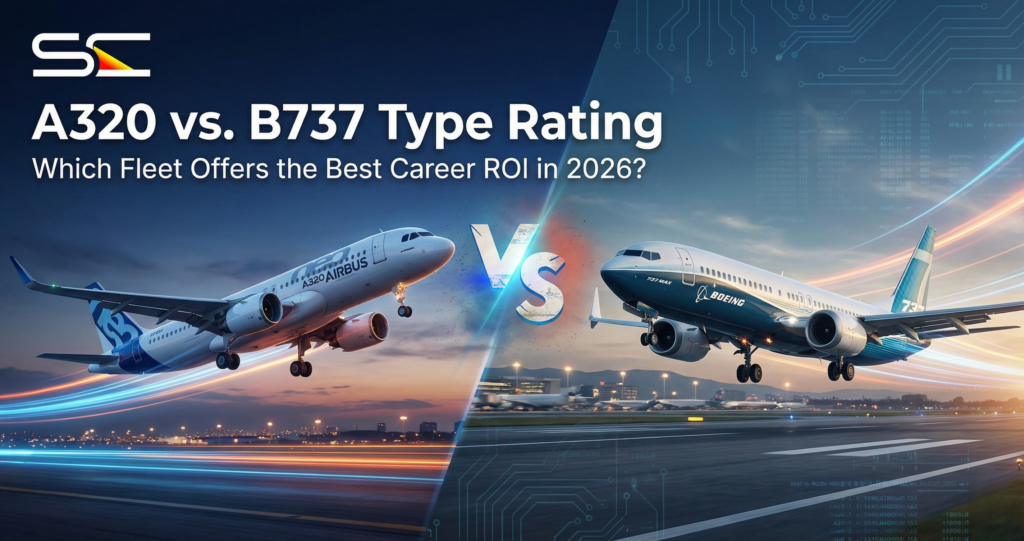
Choosing between an A320 and B737 type rating is the most critical financial decision of your 2026 pilot career. Both aircraft dominate the global narrowbody market, but they offer vastly different returns on investment depending on your location and goals. Here is the definitive guide to which fleet offers the best career ROI this year and how Simulator Center LLC can help you secure your future.
The 2026 Narrowbody Landscape
The aviation industry in 2026 is defined by a “Great Pilot Scramble.” With record-breaking aircraft orders and a massive wave of retirements, airlines are competing fiercely for type-rated flight crews.
- The “Great Pilot Scramble”: Hiring has reached a decade-high as carriers struggle to keep up with travel demand.
- A320 vs. B737 at a Glance: The Airbus A320neo family currently holds a ~60% market share, while the Boeing 737 MAX is ramping up production to 52 aircraft per month.
- The ROI Formula: True ROI isn’t just the cost of the course; it is your training cost subtracted from your projected 5-year earnings.
2026 Market Dynamics – Who is Winning the Skies?
Airbus has officially overtaken Boeing as history’s most-delivered jetliner family. However, this doesn’t mean the 737 is a losing bet.
The Market Share Shift
The A320neo family commands the majority of the narrowbody market. This dominance provides Airbus pilots with unparalleled job security across low-cost, charter, and flag carriers globally.
The Boeing Resurgence
Boeing has recovered its production pace in 2026. With a backlog of nearly 5,000 aircraft, 737-rated pilots are in high demand to staff new deliveries at major US and Asian carriers.
The A321XLR Factor
The rise of the A321XLR (Extra Long Range) has changed the game. This aircraft allows narrowbody pilots to fly 8-hour transatlantic routes—missions previously reserved for widebody jets. Because these routes are high-value, many airlines are offering premium “long-haul” pay scales to A320-rated crews, significantly boosting the rating’s ROI.
Type Rating Costs & Training Pathways
In 2026, training costs vary significantly by region. You must choose a path that balances quality with price.
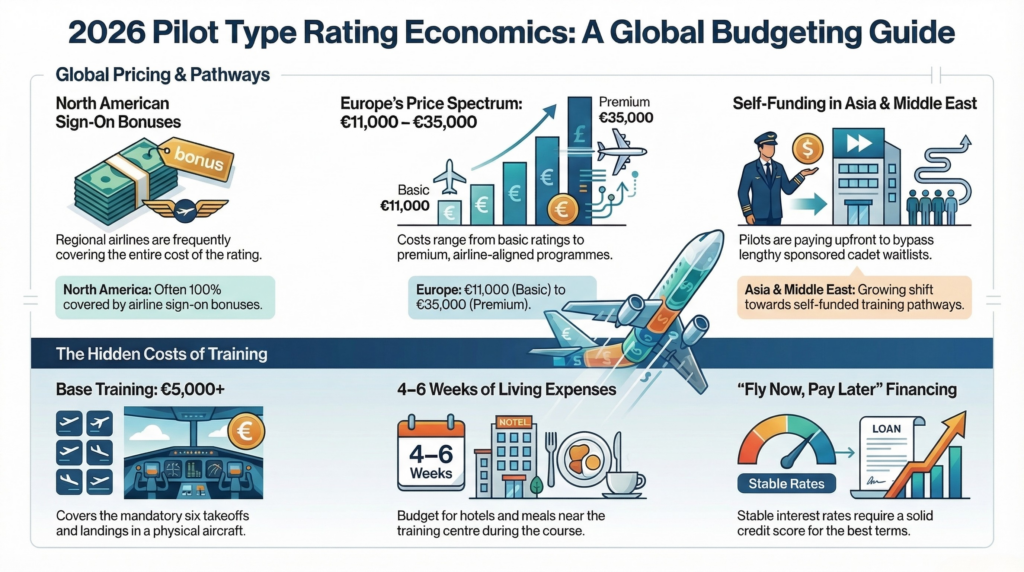
Global Pricing Comparison (2026)
- Europe: Expect to pay between €11,000 for a basic rating to €35,000 for “premium” airline-aligned programs.
- Asia & Middle East: Many pilots are now self-funding to bypass long waitlists for sponsored cadet programs.
- North America: Regional airlines are offering massive sign-on bonuses, often covering the entire cost of the rating.
The Hidden Costs
When budgeting, many pilots forget the “soft costs.” These include:
- Base Training: The required 6 takeoffs and landings in the actual aircraft (can cost €5,000+).
- Living Expenses: Budgeting for 4–6 weeks of hotels and meals near the training center.
- Credit Checks & Financing: If you are taking a loan, interest rates in 2026 have stabilized, but a solid credit score is required to secure the best “fly now, pay later” terms.
Salary & Compensation: The 2026 “Arms Race”
Airlines are in a “Salary Arms Race” to attract talent.
- Narrowbody Pay Scales: A senior Captain on a narrowbody at a major airline can now earn up to $450,000 annually, while first-year First Officers start between $90,000 and $110,000.
- The Per-Diem & Bonus Gap: 737 operators (like Southwest and Ryanair) often have unique productivity bonuses that can push a pilot’s total take-home pay above the base salary of an Airbus pilot.
- Quick Command ROI: In 2026, the 737 fleet often offers a slightly faster path to the Captain’s seat because of the rapid expansion of Low-Cost Carriers (LCCs).
Operational Reality – The Pilot’s Daily Life
ROI isn’t just about money; it’s about how you feel after a 4-sector day.
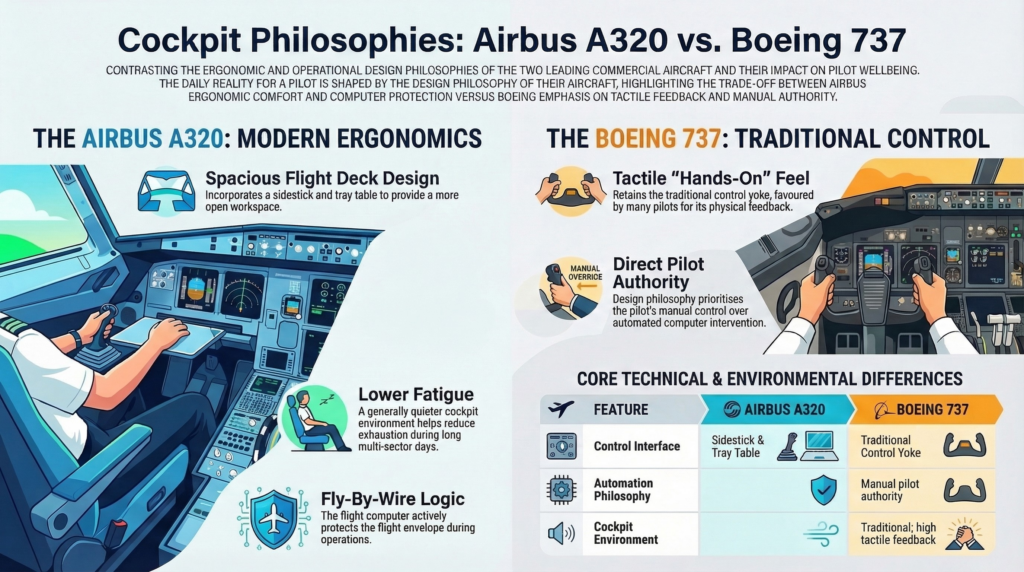
- Ergonomics & Fatigue: The Airbus A320 is famous for its tray table and sidestick, providing a spacious cockpit. The Boeing 737 retains the traditional yoke, which some pilots prefer for its tactile “hands-on” feel.
- Noise Levels: The A320 cockpit is generally quieter, which can lead to lower fatigue levels over a long career.
- Automation: Airbus uses “fly-by-wire” logic (the computer protects the flight envelope), while Boeing prioritizes pilot authority.
Future-Proofing Your Career
Your type rating is a stepping stone. You should consider where you want to be in 10 years.
Cross-Crew Qualification (CCQ)
The A320 rating makes it easy to transition to the A350 or A330. This “commonality” is a massive advantage if you want to fly widebody jets later.
Sustainability & SAF
As airlines shift to Sustainable Aviation Fuel (SAF) and “Green” operations in 2026, being rated on modern Neo or MAX variants is essential. Older CEO or NG ratings are becoming less valuable as airlines retire fuel-thirsty fleets.
The Verdict – Which Rating Should You Choose?
- Choose the A320 if you want maximum global flexibility and a path to high-tech widebody flying.
- Choose the B737 if you want to work for major US carriers or high-growth LCCs with potentially faster paths to Command.
No matter which path you choose, the key to a high ROI is professional, high-fidelity training. Simulator Center LLC provides the bridge to the airline flight deck with Level D full-motion simulators and expert instructors.
People Also Ask (FAQ)
Is the B737 MAX 10 vs. A321neo training different?
Yes. While they are similar to their predecessors, both require specific differences training. The A321neo training focuses on flight control laws, while the MAX 10 requires specific knowledge of its landing gear and takeoff performance.
Can I switch from A320 to B737 later?
Absolutely. Many pilots hold dual ratings. However, you will need to complete a full initial type rating for the new aircraft type, as there is no “shortened” conversion between Boeing and Airbus.
What is the average “break-even” time for a rating in 2026?
With current 2026 salary levels, most pilots recover their training investment within 8 to 14 months of starting their first airline job.
Does Simulator Center LLC offer job placement?
While we don’t guarantee jobs, our training is recognized by major airlines worldwide. We provide “Airline Assessment Preparation” to ensure you ace your interview and simulator check-ride.
Which aircraft is easier to fly?
“Easier” is subjective. Airbus pilots enjoy the automation and protection systems, while Boeing pilots often feel more “connected” to the aircraft through the mechanical yoke.
Is there a pilot shortage in 2026?
Yes, the shortage remains critical. Airlines are expanding fleets faster than they can train pilots, making 2026 one of the best years in history to enter the profession.
Ready to Launch Your Career?
Don’t leave your ROI to chance. Secure the highest quality training on the world’s most advanced simulators.
Contact Simulator Center LLC today to view our 2026 A320 and B737 training schedules.