FAA vs. EASA: Understanding the Framework
If you plan to fly an EASA-registered aircraft or reside in the European Union while operating a U.S. (N-registered) plane, holding only an FAA certificate is no longer enough. The European Union Aviation Safety Agency (EASA) and the Federal Aviation Administration (FAA) operate under different regulatory philosophies.
While the FAA focuses on practical demonstration, EASA places a heavy emphasis on theoretical knowledge. However, thanks to the TIP-L (Technical Implementation Procedures – Licensing) agreement, pilots now have a streamlined “fast track” for certain ratings that bypasses much of the traditional red tape.
Eligibility & Pre-Check: Do You Qualify for the “Fast Track”?
Before you start your flight training, you must meet specific residency and currency requirements.
- The Residency Rule: Your primary residence affects which National Aviation Authority (NAA) you should apply to. Whether it’s Germany’s LBA or Austro Control, you must choose one “State of Issue.”
- Verification of Authenticity: You must request the FAA to send a verification letter (Form 8060-71) directly to your chosen European authority.
- English Proficiency: While FAA licenses state “English Proficient,” EASA requires a formal ICAO Level assessment (Level 4, 5, or 6).
Converting an FAA PPL (Private Pilot License)
Under the BASA agreement, converting a PPL is the most straightforward path.
- Theoretical Knowledge: You don’t need to sit for nine written exams. Instead, you will have a verbal “oral exam” with your examiner during your skill test, covering Air Law and Human Performance.
- The Skill Test: You must pass a VFR skill test with an EASA examiner.
- Medical Requirements: You must obtain at least an EASA Class 2 Medical Certificate from an authorized European medical examiner.
Converting an FAA IR (Instrument Rating)
The “50-Hour Threshold” is the magic number for FAA pilots.
- Experience-Based Credit: If you have at least 50 hours of flight time under Instrument Flight Rules (IFR) as Pilot-in-Command (PIC), the conversion is simplified to an oral exam and a skill test.
- Competency-Based IR (CB-IR): For those with less than 50 hours, EASA offers the CB-IR route, which requires a reduced theoretical course and a flight checkride.
Converting FAA CPL/ATPL (Professional Licenses)
For commercial pilots, the process is more rigorous. EASA does not offer a direct “swap” for professional licenses.
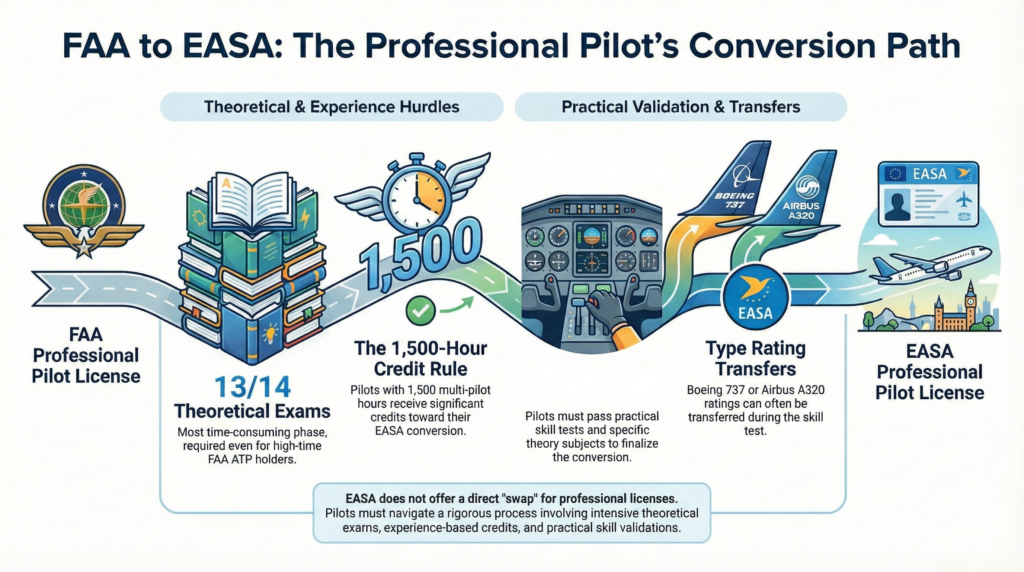
- The 13/14 Exams: Even high-time FAA ATP holders must usually pass the EASA ATPL theoretical knowledge exams. This is often the most time-consuming part of the process.
- The 1,500-Hour Rule: Pilots with 1,500 hours of multi-pilot experience can receive significant credits, but they must still pass the skill tests and specific theory subjects.
- Type Ratings: If you hold a Boeing 737 or Airbus A320 type rating, you can often transfer it to your EASA license during the skill test, provided you meet the experience requirements on that specific type.
Night Rating and Multi-Engine (MEP) Conversions
If your FAA license includes a night rating, it can be added to your EASA license if you can prove at least 5 hours of night flight time, including 3 hours of dual instruction and 5 solo take-offs/landings. Multi-Engine Piston (MEP) ratings require a specific class rating flight test.
Step-by-Step Conversion Workflow
Verification: Submit your FAA verification request.
The Medical: Get your EASA Class 1 (Commercial) or Class 2 (Private) medical.
The ATO: Join an Approved Training Organization (ATO) to handle your paperwork and training.
Theory Prep: Complete distance learning for the required exams.
The Checkride: Pass your EASA Skill Test with an authorized examiner.
Financial Planning: Costs and Timelines
Converting a license is an investment. While costs vary by country, here is a general breakdown:
- PPL Conversion: Usually costs between €3,000 and €5,000, including medical fees, aircraft rental, and examiner costs.
- Professional Conversion (CPL/ATPL): This can range from €7,000 to €15,000. The bulk of this cost comes from the ATPL theory courses and the mandatory flight hours needed to satisfy EASA’s specific maneuvers.
- Timeline: A PPL conversion can be done in 2–4 weeks if your paperwork is ready. A professional conversion typically takes 6–12 months due to the volume of theory exams.
The “N-Reg” Pilot Trap: Recent Regulatory Changes
Many pilots believe they can live in Europe and fly an N-registered aircraft forever using only their FAA license. Since June 20, 2022, this is no longer true for EU residents.
- The Operator Rule: If you are “established or residing” in the EU, you are legally required to hold an EASA license to fly any aircraft, regardless of its country of registration.
- Dual Licensing: To stay legal, you must maintain both licenses—the FAA license to satisfy the aircraft’s registration state and the EASA license to satisfy your state of residence.
Post-Conversion: Keeping Your EASA License Valid
EASA licenses do not expire, but the ratings on them do.
- Revalidation: This happens before your rating expires (e.g., every year for a Single-Pilot MEP). It usually involves a proficiency check or experience-based signatures.
- Renewal: If you let a rating expire, you must go through a “renewal” process at an ATO, which involves additional training before the checkride.
- One License Rule: You can only hold one EASA license at a time. If you move from France to Spain, you must eventually transfer your “records” to the new authority.
The Professional Solution: Simulator Center LLC
Navigating the complexities of license conversion can be overwhelming. Whether you are an FAA pilot looking to gain a competitive edge or a professional transitioning to European operations, Simulator Center LLC provides the expert guidance you need. Specializing in high-fidelity simulation and tailored conversion programs, Simulator Center LLC ensures you are fully prepared for the EASA skill test. Their experienced instructors bridge the gap between FAA and EASA standards, making your transition seamless and efficient.
People Also Ask (FAQ)
Can I convert my FAA license to EASA without taking any exams?
Only if you are converting a PPL under the BASA agreement. In this case, the written exams are replaced by an oral exam during your flight test. For CPL or ATPL, written exams are mandatory.
Do I have to give up my FAA license to get an EASA one?
No. You can—and in many cases, must—hold both licenses simultaneously. They are independent of each other.
Is an EASA Class 1 medical harder to get than an FAA First Class?
Generally, yes. EASA has stricter requirements for initial certification, particularly regarding vision and cardiovascular health. It must be done at an Aero-Medical Center (AeMC).
How many hours do I need to convert to an EASA CPL?
You need at least 200 hours of total flight time. Most FAA pilots already have this, but you will still need “brush-up” training (usually 5-15 hours) at a European ATO to learn EASA-specific procedures.
Can I do my EASA training in the United States?
Yes, but only at an EASA-certified flight school. Simulator Center LLC offers advanced training solutions that help prepare you for international standards.
Does the conversion cover my type ratings?
Yes, provided you meet the experience requirements (usually 500 hours on type for multi-pilot aircraft) and pass a proficiency check with an EASA examiner.
Is the conversion valid in the UK after Brexit?
The UK CAA is no longer part of EASA. While the processes are currently similar, you must apply specifically to the UK CAA if you intend to fly UK-registered aircraft or reside in the UK.
Ready to take the next step in your aviation career? Don’t let regulatory hurdles keep you grounded. Contact Simulator Center LLC today to build a personalized conversion plan and master the flight deck.