
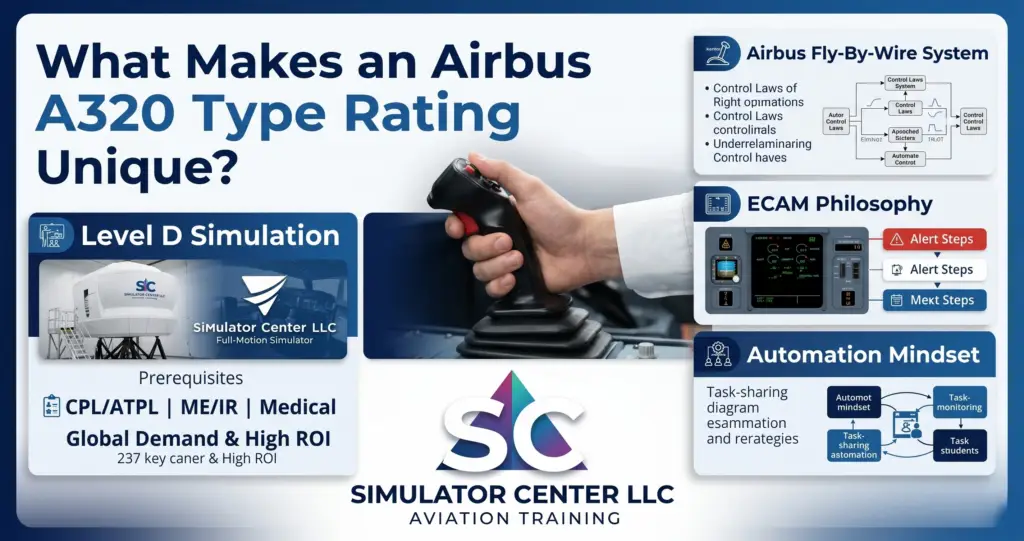
The Airbus A320 type rating is one of the most highly sought-after certifications in commercial aviation today. Earning this rating opens doors to legacy and regional airlines across the globe. By understanding what makes this training unique, pilots can better prepare for a successful transition into the cockpit of the world’s favorite narrow-body airliner.
The Gateway to Modern Commercial Aviation
What is a Type Rating and Why Does it Matter?
A type rating is an advanced certification required by aviation authorities to operate specific transport-category aircraft. Unlike standard pilot training, which covers general flight principles, a type rating focuses deeply on a single airframe. It ensures that a pilot is thoroughly competent in the exact systems, weights, and operating procedures of that specific machine.
The Airbus A320 Family: A Global Aviation Standard (CEO vs. NEO Variants)
The Airbus A320 family stands as a pillar of modern commercial aviation. It spans the classic Current Engine Option (CEO) models up to the highly efficient New Engine Option (NEO) variants. The sheer volume of these jets in active service means that obtaining an A320 certification is one of the safest investments a pilot can make for long-term career stability.
The Core Technical Elements: What Makes the A320 Type Rating Unique?
The Fly-By-Wire (FBW) Paradigm Shift
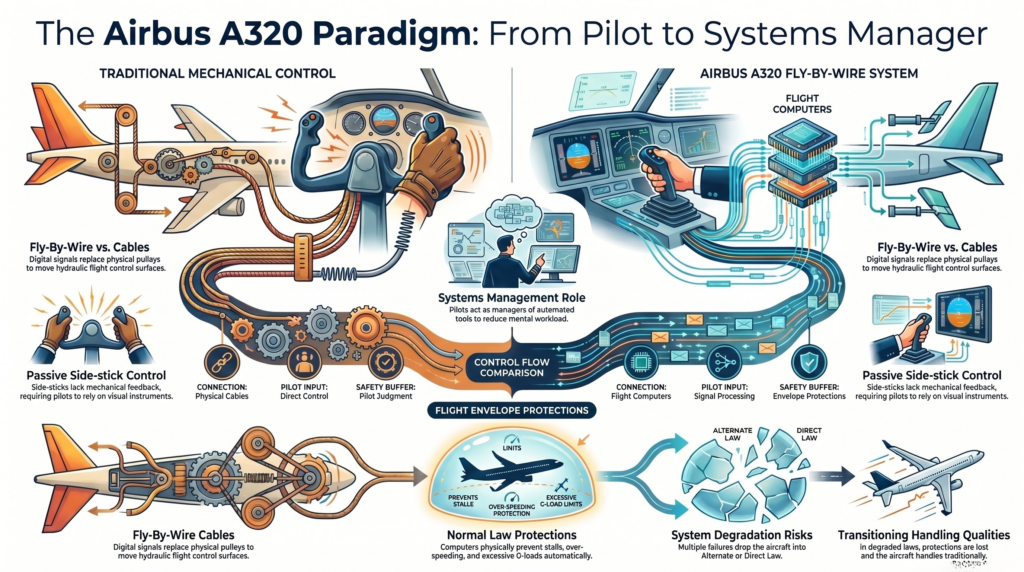
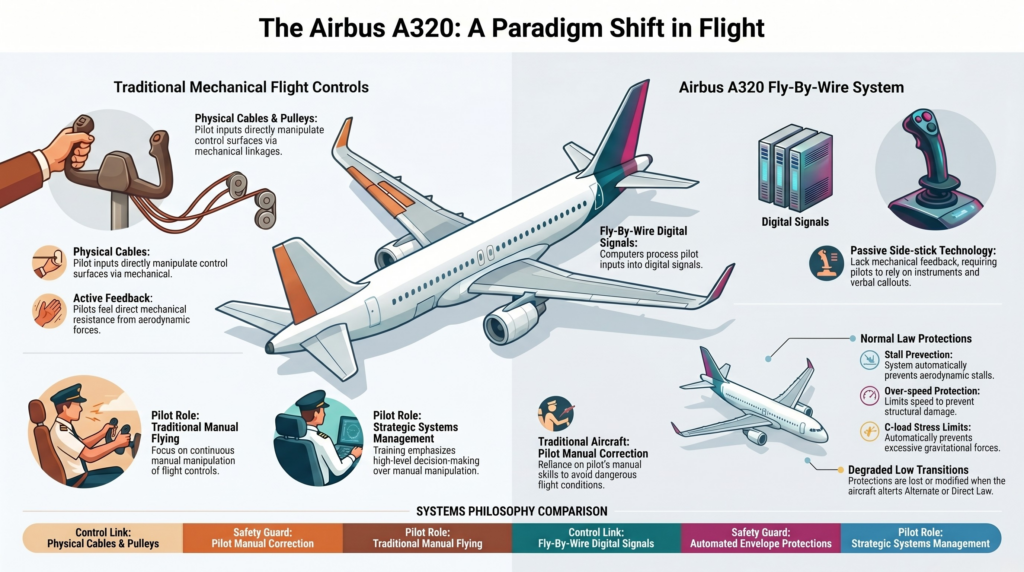
The most defining feature of an Airbus A320 type rating is learning to fly an aircraft governed by Fly-By-Wire (FBW) technology. In older, conventional airplanes, mechanical cables and pulleys directly move the flight controls.
On the A320, the pilot’s inputs are converted into digital signals. Computers process these signals and tell hydraulic actuators how to move the control surfaces. This shift changes the very nature of how a pilot interacts with the aircraft.
Airbus Automation Philosophy: Task Sharing vs. Traditional Flying
Airbus designed the A320 around a clear automation philosophy: the aircraft is a highly automated tool, and the pilots are systems managers. Training focuses heavily on task sharing, strict workload management, and monitor-heavy routines. Pilots learn to let the automation reduce their mental burden so they can focus on high-level decision-making during complex operational scenarios.
Side-stick Controllers and Lack of Mechanical Feedback
Transitioning to an Airbus means trading the traditional control yoke for a side-stick. The A320 side-stick is passive, meaning it does not move in tandem with the other pilot’s stick. Because there is no mechanical feedback or physical connection between the two seats, pilots must learn to rely entirely on visual instruments and strict verbal callouts to maintain situational awareness.
+-------------------------------------------------------------+
|               THE AIRBUS AUTOMATION PHILOSOPHY              |
+-------------------------------------------------------------+
|  Traditional Aircraft:         Airbus A320 System:          |
|  [Pilot Input]                 [Pilot Input]                |
|       │                             │                       |
|       ▼                             ▼                       |
|  (Physical Cables)           (Flight Computers)             |
|       │                             │                       |
|       ▼                             ▼                       |
|  [Flight Controls] <───────> [Envelope Protections Prevent] |
|                              [Stalls, G-loads, & Over-speed]  |
+-------------------------------------------------------------+
Flight Envelope Protection: How the Aircraft Defends Itself
One of the most vital components of the A320 training curriculum is learning the aircraft’s control “laws.” Under normal operations (Normal Law), the aircraft computers enforce strict flight envelope protections. This means the system will physically prevent the pilot from over-speeding, over-stressing, or stalling the aircraft, no matter how hard the side-stick is deflected.
However, if multiple system failures occur, the aircraft degrades into Alternate Law or Direct Law. In these degraded states, protections are lost or modified, and the aircraft handles more like a traditional airplane. Mastering these laws and knowing exactly when the plane will defend itself—and when it will not—is a core challenge of the A320 rating.
The Strategic Advantage: Fleet Commonality & Career ROI
Cross-Crew Qualification (CCQ): Upgrading to the A330, A350, and A380
Airbus engineered its entire modern fleet with a uniform cockpit design and handling philosophy. This feature, known as fleet commonality, allows for Cross-Crew Qualification (CCQ).
Once a pilot holds an A320 type rating, upgrading to a wide-body aircraft like the A330 or A350 does not require starting training from scratch. Instead, it takes a short, highly accelerated course lasting just a few days. This makes an A320 rating highly valuable for pilots who want to advance quickly to long-haul routes later in their careers.
Unmatched Global Demand and Market Domination
Airlines on every continent operate thousands of A320 family aircraft. From low-cost carriers to major legacy airlines, the demand for certified A320 pilots remains incredibly high. Holding this rating makes a resume instantly attractive to hundreds of global operators.
The Ideal Entry Point for Low-Hour Airline Pilots
For newly licensed commercial pilots, the A320 is often the easiest entry point into transport-category jet operations. The cockpit logic is intuitive, the training pipelines are well-established, and many airlines actively recruit first officers who already possess the rating.
Prerequisites and Eligibility Requirements
Licensing Standards: CPL or ATPL Boundaries
To enroll in an A320 type rating course, an individual must hold either a valid Commercial Pilot License (CPL) or an Airline Transport Pilot License (ATPL). The specific entry point depends on the regulatory authority overseeing the training.
Multi-Engine and Instrument Ratings (ME/IR)
Pilots must have an active Multi-Engine rating and an Instrument Rating. Operating an airliner requires flying complex, multi-engine procedures completely by reference to cockpit instruments, making these foundational skills non-negotiable.
Multi-Crew Cooperation (MCC) Certificate
Because commercial airliners require a two-pilot crew, applicants must hold a Multi-Crew Cooperation (MCC) certificate before initial type rating training. This training ensures that pilots know how to communicate, share tasks, and function effectively as a cohesive team.
Medical Fitness Standards (Class 1)
A valid Class 1 Medical Certificate is mandatory. Pilots must meet the highest standards of physical and mental health to exercise the privileges of an airline-level certification.
The Training Process: From Systems Mastery to the Cockpit
Systems Mastery & Integration Training (SIT) Ground School
Training begins with ground school, which focuses heavily on Computer-Based Training (CBT) modules and Systems Integration Training (SIT). Pilots learn the inner workings of the electrical, hydraulic, pneumatic, and fuel systems. They must also learn the language of the Electronic Centralized Aircraft Monitor (ECAM), which is the primary system used to monitor the health of the jet.
Mastering the ECAM Philosophy
Unlike older jets where pilots look up emergency checklists in paper manuals, the A320 displays faults and step-by-step resolution steps directly on the center ECAM screen.
Pilots are trained in a rigid discipline: Read the line, confirm the control, execute the action. Learning to trust the ECAM and following its logic without rushing is a major paradigm shift for pilots accustomed to traditional emergency checklists.
Level D Full-Motion Simulation & Tactical Management
Once ground school is complete, students step into the simulator. For an elite training experience, Simulator Center LLC provides access to state-of-the-art Level D Full-Motion Simulators at their Miami Springs training hub.
These full-motion simulators perfectly replicate the exact flight characteristics, high-fidelity visual environments, and physical sensations of flying a real A320. Under the guidance of veteran instructors, pilots practice normal profiles, manual handling skills, and extreme emergency scenarios until their reactions become second nature.
       [ Phase 1: Ground School & SIT ]
                       │
                       ▼
       [ Phase 2: ECAM Emergency Logic ]
                       │
                       ▼
   =>  [ Phase 3: Level D Full-Motion Sim ]  *Simulator Center LLC*
                       │
                       ▼
       [ Phase 4: FAA / EASA Checkride ]
The Skill Test & Passing Your FAA Checkride
The culmination of the course is the formal checkride. Conducted by a certified examiner, this test evaluates a pilot’s ability to safely manage the aircraft under normal, abnormal, and emergency conditions. Passing this test officially adds the A320 endorsement to the pilot’s license.
Aircraft Base Training: The “6 Takeoffs and Landings” Rule
In certain international jurisdictions, such as under EASA regulations, passing the simulator checkride is not the final step for initial type ratings. Pilots without prior jet experience must complete actual base training.
This requirement involves taking a real, empty A320 aircraft up to an airfield to perform at least six takeoffs and landings. This step ensures the pilot can handle the transition from the virtual simulator environment to the actual aircraft before carrying passengers.
Regulatory & International Training Pathways
FAA vs. EASA vs. DGCA Training Hours and Checkride Differences
Aviation authorities govern type ratings differently. The American FAA, European EASA, and Indian DGCA each have unique rules regarding required ground school hours, simulator profiles, and prerequisite flight times. Navigating these regulatory differences can be challenging for international students.
The FAA License Conversion Pathway for International Pilots
For international pilots holding ICAO, EASA, or DGCA licenses, converting their credentials to an FAA certificate is a powerful way to boost global employment opportunities. Simulator Center LLC specializes in these regulatory conversion pathways.
Their admissions team handles the credential verification process and provides tailored, examiner-aligned simulator training. This pathway helps foreign pilots adapt efficiently to American airspace regulations and standard operating procedures.
Self-Funded vs. Airline-Sponsored Type Ratings
Historically, airlines paid for all pilot type ratings. Today, self-funding a type rating has become an incredibly popular way for pilots to jump ahead in the hiring queue. Paying for the course out-of-pocket requires a significant upfront financial investment, but it often rewards pilots with faster employment, higher starting pay, and immediate placement into regional or mainline carriers.
Common Challenges & Mental Workloads During Training
Transitioning from a Conventional Yoke to a Side-Stick
For pilots who have spent hundreds of hours flying with a traditional control column, moving to a side-stick feels unnatural at first. The left hand (for Captains) or right hand (for First Officers) must develop precise muscle memory. Because the side-stick requires very little physical effort, over-controlling the aircraft during crosswind landings is a common hurdle.
Understanding and Trusting the FMA (Flight Mode Annunciator)
The ultimate rule of flying an Airbus is: “Always read your FMA.” The Flight Mode Annunciator is a small visual display at the top of the Primary Flight Display (PFD). It tells the pilot exactly what mode the autothrust and autopilot are in.
Students often make the mistake of looking at the physical positions of the thrust levers or switches instead of reading the FMA. Learning to look at the screen to know exactly what the flight computers are doing is essential to passing the course.
Crucial Airbus Rule: The physical thrust levers on an A320 do not move automatically when the autothrust changes power. Pilots must break the habit of watching the levers and learn to read the Flight Mode Annunciator (FMA) to verify engine power states.
Managing the High Mental Workload of the Jet Environment
The speed of a jet completely changes the timeline of a flight. Events happen much faster than they do in a piston training airplane. Pilots must learn to think miles ahead of the aircraft, anticipating arrivals, descents, and weather deviations well before they happen.
Overcoming Simulator Fatigue and Communication Barriers
Intensive simulator training can cause immense physical and mental fatigue. Combined with the challenges of Crew Resource Management (CRM) and working with crew members from different cultural backgrounds, maintaining clear communication under pressure is a skill that must be practiced constantly.
Tips for Success: How to Pass Your A320 Checkride on the First Attempt
- Master Chair Flying: Spend hours sitting in a mock cockpit or using static posters to practice physical flow patterns. Your hands should automatically know where to reach without you having to look for the switch.
- Study the SOPs Early: Memorize your airline or training center’s Standard Operating Procedures (SOPs) before your first simulator session. The sim is for learning to fly the plane, not for reading memory items.
- Leverage Active Captain Differentiators: Train with organizations that use active airline captains as instructors. Simulator Center LLC ensures that all simulator sessions are led by highly experienced aviators who bring real-world airline wisdom and examiner expectations straight to your briefings.
- Prioritize CRM Discipline: Treat your sim partner as a vital asset. Good Crew Resource Management, clear briefing habits, and professional communication save crews during difficult checkrides.
Maintaining Currency and Recurrent Training
The 12-Month Revalidation Check
An A320 type rating does not last forever. To keep the rating active, pilots must undergo a revalidation check every 12 months. This ensures that skills do not degrade over time and that safety standards remain high.
LPC (License Proficiency Check) vs. OPC (Operator Proficiency Check)
A License Proficiency Check (LPC) is required by the regulatory authority to keep the pilot’s license valid. An Operator Proficiency Check (OPC) is conducted internally by an airline to ensure the pilot meets the specific company standard operating procedures. Both require extensive simulator testing to verify emergency handling capabilities.
Conclusion:
Earning an Airbus A320 type rating is a definitive milestone that can launch a pilot’s commercial career to new heights. While the technical shift to fly-by-wire logic, ECAM emergency procedures, and automation management is challenging, training with the right institution makes all the difference.
Simulator Center LLC offers the ultimate environment for pilots to achieve operational excellence. Based in Miami Springs, Florida, their facility provides 24/7 access to state-of-the-art Level D Full-Motion Simulators, flexible scheduling blocks, and direct instruction from veteran airline captains. Whether you are looking for an initial type rating, preparing for a high-stakes airline interview assessment, or completing an international FAA license conversion, their team delivers professional training built to global airline standards.
Ready to secure your spot on the flight deck? Contact the admissions experts at Simulator Center LLC today to map out your customized route to career advancement.
Frequently Asked Questions (FAQs)
How long does an A320 type rating take to complete?
A standard, comprehensive A320 type rating program typically takes between 28 and 33 days to complete. This timeframe includes intensive ground school modules, systems integration training, and extensive full-motion simulator sessions, culminating in the final checkride.
What is the average cost of an A320 type rating?
The cost of an A320 type rating generally ranges from $10,000 to $15,000 USD, depending on the training facility, regulatory authority (FAA vs. EASA), and whether the course includes additional certifications like the ATP-CTP.
Can I fly an A321 or A319 with an A320 type rating?
Yes. One of the greatest benefits of the Airbus family is its single-fleet type rating. A single A320 type rating allows a pilot to legally operate the A318, A319, A320, and A321 models, as they all share identical cockpit commonality.
Does Simulator Center LLC assist international students with housing and logistics?
Yes. Simulator Center LLC caters to a global student base at their Miami Springs training hub. Their support team assists international pilots with local logistics, accommodation recommendations, and documentation tracking for smooth transitions.
What is the difference between a type rating and hourly simulator training?
A type rating is a formal, regulated certification course that adds a specific aircraft endorsement to a pilot’s license. Hourly simulator training focuses strictly on skill refreshes, airline assessment preparation, or maintaining currency without issuing a new rating.