
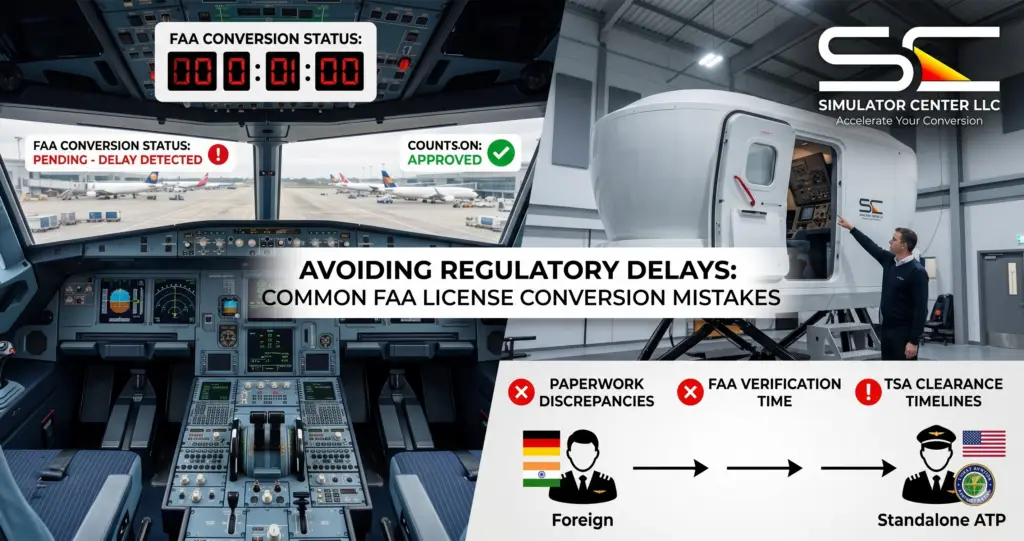
Converting a foreign pilot license to an FAA certificate opens doors to elite global aviation careers, but navigating the administrative process can be incredibly challenging. Every year, thousands of international aviators experience costly delays because of easily avoidable clerical and regulatory missteps. Understanding these common mistakes is the secret to moving smoothly from your home country’s license to an FAA jet qualification.
The Reality of FAA Conversion Timelines
The Federal Aviation Administration (FAA) has transitioned heavily toward digital systems over the last few years. While platforms like the Airmen Certification and Rating Application (IACRA) and the Designee Management System (DMS) aim to streamline workflows, they have also introduced strict digital filters.
The Airmen Certification Branch (AFS-760) handles all foreign verifications. Because they process applications from all over the world, any error on your paperwork will cause your application to be rejected and sent to the back of the line.
Pilots must understand the two primary conversion pathways:
- The 14 CFR § 61.75 “Piggyback” Certificate: This process grants you an FAA private pilot certificate based on your foreign license. It remains legally tied to the validity of your foreign credentials.
- A Standalone FAA Commercial or Airline Transport Pilot (ATP) Certificate: This is an independent FAA license. It requires passing written exams, meeting flight hour minimums, and completing a practical checkride.
The Simulator Center LLC Advantage
For pilots seeking a standalone certificate, the transition involves complex training requirements. Simulator Center LLC, located right next to Miami International Airport in Miami Springs, Florida, serves as a comprehensive training hub to bridge this gap. They provide the certified ground schools, FAA-approved ATP-CTP courses, and advanced Level D full-motion simulators needed to turn your foreign credentials into an independent FAA license without missing a beat.
The Fatal Paperwork Discrepancies (Data Integrity)
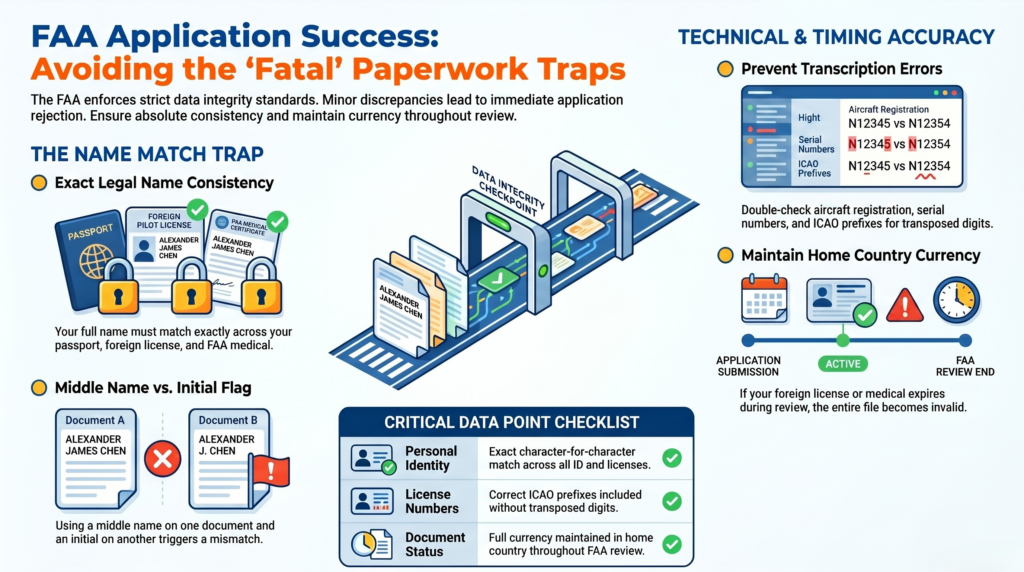
The FAA values strict data integrity. The most common cause for immediate application rejection is a mismatch of basic personal information across official documents.
The Name Match Trap
Your full legal name must match exactly across your passport, your foreign civil aviation license, and your FAA medical certificate. If your home country license includes a middle name but your passport uses a middle initial, the FAA digital system will trigger a mismatch flag.
Transcription Errors
When typing your application data into the FAA systems, a single transposed digit will halt the process. Reviewers frequently see pilots confuse their aircraft registration numbers, serial numbers, or ICAO license prefixes with their actual core license numbers.
Currency Failures during Review
The verification process takes time. If your foreign medical certificate or your home country license privileges expire while the FAA is reviewing your application, the entire file becomes invalid. You must maintain complete currency in your home country throughout the entire conversion window.
Mismanaging the Verification of Authenticity Process
Many pilots assume that submitting an application means their training can begin immediately. In reality, the background verification process requires a significant time investment.
Factoring in the AFS-760 Timeline
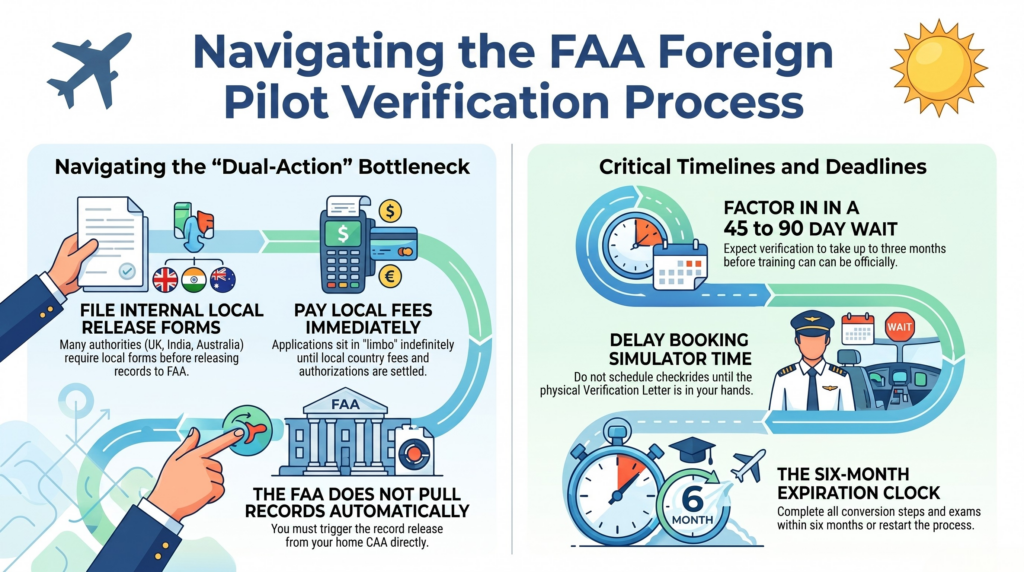
The initial Verification of Authenticity process usually takes between 45 and 90 days. Attempting to book simulator time or schedule a checkride before this letter is physically in your hands is a recipe for expensive rescheduling fees.
The Dual-Action Bottleneck
The FAA does not pull your records automatically; they must request them from your home Civil Aviation Authority (CAA). However, many foreign CAAs—such as the UK CAA, India’s DGCA, or Australia’s CASA—will not release your records to the FAA until you file an internal release form with them directly.
[Pilot Files with FAA] ➔ [FAA Requests Records] ➔ [Foreign CAA Holds Request] ➔ [DELAY]
                                                       ▲
                                        (Requires Local Release Form & Fee)
If you do not submit this local authorization and pay any required local fees to your home country authority, your application will sit in limbo indefinitely.
The Six-Month Expiration Clock
Once the FAA successfully verifies your documents, they will issue an official Verification Letter. This letter is only valid for exactly six calendar months. If you do not complete your conversion, written exams, and practical tests within this timeframe, you must restart the verification process from the beginning.
Missing the Country-Specific Regulatory Gatekeepers
Different bilateral agreements require different processing steps. Treating the FAA conversion as a one-size-fits-all process leads to major timeline disruptions.
The EASA-to-FAA BASA/TIP-L Agreement
Pilots converting an EASA license can take advantage of the Technical Implementation Procedures for Licensing (TIP-L) under the bilateral safety agreement. While this simplifies the process, it requires specific theoretical knowledge exams and explicit proof of EASA currency that must be validated correctly.
The TSA Flight Training Security Program (FTSP) Interdependency
If you are a non-U.S. citizen seeking a standalone FAA certificate or an initial Type Rating, you must clear a Transportation Security Administration (TSA) background check.
The security review requires submitting fingerprints and background data before you can step into a flight training device. Pilots frequently wait until they arrive in the United States to start this process, which grounds them for weeks while waiting for TSA approval.
Special Administrative Needs for DGCA and GCAA
Navigating conversions from India (DGCA) or the Middle East (GCAA/GACA) requires careful tracking. These authorities often have extensive verification backlogs and require additional notarized statements or direct verification tracking tokens before responding to the FAA’s requests.
Misinterpreting Flight Experience and Logbook Rules
Meeting the total time requirements under your home country’s rules does not guarantee that you meet the FAA’s legal definitions under 14 CFR Part 61.
The 1,500-Hour Myth
To obtain an FAA ATP certificate, you need 1,500 hours of total flight time. However, the FAA audits how those hours were earned. For example, some foreign authorities allow pilots to log co-pilot (SIC) time as cruise-only pilot time, or count simulator hours toward total flight time. The FAA will deduct these hours during a strict logbook audit.
Night Flying and Cross-Country Definition Mismatch
The FAA has strict definitions for specific types of flight time:
- Cross-Country Time: For most certificates, this requires a landing at an airport more than 50 nautical miles away from the original departure point. Many foreign countries define cross-country simply as any flight leaving the local traffic pattern.
- Night Time: The FAA defines night flying precisely by the period between the end of evening civil twilight and the beginning of morning civil twilight.
If your logbook entries do not conform to these specific U.S. legal definitions, an FAA inspector or Designated Pilot Examiner (DPE) can reject your hours right before your scheduled checkride.
Certified English Translations
If your original pilot logbook entries, remarks, or endorsements are written in a language other than English, they must be accompanied by a certified translation. Self-translations are not accepted.
Poor Planning of the ATP-CTP and Jet Type Rating Window
For airline pilots, getting an FAA license is usually paired with obtaining a jet type rating, such as an Airbus A320 or Boeing 737 qualification. Mismanaging the order of these steps can ruin your training schedule.
[FAA Verification Letter] ➔ [Complete ATP-CTP Course] ➔ [Pass ATM Written Exam] ➔ [Pass Level D Sim Checkride]
The 60-Month Written Exam Trap
To earn an FAA multi-engine ATP certificate, you must pass the Airline Transport Pilot Multi-Engine (ATM) knowledge test. This written test is valid for 24 to 60 calendar months depending on the specific operation, but it cannot be taken until you complete a mandatory prerequisite course.
The Sequencing Blunder: Forgetting the ATP-CTP
You cannot register for the FAA ATM written exam until you have completed an authorized Airline Transport Pilot Certification Training Program (ATP-CTP). This course includes 30 hours of academic ground school and 10 hours of training in advanced flight training devices and Level D simulators.
Pilots often attempt to book their written exams or checkrides before completing this course, causing major disruptions to their training schedule. Simulator Center LLC solves this sequencing problem by hosting the entire ATP-CTP course in-house, letting you seamlessly transition from ground school directly to the ATM written exam room.
Overcoming DPE Availability Shortages
The FAA’s reliance on the Designee Management System means that Designated Pilot Examiners (DPEs) operate on tight schedules. Finding an available examiner for a jet checkride can take months if you try to schedule it independently. Training centers with established examiner networks are essential for avoiding these bottlenecks.
Digital & Platform Execution Blunders
Navigating online portals incorrectly can cause software locks that require manual intervention from FAA IT staff to fix.
The Dual Account Dilemma in IACRA
When registering in the FAA’s IACRA portal, you will receive a unique Federal Aviation Number (FAN). A common mistake made by international pilots is creating one account for their initial verification and a second account when registering for a written test or flight school training.
This creates a duplicate profile in the FAA database. When conflicting profiles emerge, the system automatically locks your file, requiring weeks of manual review by FAA technicians to merge the data.
The “English Proficient” Endorsement
The ICAO English Proficient endorsement must be explicitly visible and valid on your foreign license. The FAA will not issue a certificate without verifying this language proficiency requirement during the initial application screening.
The Roadmap to a Delay-Free Conversion
To avoid these common mistakes, follow this optimized chronological roadmap:
Pre-Application Verification & Home CAA Authorization
- Audit all your documents to ensure names, dates, and numbers match perfectly.
- Submit your formal verification request to the FAA via IACRA.
- Immediately file the necessary release forms and pay the processing fees with your home country’s CAA to authorize the data transfer.
Parallel Processing
- Once the FAA begins reviewing your paperwork, submit your security application to the TSA Flight Training Security Program (FTSP).
- Book your travel and secure your training slots at an approved facility.
The Miami Springs Training Residency
- Arrive at Simulator Center LLC in Miami Springs, Florida.
- Complete your comprehensive 40-hour ATP-CTP ground school and simulator modules.
- Take and pass your FAA ATM written knowledge exam at a certified testing center.
Final Qualification & Career Launch
- Complete your jet type rating training in high-fidelity Level D full-motion simulators.
- Complete your practical checkride with an integrated Designated Pilot Examiner (DPE) to receive your temporary FAA certificate.
Frequently Asked Questions (People Also Ask)
Can I complete my FAA conversion if my foreign medical certificate expires?
No. For the FAA to verify and issue an airman certificate based on a foreign license, your foreign license and its associated medical certificate must be completely valid and current. If either expires during the verification window, the process stops until you renew them with your home authority.
Can I combine my FAA License Conversion with an A320 or B737 Type Rating at Simulator Center LLC?
Yes. Simulator Center LLC specializes in helping international pilots bundle their license conversion needs. You can complete your mandatory ATP-CTP course, pass your written exams, and complete a full Airbus A320, Boeing 737, or Boeing 757 Level D simulator type rating course all at the same location.
What is the fastest way to resolve an administrative issue with AFS-760?
The most effective way to resolve an administrative issue is to ensure your application is accurate before submitting it. If an issue does arise, you must coordinate directly with the FAA Airmen Certification Branch via their official contact channels or work through an authorized training provider who can help pinpoint where your paperwork is stuck in the digital system.
Does the FAA accept digital logbooks from foreign electronic tracking applications?
Yes, the FAA accepts digital logbooks, but they must be clearly formatted, readable, and formally signed or certified by the pilot or an authorized instructor. The logbook must also clearly break down hours into the specific categories required by the FAA, such as cross-country distances greater than 50 nautical miles and precise night flight definitions.
How long does the TSA background check take for international pilots?
The TSA Flight Training Security Program (FTSP) background check usually takes between two to four weeks to process after you submit your fingerprints and pay the required fees. It is highly recommended to start this process well before your scheduled simulator training dates to avoid being locked out of training.
Secure Your Certification Timeline Today
Don’t let administrative mistakes or paperwork delays stall your international aviation career. By partnering with an experienced training center, you can avoid these common regulatory traps and keep your career moving forward.
Contact the admissions and compliance team at Simulator Center LLC today to lock in your training path. Visit Simulator Center LLC to schedule your ATP-CTP course, book high-fidelity Level D simulator time, and ensure your FAA license conversion is handled correctly from day one.