The FAA ATP-CTP course is the definitive bridge between being a commercial pilot and taking command of a multi-engine jet in an airline environment. Since the FAA mandated this training in 2014, it has become the non-negotiable gateway for every aviator aiming for the majors.
At Simulator Center LLC, we provide the elite environment and seasoned mentorship you need to move beyond the flight school mindset and step into professional airline operations.
What is the ATP-CTP? (And Why the FAA Requires It)
The Definition
The Airline Transport Pilot Certification Training Program (ATP-CTP) is a prerequisite course. You must complete it before you are allowed to sit for the ATP Multi-Engine (ATM) knowledge test. It isn’t just a hurdle; it is a foundational shift in how you fly.
The “Public Law 111-216” Context
Following several high-profile aviation accidents, the FAA recognized that high-time pilots needed more than just hours—they needed specific training in complex systems. Public Law 111-216 was passed to ensure every airline pilot understands high-altitude aerodynamics and multi-crew coordination before they ever carry a passenger.
Bridging the Gap
We designed our program to bridge the gap between “flying an airplane” and “managing a crew.” You transition from being a single pilot in a piston aircraft to a crew member in a sophisticated jet, where communication and systems management are just as important as your hands on the yoke.
Do You Qualify for the ATP-CTP?
Prerequisites vs. Certification Requirements
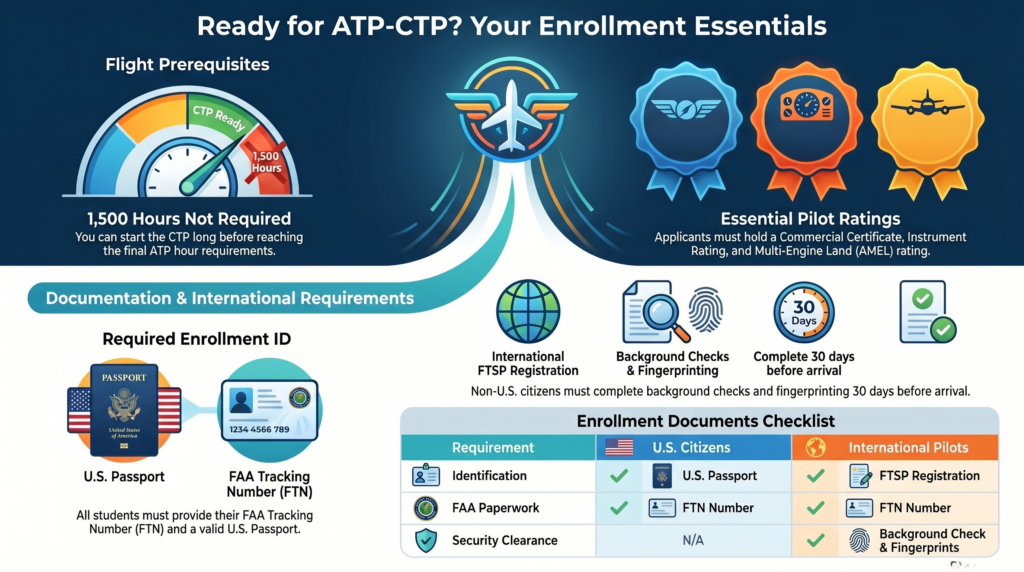
A common misconception in the hangar is that you need 1,500 flight hours to start the ATP-CTP. This is incorrect. While you need those hours to receive your final ATP certificate, you can take the CTP much earlier. To enroll at Simulator Center LLC, you only need:
- A Commercial Pilot Certificate.
- An Instrument Rating.
- A Multi-Engine Land (AMEL) rating.
Required Documents
When you arrive for day one, ensure you have your FAA Tracking Number (FTN) and proof of citizenship (such as a valid U.S. Passport). We handle the paperwork so you can focus on the syllabus.
TSA & International Pilots
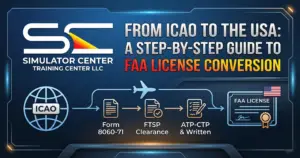
For our international colleagues, the process has become more streamlined in recent years. If you are a non-U.S. citizen, you must register with the Flight Training Service Program (FTSP). This involves a background check and fingerprinting. We recommend starting this process at least 30 days before your arrival to ensure your training stays on schedule.
Inside the ATP-CTP Curriculum: Ground School & Simulators
The 30-Hour Ground School
Our ground school is led by veteran captains who have “been there, done that.” We cover:
- High-Altitude Aerodynamics: Understanding why jet upsets happen and how to prevent them.
- Meteorology: Mastering low-visibility operations and severe weather avoidance.
- Air Carrier Operations: Navigating the complex world of Part 121 regulations.
The 10-Hour Flight Simulation Phase
This is where the theory comes to life. We utilize two levels of simulation:
Level 4/5 FTD (4 Hours): We focus on the “box”—mastering the Flight Management System (FMS) and the flight deck layout.
Full Flight Simulator (6 Hours): You step into a Level D simulator. These devices offer full motion and 180-degree visuals. You will practice stalls, upset recovery, and high-altitude handling in a jet that feels entirely real.
The Rise of Virtual Training
We understand that your time is valuable. Simulator Center LLC now offers Virtual Instructor-Led Training (VILT). This allows you to complete the 30 hours of academic ground school from your home via a live, interactive video feed. This modern approach saves you significant travel and hotel costs, requiring you to visit our physical facility only for your simulator sessions.
Planning Your Training: Timeline and Locations
Standard 7-Day Fast Track
The gold standard for the ATP-CTP is the 7-day intensive course. We pack everything into one week so you can return to your life (or your next job) with your graduation certificate in hand.
The 60-Day Rule
The FAA dictates that your simulator training must be completed within 60 days of your ground school completion. If you miss this window, your academics “expire” for the purpose of the course, and you must re-attend. We meticulously schedule our simulator slots to ensure you complete both phases back-to-back without delay.
The Total Financial Investment: Beyond Tuition
The Sticker Price
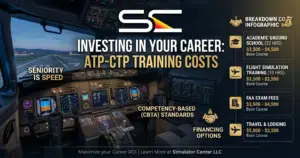
Tuition for the ATP-CTP at Simulator Center LLC is competitive. While prices vary based on the season and simulator type (A320 vs. B737), you should budget between $3,800 and $4,500 for the core course.
The “Hidden” Costs
Don’t be caught off guard by extra expenses. When planning your trip, remember to account for:
- ATM Written Exam Fee: Currently about $175 at an FAA-approved testing center.
- Lodging: We offer discounted crew rates at nearby hotels, but these are separate from tuition.
- Transportation: Car rentals or ride-shares to and from the training center.
The “Free” Path
Many regional airlines are currently offering “Sign-On Bonuses” that include a fully paid ATP-CTP. If you have a conditional job offer, check with your recruiter—they may already be one of our training partners, meaning your tuition is covered by the company.
Military to Civilian: The ATP-CTP Transition Guide
For our veterans, the transition to the airlines is a mission of its own. We specialize in helping military pilots translate their tactical hours into civilian-speak.
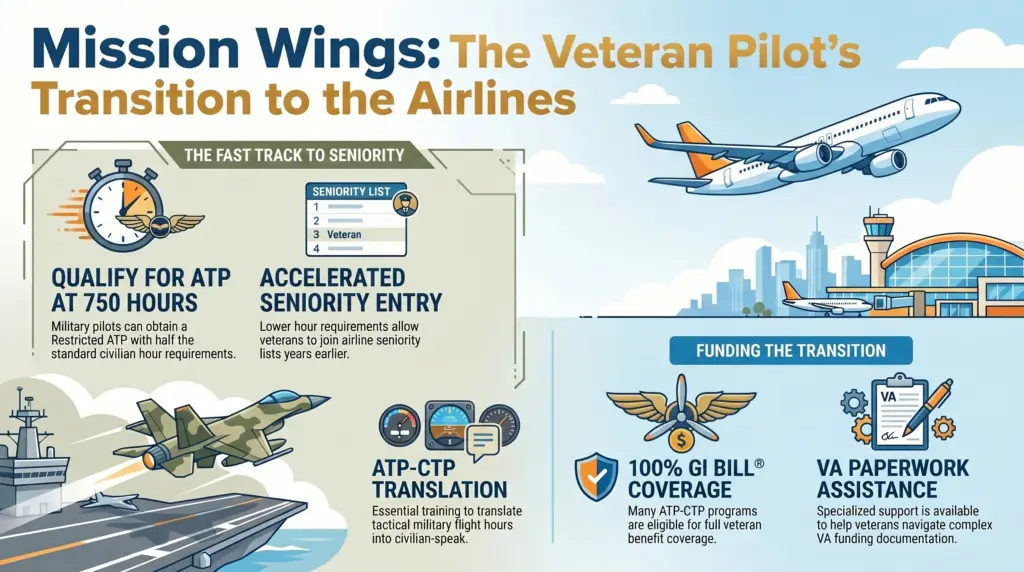
- The Restricted ATP (R-ATP): Military pilots can qualify for an ATP at just 750 total hours. The ATP-CTP is still required, but it allows you to get into a seniority list years earlier than a civilian.
- GI Bill® Coverage: Many of our programs are eligible for veteran benefits. We take pride in helping those who served navigate the VA paperwork to fund their training.
Passing the ATP Multi-Engine (ATM) Written Exam
Course Prep vs. Exam Prep
It is vital to remember: the ATP-CTP is a safety course, not a test-prep course. The FAA does not allow us to give you the answers to the 125-question ATM written exam.
Sheppard Air & Study Strategies
To ace the written exam, nearly every pilot uses Sheppard Air. We recommend completing their study software before you arrive for the CTP. This allows you to take the exam at a nearby testing center the day you finish our course, while the knowledge is fresh and the stress is low.
Life After ATP-CTP: Your Path to the Airlines
Taking the Checkride
Your CTP graduation certificate never expires, but your written test results are valid for 60 calendar months. Once both are done, you are ready for your ATP Multi-Engine Checkride, which is usually combined with an airline’s initial training.
Type Rating Integration
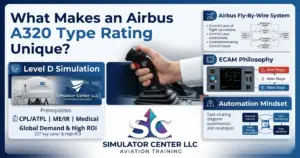
To make yourself truly un-fireable, we recommend combining your ATP-CTP with a Type Rating. At Simulator Center LLC, we offer packages where you can finish your CTP and move directly into an A320 or B737 Type Rating. This makes you “airline ready” on day one.
People Also Ask (FAQ)
Does the ATP-CTP course certificate expire? No. Your graduation certificate is valid forever. However, the written test results you get after the course expire in five years.
Can I fail the ATP-CTP? It is not a “pass/fail” checkride. It is a completion-based course. As long as you are present for all the hours and participate professionally in the simulator, you will graduate.
Do I need a First-Class Medical to start? No. You don’t need a medical certificate to take the course. However, you should have one before applying to airlines to ensure you are medically fit for duty.
Is there a checkride at the end of the ATP-CTP? No. There is no FAA checkride during the CTP. The “checkride” comes later when you test for your full ATP certificate or Type Rating.
Can I do my ground school online? Yes. Through our Virtual Instructor-Led Training (VILT), you can attend the ground school remotely with a live instructor.
What is the difference between an FTD and an FFS? An FTD (Flight Training Device) is a fixed-base simulator used for learning systems. An FFS (Full Flight Simulator) has motion and is used for practicing actual flight maneuvers.
Take Your Career to the Next Level with Simulator Center LLC
The path to the airlines is paved with specific requirements, and the ATP-CTP is the most important one. At Simulator Center LLC, we don’t just help you pass; we help you excel. Our state-of-the-art facilities in Miami and our virtual options are designed to fit the life of a busy pilot.
Don’t wait for your seniority number. Contact Simulator Center LLC today to book your seat in our next class and take command of your future.