Getting your wings is a dream for many, but the journey doesn’t end with a pilot’s license. Knowing when is a type rating required in aviation is essential for any pilot looking to transition into larger jets or commercial airlines. This guide explains the specific legal rules and career steps you need to move from small planes to the flight deck of a Boeing or Airbus.
What is an Aircraft Type Rating?
Definition and Purpose
A type rating is an official certification added to a pilot’s license. It proves that a pilot has completed specialized training and is competent to fly a specific model of aircraft. Think of it like a “master’s degree” for a specific machine; while a basic license teaches you how to fly, a type rating teaches you how to manage the complex systems of a particular jet.
Type Rating vs. Class Rating: Understanding the Difference
Many student pilots confuse these two terms. A Class Rating allows you to fly a broad group of similar aircraft, such as “Single-Engine Land” (e.g., a Cessna 172 or Piper Archer). A Type Rating, however, is model-specific. If you want to move from a small piston plane to a Boeing 737, your Class Rating isn’t enough—you must earn a specific B737 Type Rating.
The Three Gold Rules: When You MUST Have a Type Rating
In the eyes of the FAA and other global authorities, there are three main triggers that require a pilot to hold a type rating:
Large Aircraft (The 12,500 lbs Threshold)
The most common rule is weight-based. Any aircraft with a Maximum Gross Takeoff Weight (MGTOW) of more than 12,500 pounds requires a type rating. This includes most regional turboprops and all major airliners.
Turbojet-Powered Airplanes (Regardless of Weight)
If the airplane is powered by a turbojet engine, the weight doesn’t matter. Even if a small “Very Light Jet” weighs only 6,000 pounds, the pilot must have a type rating to act as Pilot in Command (PIC).
Specific Aircraft Designated by the Authority
Sometimes, an aircraft is so complex or has such unique handling that the FAA or EASA requires a type rating regardless of its size or engine type. These are specifically listed in the regulatory “Type Certificate Data Sheets.”
The “Small Jet” Exception: Why Very Light Jets (VLJs) Still Need Type Ratings
Beginners often ask if they can fly a small jet like the Cirrus Vision Jet without a type rating because it “feels” like a small plane. The answer is no. Because it is a turbojet, the FAA mandates a type rating to ensure the pilot can handle the high speeds and high-altitude systems inherent to jet flight.
Regulatory Differences: FAA vs. EASA Requirements
US Federal Aviation Regulations (14 CFR § 61.31)
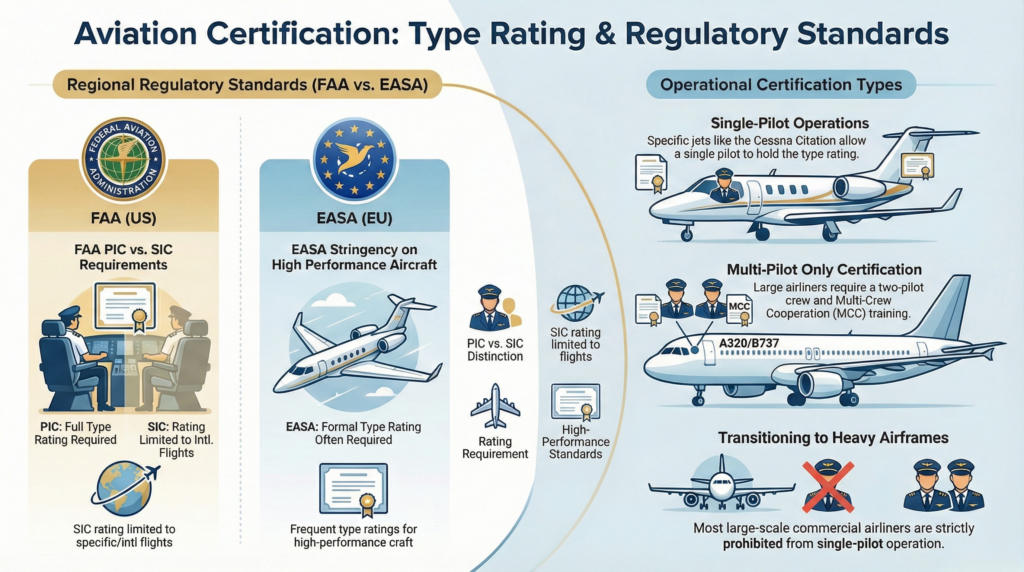
In the United States, the FAA focuses heavily on the distinction between PIC (Pilot in Command) and SIC (Second in Command). While the PIC always needs the full type rating, the SIC only needs a “SIC Type Rating” for international flights or specific crew requirements.
European (EASA) Part-FCL Standards
EASA regulations in Europe are often more stringent. They frequently require type ratings for a wider variety of “High Performance” aircraft that might only require a simple endorsement in the U.S.
Single-Pilot vs. Multi-Pilot Type Rating Requirements
Some aircraft, like the Cessna Citation series, are certified for “Single-Pilot” operations. This means one pilot can earn a type rating to fly the jet alone. However, most larger airliners (A320, B737) are “Multi-Pilot” only, requiring a crew of two and specific training in Multi-Crew Cooperation (MCC).
The Path to Certification: How to Get a Type Rating
Prerequisites: Hours and Ratings Needed Before You Start
Before you can apply for a type rating, you typically need a Commercial Pilot License (CPL) with an Instrument Rating. Most programs also require an ATP-CTP course if you are pursuing an Airline Transport Pilot certificate simultaneously.
Ground School and Systems Training
This phase involves roughly 40 to 80 hours of classroom work. You will learn every nut and bolt of the aircraft, including electrical systems, hydraulics, fuel management, and emergency checklists.
Flight Simulation (Level C and D Simulators)
Modern type ratings are done almost entirely in “Full Flight Simulators” (FFS). These multi-million dollar machines perfectly mimic the motion and feel of the real plane. Simulator Center LLC specializes in this high-tech environment, providing the “Level D” realism required for certification.
The Checkride (Practical Test)
The final step is a rigorous checkride with an examiner. You will be tested on your ability to handle engine failures, fires, and complex approaches—all within the safety of the simulator.
Maintaining Privileges: How Long Does a Type Rating Last?
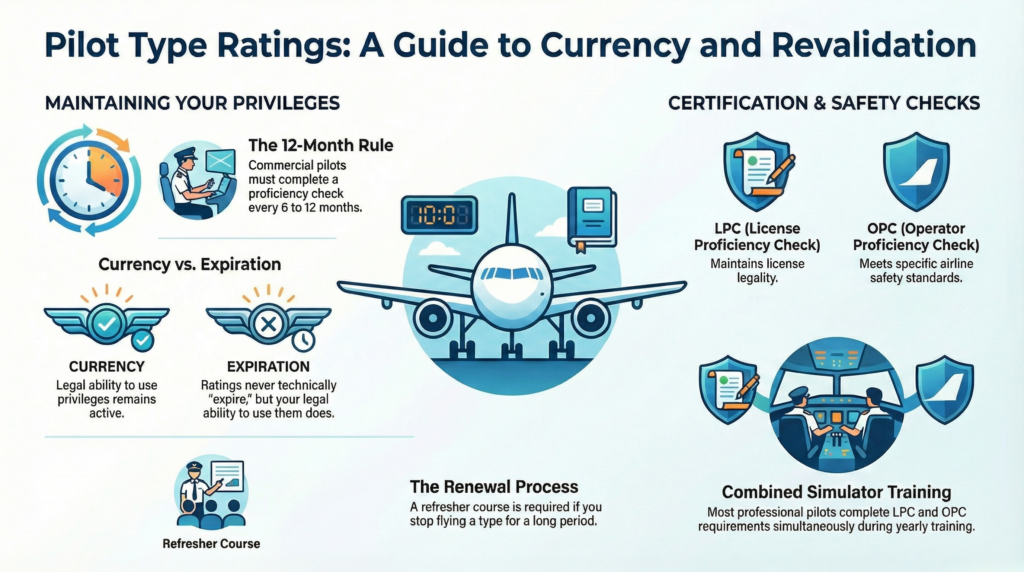
Expiration vs. Currency: The 12-Month Rule
Technically, a type rating on your license never “expires,” but your ability to use it does. To remain “current,” most commercial pilots must undergo a proficiency check every 6 to 12 months.
Revalidation vs. Renewal: What Happens if it Expires?
If you stop flying a specific type for a long period, you must go through a “Renewal” process. This usually involves a shorter refresher course at a training center to ensure your skills haven’t gone “stale.”
Proficiency Checks: LPC (License) vs. OPC (Operator)
There is a difference between keeping your license legal (LPC) and meeting your airline’s specific safety standards (OPC). Most professional pilots do both simultaneously during their yearly simulator training.
The Business of Type Ratings
Average Costs for Common Models
- Airbus A320 / Boeing 737: $10,000 – $25,000
- Business Jets (Citation, Learjet): $15,000 – $30,000
- ATP-CTP Prerequisites: $3,500 – $5,000
Who Pays? “Self-Funded” vs. Airline-Sponsored
In the past, pilots almost always paid for their own ratings. Today, many regional and major airlines include the cost of the type rating as part of their new-hire training package.
Why Insurance Companies Might Require a Type Rating
Even if the FAA says you don’t legally need a rating for a specific 12,000 lb turboprop, your insurance company might disagree. They often refuse to cover an aircraft unless the pilot has completed a formal “Initial” training course at a recognized center.
People Also Ask (FAQ)
Can I fly a turboprop without a type rating?
Yes, if the turboprop weighs 12,500 lbs or less and is not designated as needing a rating. For example, a King Air 90 does not require a type rating, but a King Air 350 (which is heavier) does.
Do I need a type rating for a King Air?
It depends on the model. The King Air 200 and 90 series usually do not require one (they are “Class Rated”), while the King Air 300/350 series requires a type rating because of their weight.
What is a “Differences Training” endorsement?
If you are rated for the Boeing 737 Next Gen (NG) and want to fly the 737 MAX, you don’t need a whole new type rating. You simply take “Differences Training” to learn the specific changes between the two models.
How long does it take to get a type rating?
A typical course takes between 2 and 4 weeks of full-time study and simulator sessions.
Can I get a type rating with a Private Pilot License?
Yes, but it is rare. You must still have an Instrument Rating and meet specific flight hour requirements to handle the complexity of a type-rated aircraft.
Take the Next Step with Simulator Center LLC
Navigating the transition to heavy aircraft can be overwhelming, but you don’t have to do it alone. Whether you are aiming for a career at the airlines or upgrading to a private jet, having the right training partner makes all the difference.
Simulator Center LLC provides world-class instruction and state-of-the-art simulators to help you master your next aircraft. Don’t let a lack of certification hold your career back.
Contact Simulator Center LLC today to view our upcoming course schedule and secure your training slot!