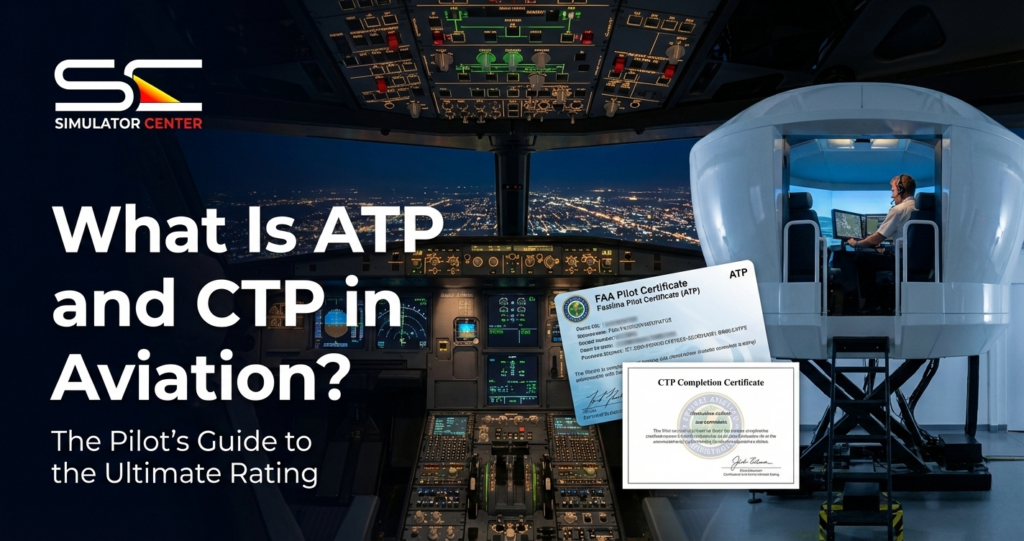
Understanding what is ATP and CTP in aviation is the first step toward reaching the flight deck of a major airline. For many pilots, the transition from a commercial certificate to the Airline Transport Pilot (ATP) rating feels like a daunting mountain of regulations and flight hours. This guide simplifies the process, explaining how the Certification Training Program (CTP) serves as the essential bridge to your career goals.
Defining the Terms: ATP vs. ATP-CTP
In the world of professional flying, acronyms are everywhere, but these two are the most important for your career progression. While they are often mentioned in the same breath, they represent two different stages of your professional development.
- What is ATP? The Airline Transport Pilot (ATP) certificate is the highest level of aircraft pilot certificate issued by the FAA. Think of it as the “PhD” of aviation. It is required to act as a captain or first officer for a Part 121 air carrier (a scheduled airline).
- What is CTP? The ATP Certification Training Program (ATP-CTP) is a mandatory training course that pilots must complete before they are even allowed to sit for the ATP multi-engine knowledge test.
How They Work Together: You cannot get your ATP without first passing the CTP. The CTP provides the academic foundation, while the ATP certificate is the final credential that proves you have the skill to command a transport-category aircraft.
The ATP-CTP Course: A Deep Dive into the Prerequisites
The ATP-CTP was not always a requirement. Following the tragic accident of Colgan Air Flight 3407, the FAA realized that commercial pilots needed more specialized training in high-altitude operations and multi-crew environments before joining an airline.
Course Structure & Itinerary
A standard ATP-CTP course typically lasts 7 to 10 days and is divided into two main parts:
Academic Ground School (30 Hours): You will spend 30 hours in a classroom covering advanced topics that aren’t usually emphasized in general aviation. This includes high-altitude aerodynamics, adverse weather (like severe icing), and complex meteorology.
Simulator Training (10 Hours): This is where the theory meets the cockpit. You will complete 10 hours in a flight simulation training device. At least six of these hours must be in a Level C or higher Full Flight Simulator (FFS), which replicates the motion and feel of a real airliner.
What You’ll Learn
The goal of the CTP is “bridging the gap.” You will focus on:
- Crew Resource Management (CRM): Learning how to communicate and work effectively with a co-pilot.
- Upset Prevention and Recovery Training (UPRT): Training on how to recover an airliner from unusual attitudes or stalls.
- Stall Recovery: Understanding the specific physics of how large swept-wing jets behave during a stall.
Eligibility and Requirements for ATP Certification
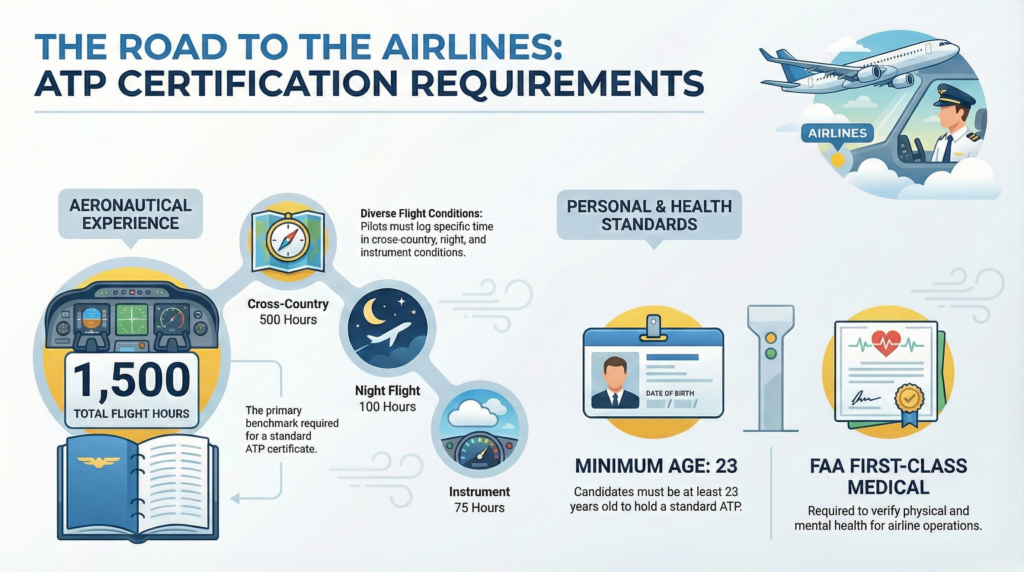
Before you apply for your ATP checkride, you must meet strict aeronautical experience requirements. Most pilots refer to this as the “1,500-hour rule.”
Aeronautical Experience
To qualify for a standard ATP, you generally need:
- 1,500 hours of total flight time.
- 500 hours of cross-country time.
- 100 hours of night flight time.
- 75 hours of instrument flight time.
Age and Medical Requirements
You must be at least 23 years old to hold a standard ATP certificate. Additionally, because you will be flying for the airlines, you must hold a FAA First-Class Medical Certificate. This ensures you meet the physical and mental health standards required for high-stakes commercial operations.
Restricted ATP (R-ATP): The Shortcut for Military and College Grads
Many pilots are surprised to learn they don’t always have to wait for 1,500 hours to start their airline career. The Restricted ATP (R-ATP) allows pilots to fly for an airline with fewer hours, provided they meet specific educational or military criteria.
- The 1,000-Hour Rule: If you graduated from an FAA-approved Bachelor’s degree program with an aviation major and completed your instrument and commercial training through that school, you can apply for an R-ATP at just 1,000 total hours.
- The 1,250-Hour Rule: This applies to pilots who earned an Associate degree from a qualifying aviation program.
- Military Pilots: The FAA highly values military flight training. Former military pilots can qualify for an R-ATP with only 750 hours of total time and at age 21.
The R-ATP is a “restriction” because you cannot act as a Captain until you reach the full 1,500 hours and age 23, but it allows you to start earning an airline paycheck and seniority much sooner.
The Written Exam: ATM vs. ATS Knowledge Tests
Passing the ATP-CTP course is your “ticket” to the testing center. Once you receive your graduation certificate, you have 60 calendar months to pass the written exam. However, there are two different versions of the test.
- ATM (ATP Multi-Engine): This is the test most pilots take. It covers Part 121 airline operations. Important: You must complete the ATP-CTP course to take the ATM exam.
- ATS (ATP Single-Engine): This is for pilots flying smaller, single-engine aircraft under Part 135 (charter). You do not need to take the ATP-CTP course to sit for the ATS exam.
The ATM test is a 125-question exam covering everything from weight and balance to complex turbine engine systems. It requires a passing score of 70% or higher.
Choosing the Right ATP-CTP Provider
Not all training centers are created equal. When selecting a provider, you need a facility that offers modern technology and experienced instructors who have actually flown for the airlines.
Simulator Center LLC is a premier choice for pilots looking to bridge this gap. With a focus on high-fidelity simulation and streamlined scheduling, they provide the specific training needed to move from a light twin-engine plane to a transport-category jet.
When comparing providers, look for:
- Simulator Quality: Ensure they use Level C or D full-motion simulators.
- Pricing: Look for transparent, fixed-cost pricing so there are no surprises.
- Success Rates: Choose a center with a proven track record of helping students pass the ATM written exam on the first try.
The Career Impact: Beyond the Major Airlines
While most pilots think of Delta, United, or American Airlines when they hear “ATP,” this certificate opens doors across the entire industry.
- Part 135 Charter Operations: Many high-end private jet companies now require their pilots to hold an ATP, even if the FAA doesn’t strictly mandate it for every seat. It shows a level of professionalism that high-net-worth clients expect.
- Cargo Operations: Companies like FedEx and UPS require the same ATP standards as passenger airlines, often offering some of the highest salaries in the industry.
- Employer Sponsorship: The current pilot shortage has changed the game. Many regional airlines will now hire you once you hit your hour requirements and pay for your ATP-CTP course and your ATP checkride as part of your “onboarding” or “sign-on” bonus.
Preparing for Success: Tips for Your Checkride
The ATP checkride is often described as a “non-event” if you are well-prepared, but that doesn’t mean it’s easy. It is a test of your judgment as much as your flying skill.
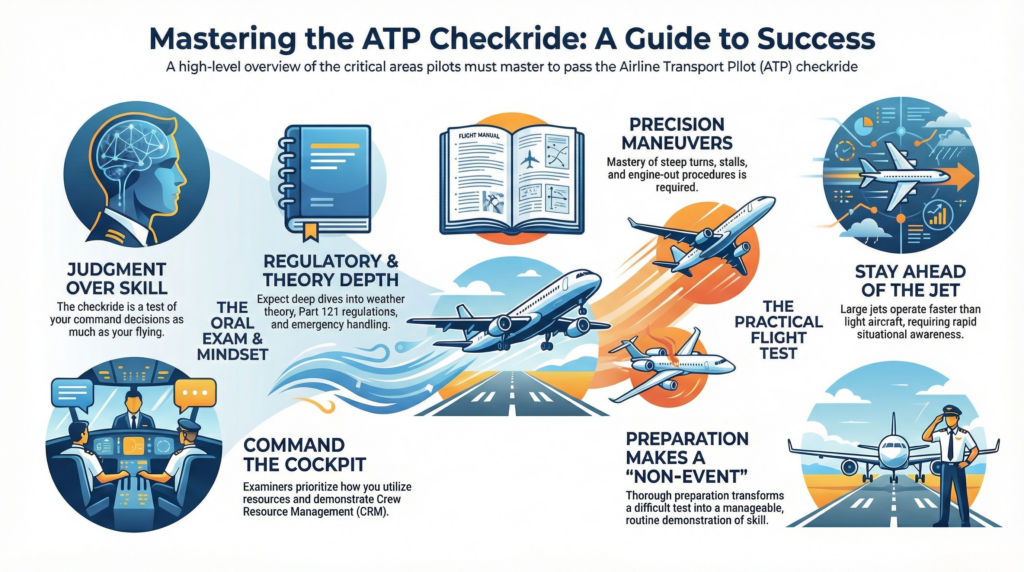
Master the Oral Exam: Expect deep questions on weather theory, Part 121 regulations, and how to handle emergencies.
Focus on CRM: The examiner isn’t just watching your hands; they are listening to how you command the cockpit and use your resources.
The Practical Flight Test: You will be tested on steep turns, stalls, and engine-out procedures. In a large jet, things happen much faster than in a Cessna. You must stay “ahead of the airplane.”
People Also Ask (FAQ)
Do I need an ATP-CTP for a Single-Engine ATP?
No. The ATP-CTP course is only a requirement for the Multi-Engine (ATM) knowledge test and certificate.
How long is the ATP-CTP certificate valid?
The graduation certificate you receive after finishing the CTP course does not expire. However, once you pass your written knowledge test (ATM), that test result is valid for 60 calendar months.
Can I take the ATP-CTP at 1,000 hours?
Yes. You can take the ATP-CTP course at any time after earning your Commercial Pilot Certificate. You do not need to wait until you have 1,500 hours to complete the training or the written exam.
How much does the ATP-CTP course cost?
Costs vary by provider, but generally range between $3,500 and $5,000. This usually includes the ground school and the simulator time.
Does Simulator Center LLC offer financing?
Many training centers, including partners of Simulator Center LLC, offer various payment options or work with lenders who specialize in aviation flight training loans.
Is the ATP-CTP hard?
The course is intensive because it covers a lot of information in a short time. However, it is designed to be a learning environment rather than a “sift-out” course. If you show up prepared and study the materials, you will succeed.
Your Future Starts in the Simulator
The path to becoming an airline pilot is structured for a reason: safety and excellence. By completing your ATP-CTP, you aren’t just checking a box for the FAA; you are gaining the life-saving skills needed to command a jet with hundreds of passengers behind you.
Don’t leave your career to chance. Get the professional, hands-on training you deserve with experts who understand the industry.
Ready to take the next step toward your ATP? Contact Simulator Center LLC today to schedule your training and soar toward your airline career.