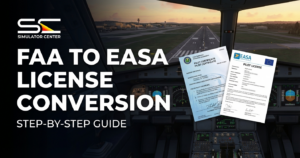

Every day, over 45,000 flights take off in the United States. Many of these are flown by pilots trained in different systems. For A320 and B737 pilots with DGCA licenses, getting an FAA certificate is key. It’s a ticket to flying in the U.S. market.
This section outlines a clear path for converting your FAA License. It’s a structured process, not just a form or test. The order of steps is what makes the difference between speed and delay.
Converting a foreign pilot license involves several steps. First, you need FAA verification and a letter of authenticity. Then, TSA approval is needed before any FAA training. After that, you must complete the ATP-CTP, pass the ATP knowledge test, and enroll in a type rating program. Each step builds on the last, and missing one can halt the process.
Simulator Center India offers A320 and B737 pilots simulator training. They focus on conversion prep. Their sessions help pilots prepare for assessments, checks, and interviews while meeting FAA standards.
Key Takeaways
- FAA License Conversion is a step-by-step pathway for licensed foreign pilots, not a single exam.
- Pilot license conversion for DGCA holders follows defined prerequisites and sequencing under FAA rules.
- Foreign pilot license conversion commonly starts with FAA verification and a letter of authenticity.
- TSA approval is required before many FAA-aligned training events can begin.
- ATP-CTP comes before the ATP knowledge test in the standard FAA flow.
- A type rating program is typically the next major step after the written test for A320 or B737 pilots.
Who This DGCA-to-FAA Pathway Is For (A320 & B737 Commercial Pilots)
This pathway is for pilots who already fly big planes and need a U.S. license. It makes sure their current skills match U.S. rules. This way, they can keep their experience while getting the right documents and training.
Eligible pilot profiles (CPL/ATPL with DGCA, ICAO-recognized privileges)
Mostly, it’s for commercial pilots with DGCA or ICAO-recognized licenses. They often fly Airbus A320 or Boeing 737. They want U.S. recognition without starting over.
Some pilots come from foreign military aviation. If their country is part of ICAO, their experience might help them get a U.S. license. This depends on their records and if they qualify.
There’s a special case for some foreign military pilots. FAA exemption 61.73 lets them skip some steps. They can go straight to CPL and then ATPL if they meet the rules.
Why airline pilots pursue a U.S. certificate for international airline eligibility
Airline jobs and fleet changes often favor pilots with U.S. licenses. A U.S. certificate helps pilots work better in many places. It’s seen as a way to move up in their career, not just a new start.
For A320 and B737 pilots, it’s about practical benefits. It means following the same rules, clear tests, and easier transitions. This makes their job smoother.
Where Simulator Center India fits: airline-standard simulator training and conversion support
Simulator Center India helps pilots get ready for FAA tests with airline-level training. It’s not for learning to fly a new plane. It’s about making sure pilots can follow U.S. rules and pass tests.
The center offers special training for pilots with A320 or B737 ratings. They get to practice in a full-motion simulator. More details are on FAA license conversion. It shows how pilots can plan their training around their schedules.
| Pilot situation | Typical starting point | Primary need | How simulator support is used |
|---|---|---|---|
| DGCA CPL/ATPL, already A320 type-rated | Current ICAO privileges with recent line operations | faa license upgrade planning with FAA-style procedures and evaluation prep | Full-motion Airbus A320 sessions focused on flows, callouts, and check-ride tolerances |
| DGCA CPL/ATPL, already B737 type-rated | Current ICAO privileges with operator SOP differences | Clean aviation license transfer path supported by documentation readiness and procedural alignment | Full-motion Boeing 737 sessions highlighting abnormal handling and CRM under pressure |
| Foreign military pilot from an ICAO contracted member country | Military logbooks, training records, and aircraft experience | Structured flight license transition into civilian FAA certificates based on documented experience | Proficiency refresh and scenario-based checks to validate instrument scan, decision-making, and standardization |
FAA Verification and Authenticity Letter for Foreign Pilot License Conversion
Before starting foreign pilot license conversion, the FAA needs a verification record. This record is tied to the pilot’s ICAO credentials. It confirms the starting license is real, current, and comes from the right authority.
What the document is and why it matters
The FAA verification, also known as a letter of authenticity, confirms the foreign license and ratings. It ensures the medical status matches official records. This step is key to faa license conversion, preventing training on unverified credentials.
Many pilots face delays without this letter. It’s essential for enrolling and scheduling. For foreign pilot license conversion, it’s the first step towards FAA approval.
Expected processing timeline: 45 to 90 days
FAA processing usually takes 45 to 90 days. The verification process can take up to 90 days. This can affect airline hiring plans.
Given the timeline, pilots start early for faa license reciprocity. This ensures they meet deadlines for simulator evaluations and training slots.
| Milestone | What is checked | Why it can affect scheduling |
|---|---|---|
| Submission for FAA verification | Identity details and license references needed to locate the issuing records | Errors or mismatched numbers can pause foreign pilot license conversion until corrected |
| Authority-to-authority confirmation | License validity, ratings status, and medical currency confirmed by the issuing CAA | faa license reciprocity depends on an official match, not personal copies |
| FAA review completion | FAA confirmation on file to support next certificate or authorization steps | Training dates for faa license conversion can remain tentative until the record clears |
Authority and validation flow: AFS-760 and CAA checks
The FAA Airmen Certification Branch (AFS-760) runs the verification process. They rely on the Civil Aviation Authority (CAA) to confirm the credential. The CAA checks the validity and currency of the pilot’s license and medical certificate.
This exchange is key for foreign pilot license conversion. It’s based on official records, not personal copies. Once AFS-760 gets confirmation, the pilot can move forward with faa license conversion.
TSA Approval Requirements Before Any FAA-Aligned Training
TSA approval is a key step in planning your training. It’s often the first hurdle in a pilot license conversion plan. Training providers may wait until you get clearance before starting certain parts of your training.
Why TSA clearance is required prior to training events
TSA clearance ensures security in advanced aircraft and simulators. It’s needed before starting ATP-CTP sessions and type rating programs.
Ignoring TSA timing can cause delays. These delays can affect your study time and written test plans. It’s important to plan ahead to avoid these issues.
Planning guidance to avoid delays while scheduling ATP-CTP and type rating training
Pilots should plan TSA approval and FAA verification together. This way, you can avoid last-minute changes. It helps keep your training on track.
It’s also wise to budget early. TSA compliance costs can be around $520. This helps you plan your training budget without surprises.
| Planning item | What it affects | Common scheduling risk if delayed | Practical planning move |
|---|---|---|---|
| TSA approval submission | Eligibility to start FAA-aligned training events | ATP-CTP seat lost; type rating start date slides | Start early and treat it as a required gate in the pilot license conversion timeline |
| FAA verification lead time (about 45–90 days) | Proof the foreign license is valid and current | Training dates set before documents are ready | Run verification and TSA steps in parallel to support aviation license transfer planning |
| ATP-CTP class scheduling | Access to the ATP knowledge test path | Missed preferred course week; test prep window shrinks | Hold a target week, but only confirm travel after TSA status is secure |
| Type rating availability | Checkride slots and simulator time allocation | Fewer examiner dates; domino delays after ATP-CTP | Build a buffer between ATP-CTP completion and the type rating start for a steadier flight license transition |
| TSA compliance cost example | Upfront budgeting and payment readiness | Administrative hold due to incomplete payment planning | Plan for an estimated $520 (four certifications at $130 each) when forecasting program costs |
FAA License Conversion Programs and Step-by-Step Training Sequence
For airline pilots, FAA License Conversion is a process, not just one event. Training plans are built around key steps like document checks, security clearances, and test dates. Each step is designed to support the next, making the process smoother.

Standard sequence used by airline training providers
Most training programs follow a set order. This order keeps paperwork, scheduling, and eligibility in line. It helps pilots convert their FAA license without last-minute delays.
- Request FAA verification and the Letter of Authenticity that validates the foreign license and medical status (this review can take up to 90 days, and incomplete requests may be canceled after repeated follow-ups).
- Secure TSA approval before any FAA-aligned training events are started.
- Complete ATP-CTP, then schedule the ATP written knowledge test after graduation.
- Enroll in the appropriate type rating course once the written is passed and prerequisites are confirmed.
Pilots often follow steps similar to foreign license conversion steps to keep their file organized. This is important when names, passport data, and medical currency must match exactly.
DGCA-aligned vs FAA-aligned planning differences
“DGCA-aligned” planning focuses on keeping DGCA readiness in mind while aligning with FAA requirements. This means careful planning around document verification and test prep.
“FAA-aligned” planning is more straightforward. It organizes training around FAA milestones like ATP-CTP completion and written test scheduling. This ensures a smooth flow into FAA testing without unnecessary delays.
In the U.S., some providers offer short, focused training windows. For example, Alliance Aviation offers a seven-day ATP-CTP course in Fort Lauderdale, Florida. After that, they guide pilots toward Boeing 737 and Airbus 320 type rating courses based on their background and program track.
How Simulator Center India supports A320 and B737 pilots
Simulator Center India supports pilots by preparing them for Airbus A320 and Boeing B737 simulators. Their admissions process helps organize a training plan around verification and TSA windows. This keeps pilots moving forward while waiting for approvals.
This approach is beneficial for a clean aviation license transfer file and strong simulator performance. Details on the intake steps are outlined through Simulator Center India admissions. Pilots share their license authority, aircraft time, and target outcomes to shape the training sequence.
| Milestone | What gets completed | What pilots should have ready | Common timing pressure points |
|---|---|---|---|
| FAA verification | Verification request and Letter of Authenticity workflow to validate foreign license and medical | Accurate identity details that match passport, plus clear copies of license and medical | Processing can extend toward 90 days; mismatches can stall issuance |
| TSA clearance | Security approval required before FAA-aligned training activity begins | Travel planning that allows for approval before fixed simulator dates | Late submission can force rescheduling and higher change fees |
| ATP-CTP | Required course completion prior to the ATP written knowledge test | Confirmed course seat, travel dates, and a study plan that fits the course pace | Compressed schedules leave little room for missed sessions |
| ATP knowledge test | Written exam taken after ATP-CTP graduation | Test appointment booked early, with targeted review based on weak areas | Limited appointments can push back the type rating start |
| Type rating | Enrollment and completion in the selected aircraft program (A320 or B737, as applicable) | Logbook summaries, eligibility checks, and proof of prior steps | Course availability varies by location, aircraft, and prior-experience track |
ATP-CTP Program: Ground School and Simulator Requirements for an FAA ATP
The ATP-CTP is a key step for pilots in the U.S. aiming for an FAA ATP. It’s part of a plan to convert a pilot license, adding multi-engine skills for airline work. It also helps align documents and training for a smoother conversion.
Core training minimums
The FAA requires 30 hours of ground instruction and 10 hours of simulator training. The simulator time is split into 4 hours in an FTD and 6 hours in a Level D full flight simulator. This is seen as a practical step to upgrade a license, preparing pilots for airline operations.
For example, an FAA-approved course uses Airbus A320 family equipment. The A320-200 CAE XR7000 simulator suite is at Fort Lauderdale International Airport. It combines classroom learning with realistic multi-crew scenarios.
| Training element | Minimum time | Typical platform level | What it targets |
|---|---|---|---|
| Ground school | 30 hours | Classroom / academic instruction | Systems knowledge, airline procedures, decision-making, test readiness |
| Flight Training Device (FTD) | 4 hours | FTD Level 5 | Flows, instrument procedures, crew coordination, cockpit familiarization |
| Full Flight Simulator (FFS) | 6 hours | FFS Level D | High-workload scenarios, multi-crew operations, advanced handling and risk management |
Typical duration at an FAA-approved facility
ATP-CTP training usually lasts about one week at an FAA-approved facility. Some providers offer a seven-day program. This helps pilots plan their travel and test dates efficiently.
Program details and the required certificate outcome are outlined in the provider’s course overview. For example, the ATP-CTP program outline used by FAA-approved schools.
Key learning areas covered
The academic blocks focus on airline flying and the ATP written exam. Topics include aerodynamics, meteorology, turbine engine operations, and high-altitude flight dynamics. These are tied to real-world operational limits.
It also covers CRM, professionalism, and upset prevention and recovery. Simulator sessions focus on multi-crew coordination and decision-making under pressure. These skills are critical during training and later evaluations.
ATP Knowledge Test and What Comes Next for Pilot License Conversion
In a flight license transition, the written exam comes after ATP-CTP is complete. This order is important because the course prepares you for the ATP knowledge test. It’s a key step in the FAA process.
For pilots converting their foreign pilot license, the exam is taken on a computer at an approved testing center. You need to score 70% to pass. Passing this test opens the door to the next step.
Preparing for the test is easier when you have a realistic schedule. FAA rules let flight schools share official questions and answers. This helps you focus on areas you need to improve without guessing.
Many programs use large question banks to help you get faster and more accurate. For example, a CPL-style bank has about 500 questions. But, the actual exam has 60 questions.
| Step in the timeline | What the pilot completes | What it enables next | Key standard to track |
|---|---|---|---|
| After ATP-CTP | ATP written knowledge test at a computer-based testing center | Eligibility to move into the practical path chosen for A320 or B737 goals | Minimum passing score: 70% |
| After passing the written | Document review and training plan selection for the practical phase | Enrollment in a type rating course or an ATP practical test route | Use the correct FAA test report and keep it current for scheduling |
| Practical phase | Aircraft-specific training and evaluation events | Meets the requirement to convert faa license through the selected pathway | Training footprint and evaluation standards vary by aircraft and provider |
After getting your score, you’ll know what to do next. You can start an A320 or B737 type rating, or pair the ATP practical test with a transport-category simulator program. This depends on your career goals.
For a quick reference on the exam sequence and timing, pilots often review ATP knowledge test sequencing. Then, they plan backward from their desired checkride window. This helps avoid downtime and keeps the transition moving smoothly.
A320 and B737 Type Rating Options After FAA ATP-CTP
After passing the ATP knowledge test, pilots start their practical training. They choose a type rating program that fits their aircraft and job goals. This choice also impacts their travel and simulator schedules.
Many pilots start with an ATP-CTP program that meets FAA rules. This includes ground school and simulator time. A popular U.S. option is ATP-CTP training, which prepares for the written exam and the checkride phase.
Type rating requirement after the written test
The written test is just the beginning. Pilots then join a type rating course and complete simulator events and evaluations. Early planning is key to keep the license transfer on track.
Two common checkride pathways pilots use
Pilots with 1,500 logged hours have two main checkride paths. One is a light twin checkride, and the other is a transport-category jet type. Both paths require experience and preparation.
| Pathway | Where the checkride happens | Common aircraft or device | Best fit for | How it relates to A320 & B737 type rating training |
|---|---|---|---|---|
| Option 1: Multi-engine prop checkride | In an aircraft | Piper Seminole, Piper Seneca, or Diamond DA42 | Pilots who want the ATP practical done first, then pursue a jet type rating later | Completes the ATP practical step, then schedules A320 & B737 type rating training as a separate phase |
| Option 2: Combined ATPL + PIC type rating | In a full-motion simulator | Airbus A320 or Boeing 737 full-motion simulator | Pilots targeting airline roles that expect a jet type on the certificate | Attaches the A320 or B737 type rating during the same practical-test pathway, supporting faster faa license conversion workflows |
Simulator training hours reference for a combined pathway
Combined tracks require about 18 hours in a Level-D A320 or B737NG simulator. Training plans vary by provider. Some plans last around three weeks, followed by a practical test. This helps pilots plan travel and documents without delays.
How Simulator Center India supports readiness for checks and assessments
Simulator Center India helps pilots prepare for evaluations and interviews. Through FAA-aligned A320 conversion training, pilots improve their skills. This preparation is key for A320 & B737 type rating training, ensuring pilots are ready for airline standards.
Logbooks, Documentation, U.S. Address Rules, and Aviation License Transfer Planning
Before starting training, pilots must handle paperwork first. Good planning for aviation license transfer helps avoid delays. These delays can push back ATP-CTP classes, written tests, or simulator checks.

Logbook review and FAA compliance
A logbook review checks if flight time is clear and complete. It must be easy to verify. Total time, PIC time, instrument time, and multi-engine time should be easy to follow.
Programs also check how time was recorded. This is important because FAA rules can change. For example, AC 61-144 explains how IFR time and instrument experience are defined differently.
If a gap is found, a simple fix is usually needed. This might include specific flights, an instrument check, or a short refresher. These steps help ensure a smooth transition to a new flight license.
U.S. Agent for Service for pilots without a U.S. address
Starting November 19, 2021, pilots without a U.S. address must have a U.S. Agent for Service. This is because FAA notices need a reliable way to reach the pilot, even if they live abroad.
Foreign pilots can use Raich Aerospace Group LLC (Florida registration number L12000110308). They offer registered agent services with mail forwarding for $35 USD per month. This helps pilots stay compliant while they focus on training.
Practical readiness checks that prevent delays
Many programs require documents to be in English and certified when needed. They also standardize formatting. This makes it easier for evaluators to confirm time, speeding up the faa to easa conversion planning and other cross-border paths.
| Item to Verify | What “Ready” Looks Like | Why It Matters for Scheduling |
|---|---|---|
| Passport | Valid, unexpired international passport with consistent name spelling across documents | Supports travel, identity matching, and booking timelines |
| English proficiency | Upper-intermediate ability confirmed during an interview or consultation | Reduces training delays tied to briefings, checkride communication, and CRM standards |
| Translated and certified records | English versions available, with certification when required by the reviewing entity | Speeds up verification and avoids rework during the flight license transition |
| Funding and education proofs (when requested) | High school credential plus bank statement or loan sanction letter showing liquid funds | Prevents enrollment holds that can disrupt simulator and test dates |
Once the paperwork is in order, training can proceed more quickly. Many pilots prepare their documents before booking a simulator slot, like a B737 type rating program. This keeps their training plan on track during the aviation license transfer and faa to easa conversion.
Conclusion
For pilots from DGCA, converting to FAA licenses is best done in a certain order. It begins with getting a verification letter from the FAA, which takes 45–90 days in many cases. This time is critical and should be planned ahead.
After that, TSA approval is needed before starting most FAA training. Once cleared, pilots move on to ATP-CTP training. This includes 30 hours ground and 10 hours simulator training, usually done in about one week. Passing the ATP knowledge test is a major step in this process.
The next steps vary based on the type rating needed. Some pilots go for a multi-engine prop checkride in planes like the Piper Seminole or DA42. Others aim for a combined ATPL + PIC type rating checkride in an A320 or B737 simulator. This often requires 18 hours of Level-D training.
For a smoother transition, Simulator Center India offers practical training. Its A320 and B737 simulators help pilots prepare for checkrides. This focused training ensures pilots meet FAA and airline standards.